

Introduction
I almost killed my first pothos plant within three months.
Back in spring 2022, I bought a gorgeous Golden Pothos from my local nursery. It looked so easy—just stick it on a shelf and watch it grow, right? Wrong. By month three, half the leaves had turned yellow and dropped. I had no idea what I was doing wrong.
Fast forward to today: that one struggling plant has become eight thriving pothos scattered throughout my home. My longest vine now stretches over 7 feet. And my propagation success rate? It went from a solid 0% to over 90%.
If your pothos is dropping yellow leaves, refusing to grow, or your cuttings keep rotting, I’ve been there. This guide covers everything I’ve learned about pothos care—from the watering mistake that nearly killed mine to the propagation trick that finally worked.
Here’s what we’ll cover:
- The real watering rule that changed everything
- Light requirements (and why “low light” doesn’t mean “no light”)
- Step-by-step propagation that actually works
- How to diagnose and fix common problems
Let’s get your pothos thriving.
Quick Answer: How to Care for a Pothos Plant
To care for a pothos: Place it in bright, indirect light (it tolerates low light too). Water only when the top 2 inches of soil feel dry—typically every 1-2 weeks. Keep temperatures between 65-85°F and humidity around 40-60%. Feed monthly during spring and summer with diluted fertilizer. Pothos is forgiving, but overwatering is its #1 killer.
Pothos Care At-A-Glance
| Care Aspect | Requirement |
|---|---|
| Light | Bright indirect to low light |
| Water | Every 1-2 weeks (when top 2″ dry) |
| Temperature | 65-85°F (18-30°C) |
| Humidity | 40-60% |
| Fertilizer | Monthly in growing season |
| Toxicity | Toxic to pets and humans |
| Repotting | Every 2-3 years |
Now let me break down each aspect based on what actually worked for me.
What Is a Pothos Plant?
Meet the “Devil’s Ivy”
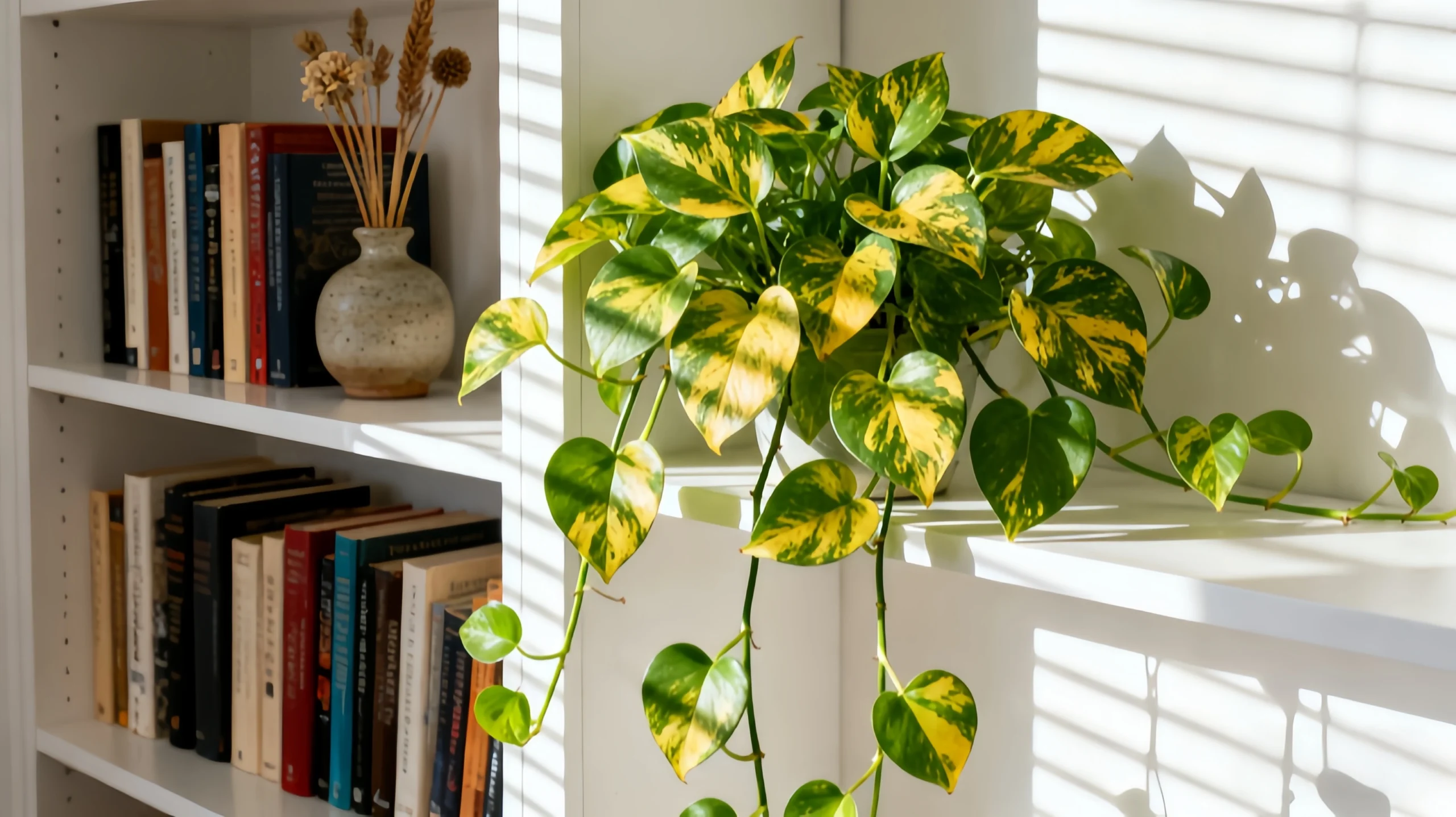
Pothos (Epipremnum aureum) earned its nickname “Devil’s Ivy” because it’s nearly impossible to kill. Seriously—this plant survives neglect that would destroy most houseplants.
Native to Southeast Asian rainforests, pothos is a climbing vine that can reach 6-10 feet indoors. In the wild, it can grow up to 60 feet while climbing trees.
What makes pothos special:
- Heart-shaped leaves in various colors
- Trails beautifully from shelves and hanging baskets
- Purifies indoor air
- Thrives in conditions that kill other plants
Popular Pothos Varieties
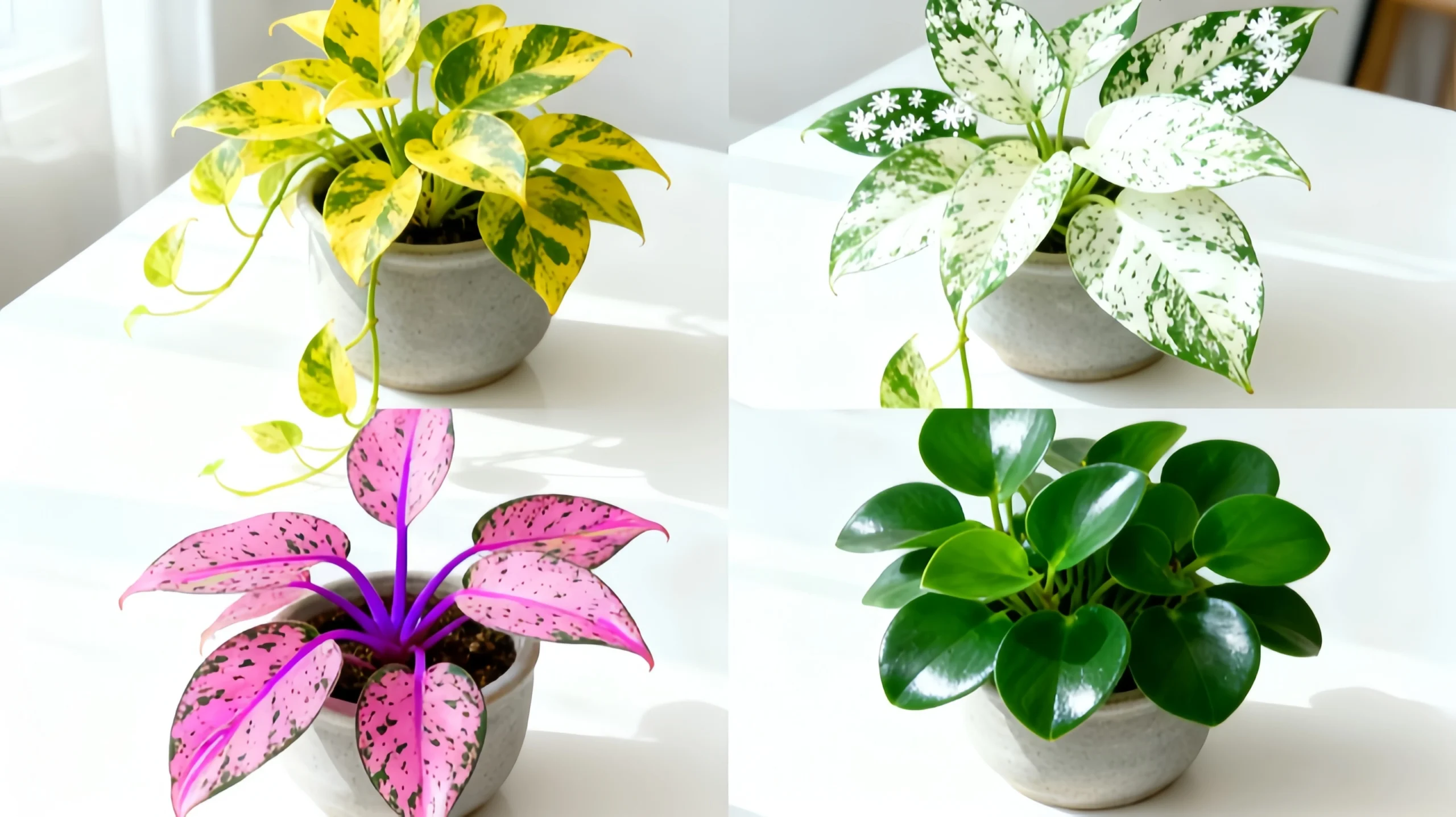
Not all pothos look the same. Here are the most common types you’ll find:
- Golden Pothos – Green leaves with yellow/gold variegation (the classic)
- Marble Queen – White and green marbled pattern
- Neon Pothos – Bright chartreuse/lime green
- Jade Pothos – Solid dark green (best for low light)
- Satin/Silver Pothos – Silver spots on dark leaves
I started with Golden Pothos because it’s the most forgiving. If you’re a beginner, I’d recommend starting there too.
Light Requirements
The Sweet Spot: Bright, Indirect Light
Here’s where I messed up early on.
I put my first pothos on a bookshelf about 20 feet from the nearest window. “It’s a low-light plant,” I thought. Big mistake. The plant barely grew, and the leaves got smaller and smaller.
The truth: Pothos tolerates low light, but it thrives in bright, indirect light.
Best spots for your pothos:
- Near an east or north-facing window
- A few feet back from a south or west window
- Anywhere with filtered natural light
Avoid:
- Direct afternoon sunlight (burns leaves)
- Completely dark corners (stunts growth)
Can Pothos Survive in Low Light?
Yes—but with trade-offs.
In low light, you’ll notice:
- Slower or no growth
- Smaller leaves
- Stretched stems with big gaps between leaves (leggy growth)
- Variegated types turning solid green
According to South Dakota State University Extension, variegated pothos may “revert to completely green leaves if it doesn’t get enough light.”
My fix: I moved my pothos closer to my east-facing window. Within weeks, new growth looked healthier and the leaves got bigger.
Pro tip: If you need a pothos for a dark corner, choose Jade Pothos. Its solid green leaves handle low light better than variegated types.
If you’re looking for another low-light champion, check out our guide on How to Care for a Snake Plant—it’s equally forgiving and perfect for beginners.
Watering Your Pothos
This is where most people go wrong—including me.
The Golden Rule: When in Doubt, Don’t Water
I used to water my pothos every Sunday like clockwork. Bad idea. By month three, the leaves were yellow and the roots were starting to rot.
The rule that saved my plant: Water only when the top 2 inches of soil feel completely dry.
Here’s how I test it:
- Stick your finger 2 inches into the soil
- If it feels dry, water thoroughly
- If it feels damp, wait a few more days
Typical watering frequency:
- Summer: Every 6-7 days
- Winter: Every 9-14 days
But honestly? Forget schedules. Just check the soil. Your pothos will thank you.
How to Water Correctly
When it’s time to water:
- Water thoroughly until it drains from the bottom holes
- Let it drain completely (never leave it sitting in water)
- Empty the saucer after 30 minutes
Important: Your pot MUST have drainage holes. No exceptions. A pothos sitting in soggy soil will develop root rot—the #1 killer of these plants.
Signs You’re Overwatering
This is what I experienced with my first plant:
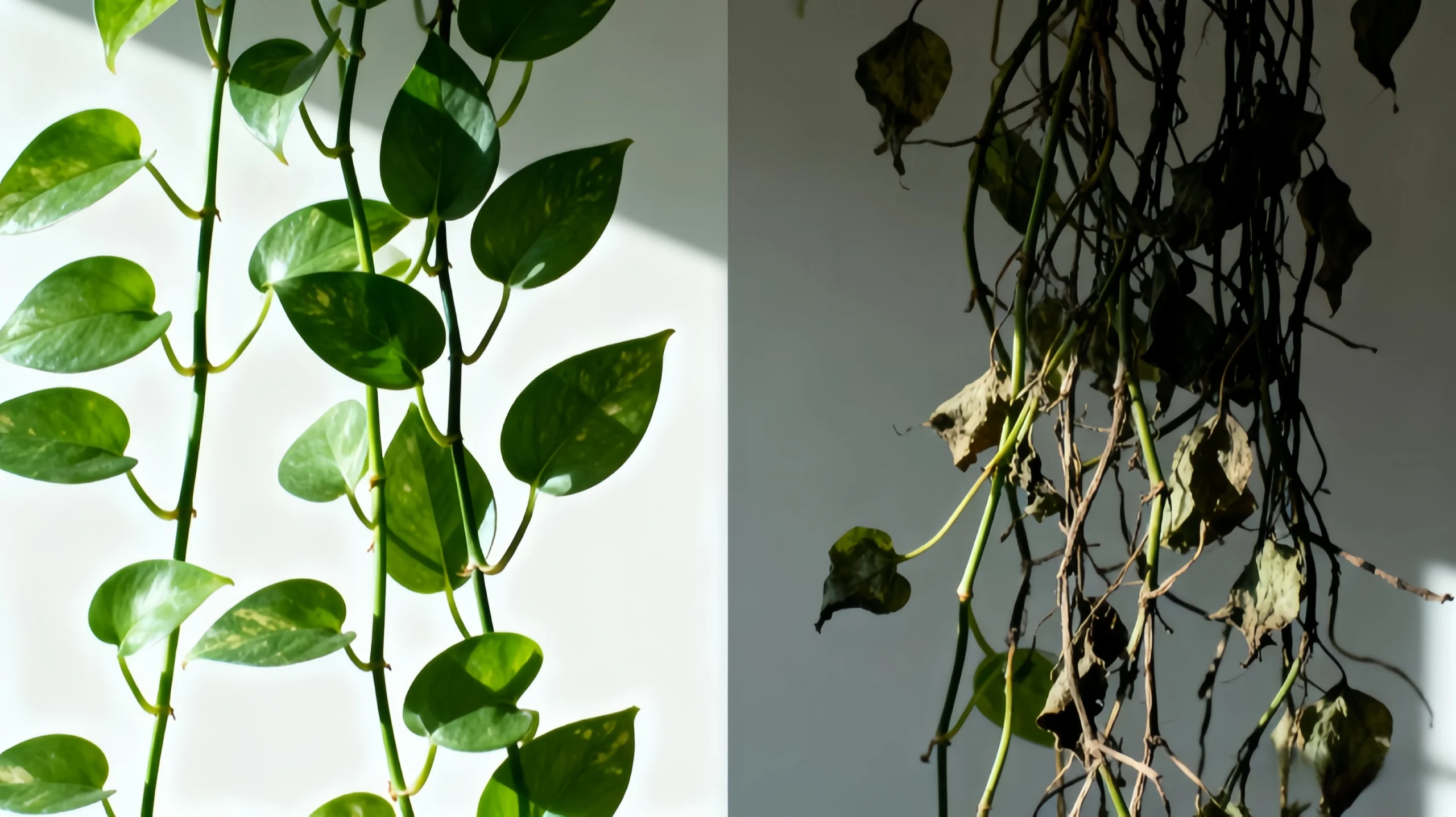
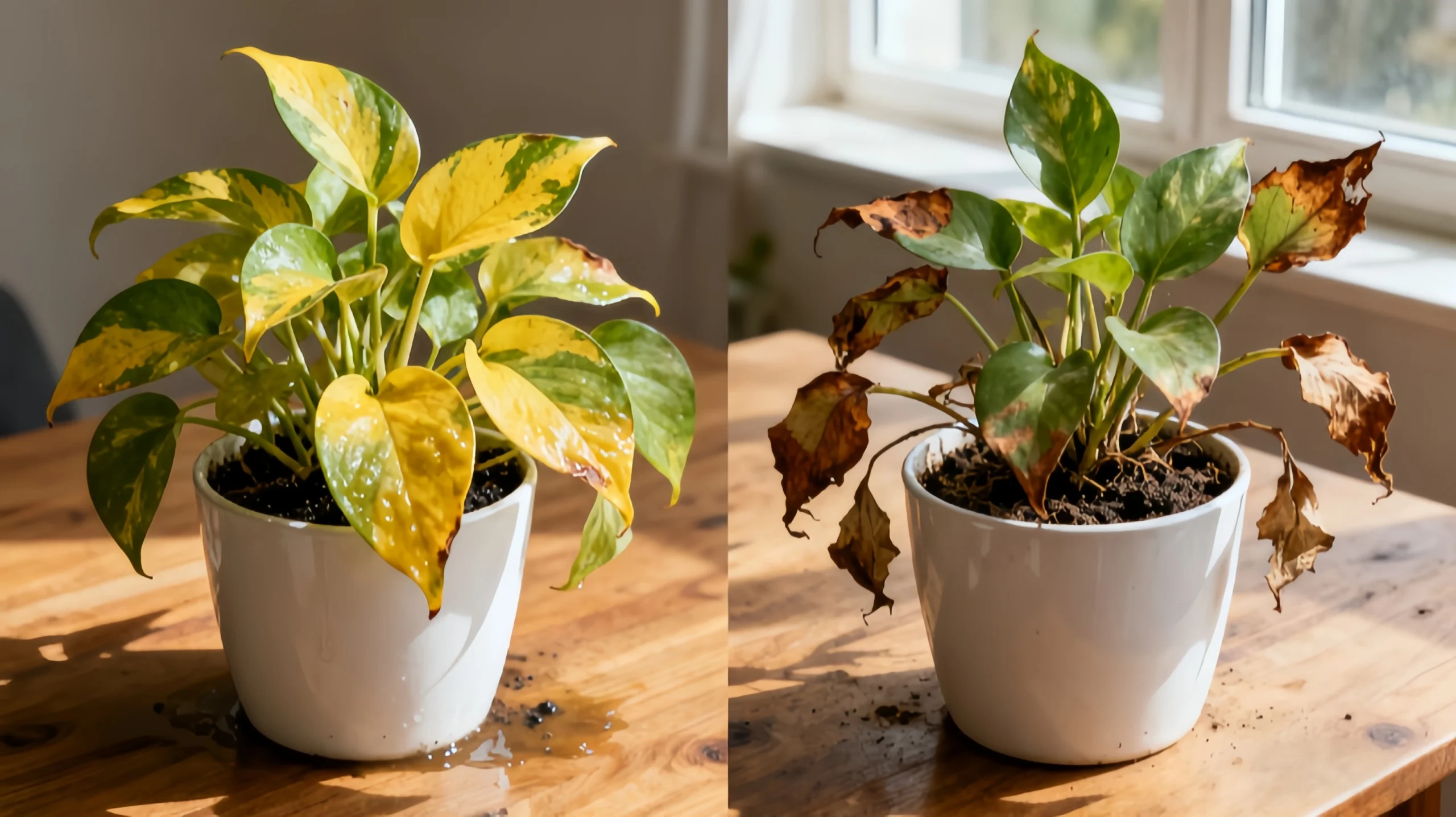
- Yellow leaves (often starting from the center, then browning)
- Soft, mushy stems near the base
- Soil stays wet for more than a week
- Musty smell from the soil
- Black stems (this means root rot has started)
Signs You’re Underwatering
On the flip side, if you’re not watering enough:
- Wilting, drooping leaves
- Curling leaves
- Dry, crispy brown edges
- Soil pulling away from the pot edges
Good news: Underwatered pothos bounce back quickly once watered. Overwatered pothos are much harder to save.
Watering Problem Diagnosis Table
| Symptom | Likely Cause | Solution |
|---|---|---|
| Yellow leaves + wet soil | Overwatering | Let soil dry completely, check drainage |
| Wilting + dry soil | Underwatering | Water thoroughly |
| Black stems | Root rot | Repot, trim dead roots, reduce watering |
| Brown leaf tips | Dry air or salt buildup | Increase humidity, flush soil with water |
Soil and Repotting
Best Soil for Pothos
Pothos aren’t picky, but they need one thing: drainage.
Use a well-draining indoor potting mix. I add a handful of perlite to improve aeration. Never use garden soil—it’s too heavy and stays wet too long.
A simple mix that works:
- 2 parts indoor potting soil
- 1 part perlite
When and How to Repot
How often: Every 2-3 years, or when you see these signs:
- Roots growing out of drainage holes
- Water runs straight through without absorbing
- Growth has slowed despite good care
- Plant looks too big for its pot
Best time: Spring or early summer (active growing season)
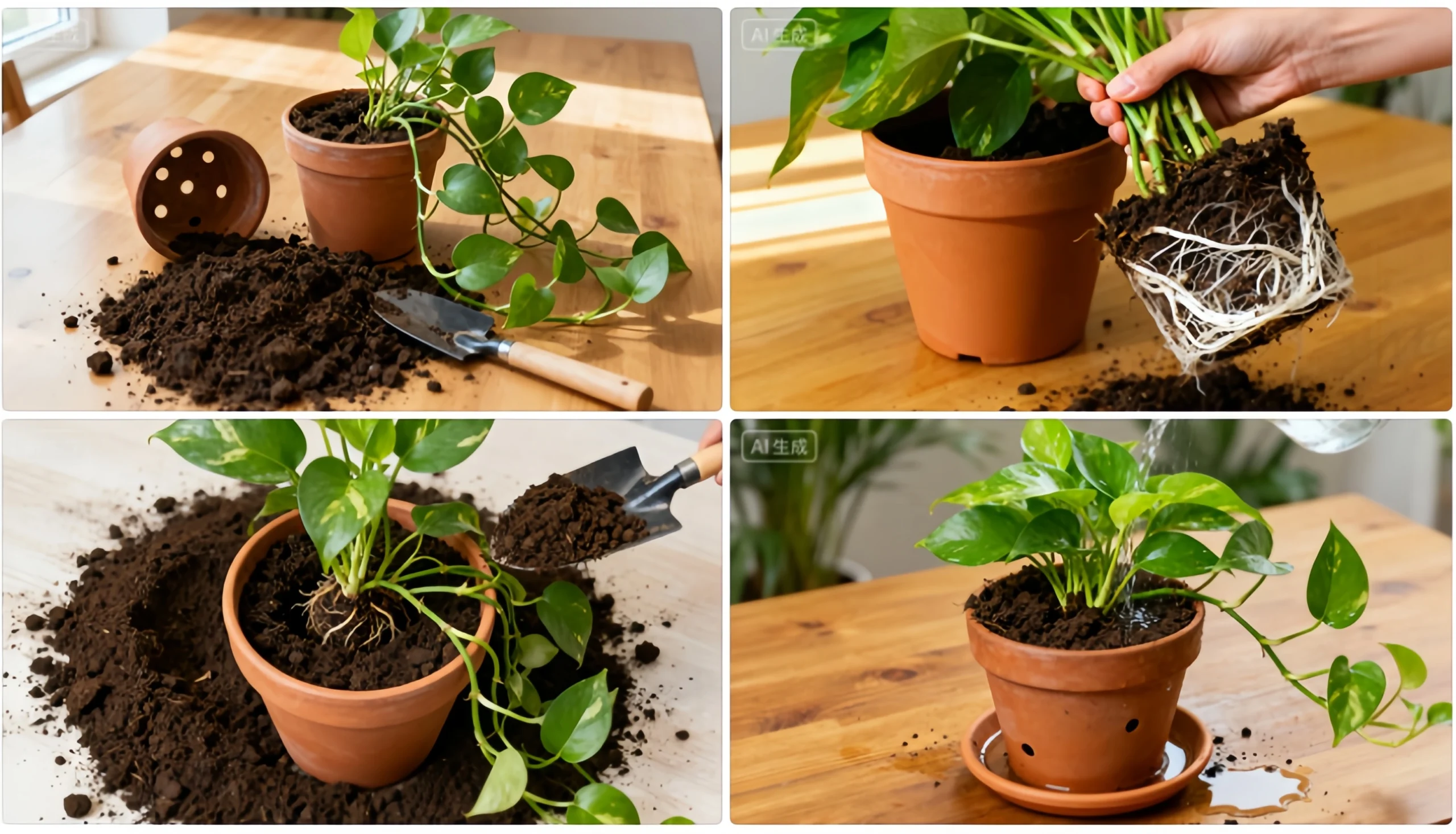
Repotting steps:
- Choose a pot 1-2 inches larger than the current one
- Gently remove the plant and loosen the root ball
- Add fresh soil to the new pot
- Place the plant and fill around with soil
- Water thoroughly and let drain
Pro tip: Don’t go too big on the pot size. A pot that’s way too large holds excess moisture and can cause root rot.
Temperature and Humidity
Temperature
Pothos like the same temperatures we do. If you’re comfortable, your plant probably is too.
Ideal range: 65-85°F (18-30°C)
Avoid:
- Temperatures below 50°F (can cause cold damage)
- Cold drafts from windows or doors
- Direct air from heating/AC vents
I keep my pothos away from my AC unit in summer. The cold air was causing brown spots on the leaves closest to the vent.
Humidity
Good news: Pothos handle average home humidity better than most tropical plants.
Ideal humidity: 40-60%
Signs of low humidity:
- Brown, crispy leaf tips
- Leaves curling inward
Easy fixes:
- Mist the leaves occasionally
- Place on a pebble tray with water
- Keep in a bathroom or kitchen (naturally more humid)
- Use a humidifier nearby
Honestly, my pothos do fine without any extra humidity effort. But if you see brown tips, try one of these fixes.
Comment
byu/maayamattoo from discussion
inpothos
Fertilizing
Less Is More
Pothos are light feeders. Over-fertilizing causes more problems than under-fertilizing.
My routine:
- Spring & Summer: Feed once a month with a balanced liquid fertilizer diluted to half strength
- Fall & Winter: No fertilizer (the plant is resting)
That’s it. Simple.
Fertilizer Mistakes to Avoid
❌ Fertilizing dry soil – Always water first, then fertilize. Fertilizing dry roots causes burn.
❌ Using full-strength fertilizer – Dilute to half the recommended amount.
❌ Fertilizing in winter – The plant isn’t actively growing, so it can’t use the nutrients.
❌ Over-fertilizing – Signs include brown leaf edges and white crusty buildup on the soil.
If you’ve over-fertilized, flush the soil by running water through it for a few minutes. Let it drain completely.
How to Propagate Pothos (Step-by-Step)
Propagation is one of the best things about pothos. You can turn one plant into many—for free.
Why Propagate?
- Get more plants without spending money
- Make the mother plant bushier
- Share with friends (cuttings make great gifts)
- Save a struggling plant by starting fresh
Water Propagation (My Preferred Method)
This is how I propagate all my pothos now. Here’s the exact process:
Step 1: Choose a Healthy Vine Select a stem that’s at least 4-6 inches long with 3-4 leaves. Make sure it looks healthy—no yellow leaves or damaged spots.
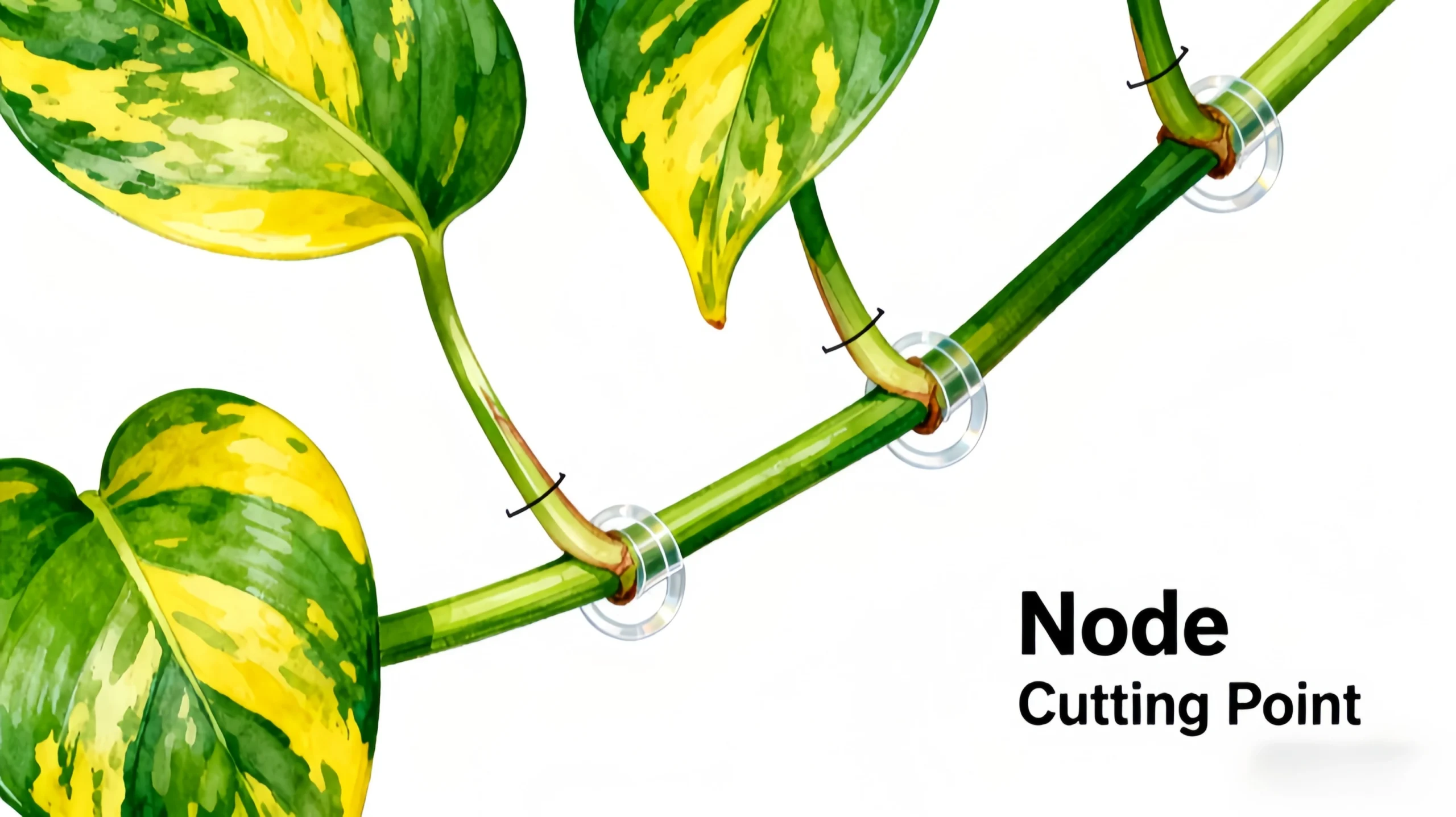
Step 2: Find the Nodes This is crucial. Nodes are the small bumps on the stem where leaves attach. This is where roots will grow. Look for the brownish bumps or aerial root nubs.
Step 3: Make Your Cut Using clean scissors or pruning shears, cut about 1/4 inch below a node. You want at least 1-2 nodes on your cutting.
Step 4: Remove Bottom Leaves Strip off the leaves from the bottom 1-2 nodes. These nodes need to be underwater, and leaves in water will rot.
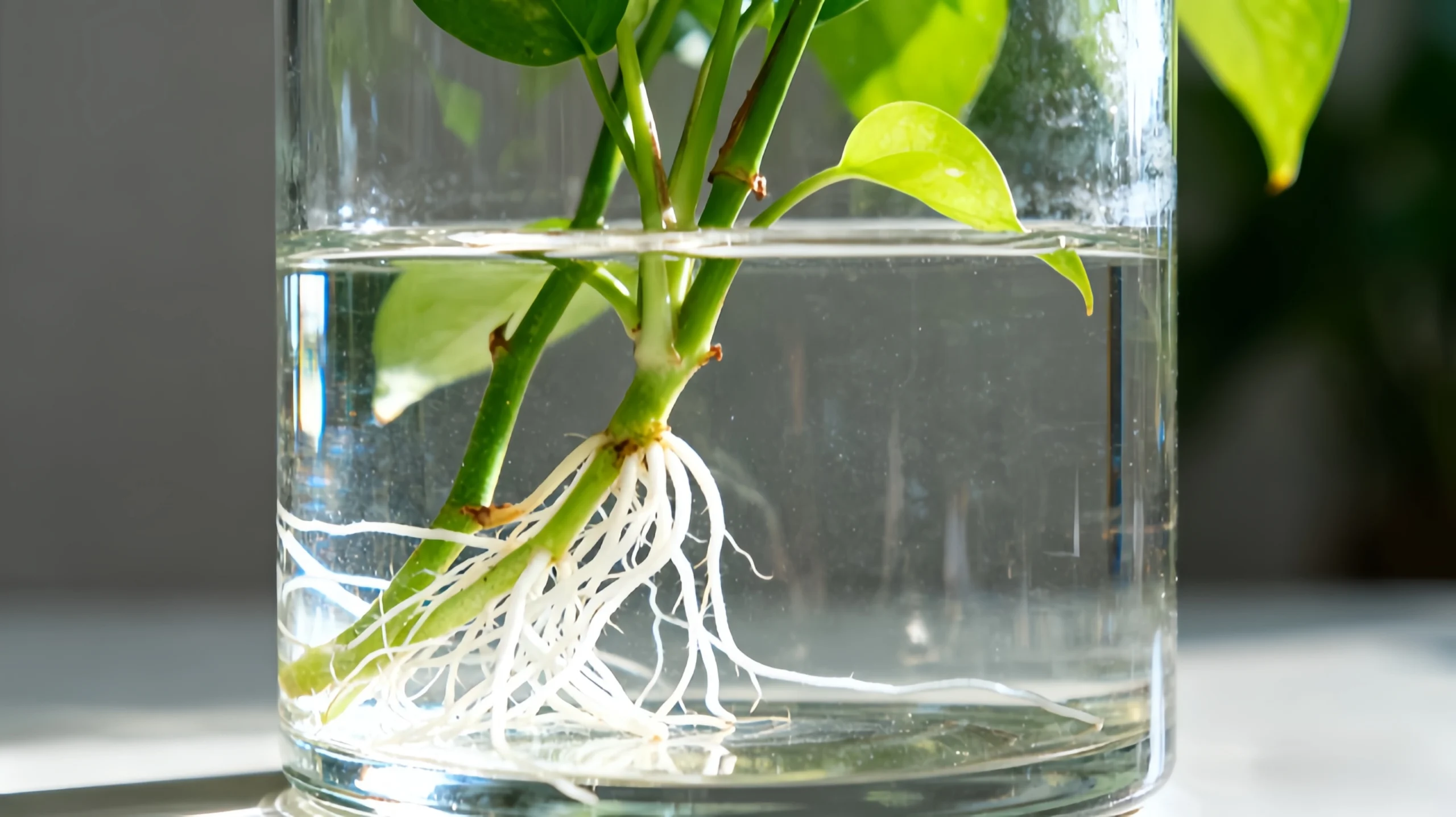
Step 5: Place in Water Put the cutting in a clear glass or jar with room-temperature water. Make sure:
- At least 1-2 nodes are submerged
- Leaves stay above water
- Use a clear container so you can watch root growth
Step 6: Change Water Regularly This is where I used to fail. Change the water every 5-7 days. Fresh water = fresh oxygen. Stagnant water = bacteria = rotting cuttings.
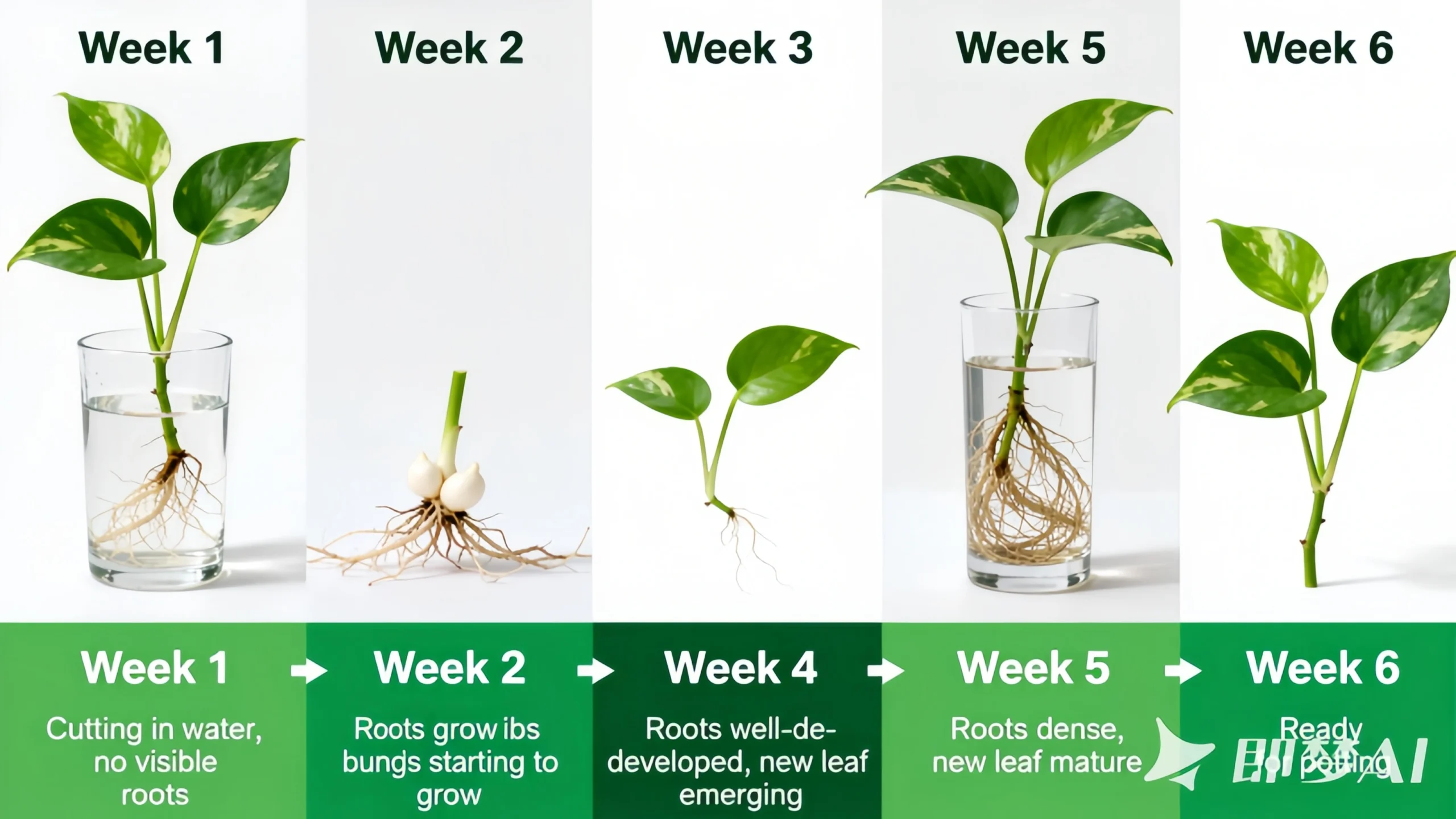
Step 7: Wait for Roots In 3-6 weeks, you’ll see white roots emerging from the nodes. Be patient!
Step 8: Plant in Soil Once roots are 1-2 inches long, it’s time to pot up. Use well-draining soil, keep it moist (not soggy) for the first few weeks, and place in bright, indirect light.
Soil Propagation (Alternative Method)
You can also root cuttings directly in soil:
- Prepare the cutting the same way (cut below node, remove bottom leaves)
- Dip the cut end in rooting hormone (optional but helpful)
- Plant directly into moist potting mix
- Keep soil consistently moist until you see new growth
- Place in bright, indirect light
Downside: You can’t see root development, so you’re guessing. I prefer water propagation because I can monitor progress.
Water vs. Soil Propagation
| Method | Pros | Cons |
|---|---|---|
| Water | See root growth, higher success rate, fun to watch | Transplant shock possible when moving to soil |
| Soil | No transplant needed, roots adapt to soil immediately | Can’t monitor roots, higher risk of rot |
My Propagation Journey: From 0% to 90% Success Rate
When I first tried propagating my Golden Pothos in 2022, I failed miserably—twice.
The Failure
My first two batches of cuttings rotted within two weeks. Both times. I was ready to give up.
Looking back, I made every rookie mistake:
- I never changed the water (bacteria built up)
- I cut in random places (sometimes no node was submerged)
- I kept the cuttings in a dark corner of my room
- I used tap water that had been sitting for weeks
What I Changed
After researching online plant communities and forums, I tried again with a completely different approach:
✓ Used a clear glass jar so I could see what was happening ✓ Made sure at least one node was fully underwater ✓ Changed the water every 5-7 days without fail ✓ Placed the jar near my east-facing window for bright, indirect light ✓ Used fresh, room-temperature water
The Results
Three weeks later, I saw tiny white roots starting to emerge. By week six, the roots were well over an inch long—healthy and white, not brown or mushy.
I potted up 4 cuttings. All 4 survived.
Where I Am Today
That one original Golden Pothos has now become 8 thriving plants throughout my home. My longest vine is over 7 feet. And my propagation success rate went from 0% to over 90%.
The lesson: Pothos propagation isn’t hard—it just requires the right technique. The biggest game-changers for me were changing the water regularly and making sure nodes were submerged.
Common Pothos Problems and Solutions
Even the toughest plants run into problems. Here’s how to diagnose and fix the most common issues.
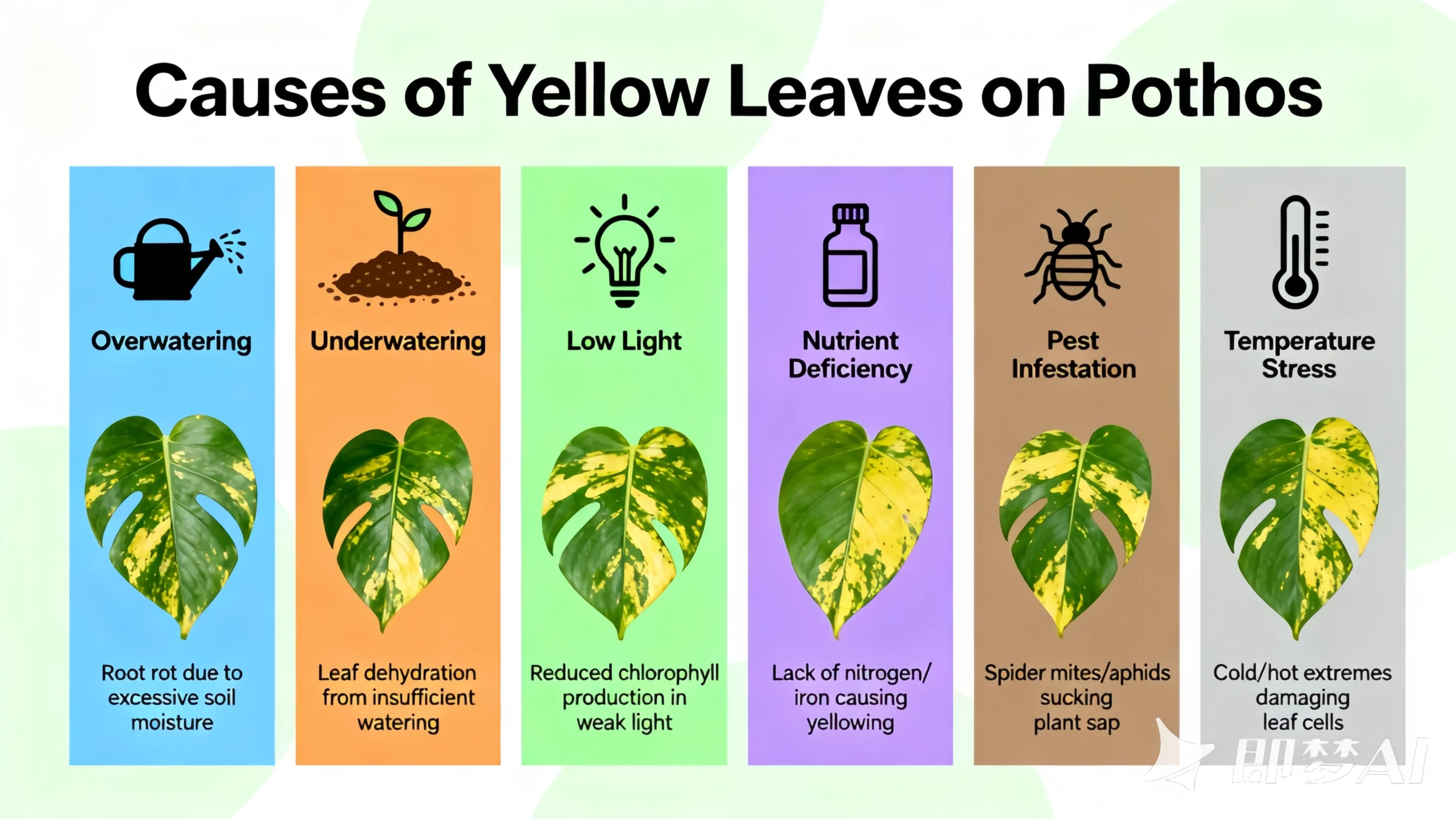
Yellow Leaves
This is the #1 question I see about pothos. Yellow leaves can mean several things:
Most common cause: Overwatering
- Leaves turn yellow and feel soft/mushy
- Soil is wet or stays damp for too long
- Fix: Let soil dry out completely before watering again
Underwatering
- Leaves turn yellow but feel dry/crispy
- Soil is bone dry
- Fix: Water thoroughly
Too little light
- Usually older/lower leaves turn yellow first
- Plant looks sparse and leggy
- Fix: Move to a brighter spot
Natural aging
- One or two yellow leaves occasionally? Totally normal
- Older leaves naturally die off
- Fix: Just remove them—no action needed
Over-fertilizing
- Yellow leaves with brown, burnt edges
- White crusty buildup on soil
- Fix: Flush soil with water, reduce fertilizer
Brown Leaf Tips
Usually caused by:
- Dry air – Increase humidity or mist leaves
- Salt/mineral buildup – Flush soil with water, use filtered water
- Underwatering – Check soil moisture more frequently
A few brown tips aren’t a big deal. It’s mostly a cosmetic issue.
Leggy Growth (Stretched Stems)
When stems grow long with big gaps between leaves, your pothos isn’t getting enough light.
Fix: Move closer to a window. You can also prune the leggy stems and propagate them. Pruning encourages bushier growth at the top.
Root Rot
This is serious and usually caused by overwatering + poor drainage.
Signs:
- Mushy, black stems at the base
- Foul smell from the soil
- Yellowing leaves that don’t perk up even after adjusting water
Fix:
- Remove the plant from its pot
- Cut away all black, mushy roots (use clean scissors)
- Let the healthy roots air dry for a few hours
- Repot in fresh, well-draining soil
- Wait several days before watering
Prevention is easier than cure. Always check soil before watering, and make sure your pot has drainage.
Problem Diagnosis Quick Reference
| Problem | Most Likely Cause | Quick Fix |
|---|---|---|
| Yellow leaves | Overwatering | Let soil dry completely |
| Brown tips | Low humidity | Mist leaves or use humidifier |
| Leggy stems | Not enough light | Move closer to window |
| Wilting | Under/overwatering | Check soil moisture |
| Loss of variegation | Low light | Increase light exposure |
| Mushy stems | Root rot | Repot, trim dead roots |
Pest Control
Pothos are generally pest-resistant, but they can still get bugs. Here’s what to watch for.
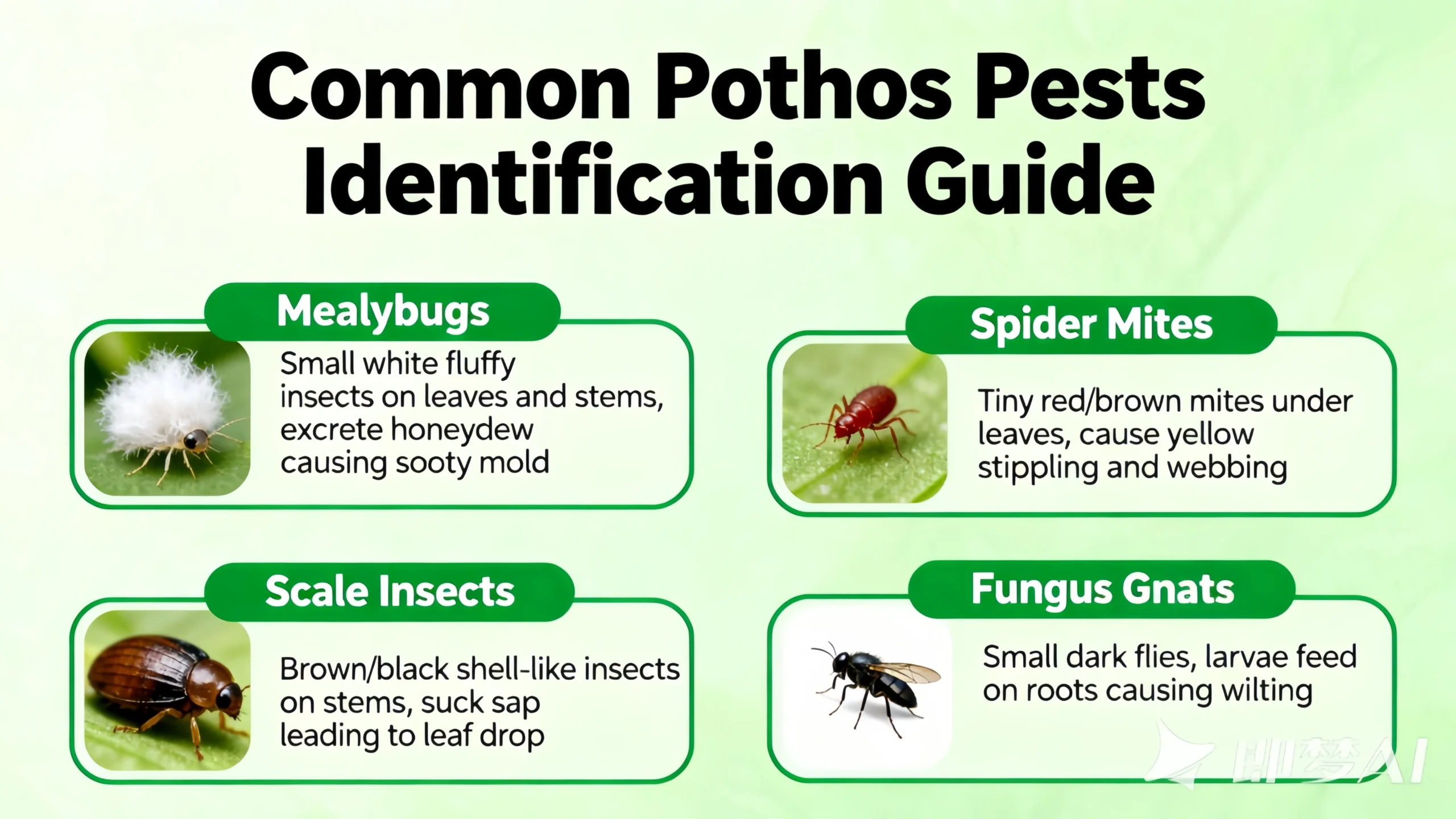
Common Pothos Pests
Spider Mites
- Signs: Tiny yellow/white dots on leaves, fine webbing on undersides
- Cause: They love dry conditions
- Treatment: Spray leaves with water to knock them off, then apply neem oil
- Prevention: Keep humidity up, mist leaves regularly
Note: Spider mites are not actual spiders—they’re tiny arachnids that harm plants. Regular house spiders can actually help control pests. But if you’re dealing with unwanted spiders in your home, here’s How to Get Rid of Spiders safely.
Mealybugs
- Signs: White, cottony masses on stems and leaf joints
- Cause: Often come in on new plants
- Treatment: Dab with rubbing alcohol on a cotton swab, or spray with insecticidal soap
- Prevention: Inspect new plants before bringing them near your others
Fungus Gnats
- Signs: Tiny black flies hovering around the soil
- Cause: Overwatering (they love moist soil)
- Treatment: Let soil dry out completely, use yellow sticky traps
- Prevention: Don’t overwater!
Scale
- Signs: Brown, shell-like bumps on stems
- Cause: Usually hitchhike on new plants
- Treatment: Scrape off with a toothbrush, apply rubbing alcohol
Natural Pest Prevention
The best defense is a healthy plant. Here’s what I do:
- Wipe leaves with a damp cloth every few weeks (removes dust and pests)
- Quarantine new plants for 1-2 weeks before placing near others
- Keep good air circulation around plants
- Avoid overwatering (wet soil attracts pests)
- Inspect regularly—catch problems early
Beyond plant-specific pests, indoor plants can sometimes attract other household bugs. If you’ve noticed stink bugs near your windows or houseplants, learn How to Get Rid of Stink Bugs effectively.
Pothos Care by Season
Your pothos needs different care depending on the time of year.
Seasonal Care Chart
| Season | Watering | Fertilizing | Notes |
|---|---|---|---|
| Spring | Increase gradually | Start monthly feeding | Best time to repot and propagate |
| Summer | Every 6-7 days | Monthly | Peak growth season—enjoy the show |
| Fall | Reduce gradually | Stop by late fall | Prepare for dormancy |
| Winter | Every 9-14 days | None | Growth slows, plant is resting |
My winter tip: I move my pothos slightly closer to windows in winter since days are shorter. Less light = even slower growth, so I try to maximize what they get.
Can Pothos Grow Outdoors?
Yes—but only in warm climates.
Pothos can grow outdoors year-round in USDA zones 10-12 (think Florida, Southern California, Hawaii). In these regions, it works great as:
- Ground cover
- Climbing vine on trees or trellises
- Patio container plant
Important warnings:
- Pothos is invasive in some tropical areas—check local regulations
- Bring indoors if temperatures drop below 50°F
- Never let it experience frost
If you’re growing pothos outdoors in your garden, you might encounter other challenges. Lawn damage from burrowing pests? Check out our guide on How to Get Rid of Moles with 7 proven methods.
For most of us, pothos is best kept as an indoor plant.
This video demonstrates pothos care and propagation techniques in detail:
FAQ
Is pothos toxic to cats and dogs?
Yes. According to the ASPCA, pothos contains calcium oxalates that can cause oral irritation, drooling, vomiting, and difficulty swallowing if pets chew on it.
Keep pothos out of reach of curious pets. Hanging baskets or high shelves work well.
How fast does pothos grow?
Under ideal conditions (bright indirect light, proper watering), pothos can grow 12-18 inches per month during spring and summer. Growth slows significantly in winter.
In low light, growth will be much slower—sometimes barely noticeable.
Why is my pothos not growing?
Common reasons:
- Not enough light (most common)
- Overwatering
- It’s winter (dormant period)
- Root-bound and needs repotting
- Pest problem
Check these factors and adjust. In my experience, light is usually the culprit.
Can pothos grow in water forever?
Yes! Pothos can live indefinitely in water. Just:
- Change the water every 1-2 weeks
- Add a drop of liquid fertilizer monthly
- Keep in bright, indirect light
I have one cutting that’s been in water for over a year and it’s thriving.
How do I make my pothos fuller and bushier?
Prune the long vines! Cut them back and propagate the cuttings. Then plant the rooted cuttings back into the same pot. This encourages bushier growth at the top and fills out the pot.
Why is my variegated pothos turning green?
This usually means it’s not getting enough light. Variegation requires more light to maintain.
Move it to a brighter spot (still avoiding direct sun). New growth should start showing variegation again. The green leaves won’t change back, but future growth will be variegated.
Conclusion
Pothos really is one of the most forgiving houseplants you can own. But even forgiving plants have limits.
Here’s what I’ve learned after 3 years and 8 plants:
The biggest lesson: Overwatering kills more pothos than anything else. When in doubt, don’t water. Check the soil first—every single time.
Second biggest lesson: “Low light tolerant” doesn’t mean “no light.” Give your pothos some brightness, and you’ll be amazed at how it grows.
Third lesson: Propagation is easier than it seems. Change that water, keep a node submerged, and be patient.
Your pothos wants to thrive. Give it decent light, don’t drown it, and it’ll reward you with beautiful trailing vines for years.
Ready to expand your plant collection? If you’ve enjoyed caring for pothos, you’ll love the equally low-maintenance snake plant. Discover everything you need to know in our complete guide: How to Care for a Snake Plant.
Got questions or want to share your pothos journey? Drop a comment below—I’d love to hear from you.
Recommended Video
This video demonstrates pothos care and propagation techniques:
[Embed YouTube video: Search for “pothos care and propagation guide” – choose a video with 50k+ views]Suggested video: “Pothos Plant Care 101” by Planterina or similar gardening channel
Summary Checklist
Before you go, here’s your quick reference:
✅ Light: Bright, indirect (tolerates low light)
✅ Water: When top 2 inches of soil are dry
✅ Soil: Well-draining potting mix
✅ Temperature: 65-85°F
✅ Humidity: 40-60% (average home is fine)
✅ Fertilizer: Monthly in spring/summer, none in winter
✅ Repot: Every 2-3 years
✅ Propagate: Cut below node, change water every 5-7 days
✅ Common problem: Yellow leaves = probably overwatering
Happy growing! 🌿
This article was created by a professional team. AI tools were used during the research and writing process to enhance efficiency and quality. All information has undergone manual verification and editing to ensure accuracy and practicality. We are committed to providing readers with objective and valuable content.
Publisher::meiruth558@gmail.com,Please indicate the source when reposting:https://gardeningtoolsgarden.com/how-to-care-for-pothos-plant/
