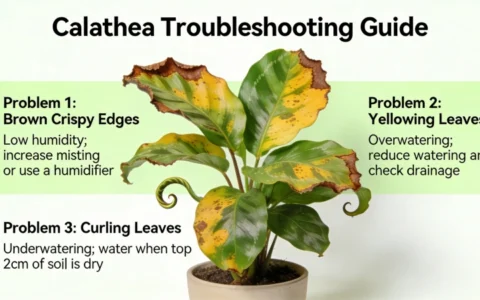
I nearly killed my first prayer plant within three months of bringing it home. The leaf tips browned within two weeks, the leaves began curling soon after, and by month three most of that beautiful foliage looked crispy and defeated.
Brown tips, curling leaves, and a plant that never quite settles in are common complaints with prayer plants, which have a reputation for being “fussy.” My first attempt seemed to confirm it. But 18 months on, I keep five healthy ones and have propagated a few more for friends. The fix wasn’t an elaborate routine. It came down to two things that guides tend to underplay: water quality and humidity.
Below is what I learned the hard way, including the changes that turned my dying plant around. If you’d rather start with something nearly unkillable, my guide on how to care for a snake plant is a gentler entry point.
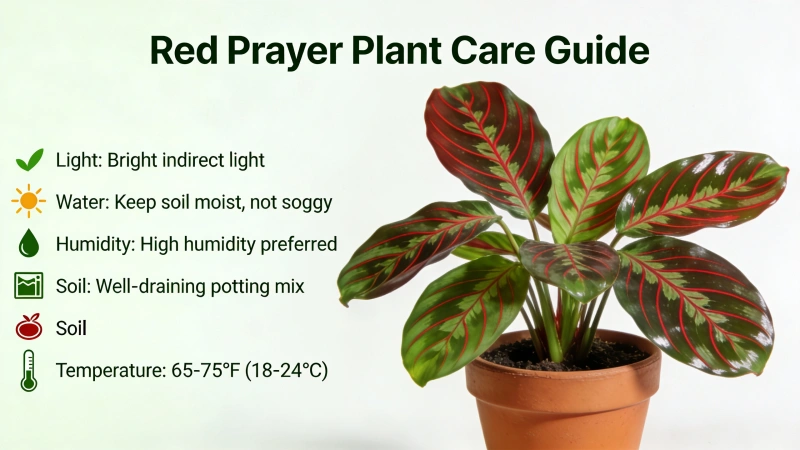
Quick Answer: How to Care for a Prayer Plant
- Light: bright, indirect light (avoid direct sun)
- Water: keep soil moist but not soggy; water when the top inch is dry
- Water quality: use distilled or filtered water — tap water can cause brown tips
- Humidity: 50–70%, with a humidifier or pebble tray
- Temperature: 65–80°F (18–27°C)
- Pet safe: non-toxic to cats and dogs ✓
What Is a Prayer Plant?
Prayer plants (Maranta leuconeura) are tropical plants native to the rainforests of Brazil. They get their common name from a charming habit: the leaves fold upward at night, like hands pressed together in prayer. That movement, called nyctinasty, is one of the best things about them. By day the leaves lie flat to soak up light; after dark they rise. I still catch myself checking on mine at odd hours just to watch them shift.
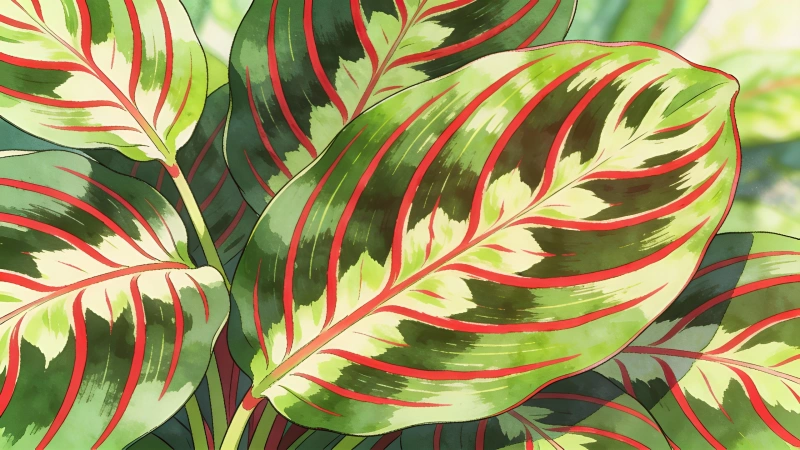
The most popular variety is the Red Prayer Plant, with dark green leaves marked by light green centers and striking red veins. Others include Lemon Lime (yellow-green markings) and Rabbit’s Foot (brown spots like little tracks).
✓ Pet-friendlyAccording to the ASPCA, prayer plants are non-toxic to cats and dogs, so they’re a safe pick if you have curious pets.
Prayer plants belong to the Marantaceae family, alongside Calathea, Stromanthe, and Ctenanthe, and the whole family has broadly similar care needs. Learn one and you’re well on your way with the others.
Light Requirements for Prayer Plants
In the wild these are understory plants, growing beneath the rainforest canopy in dappled, filtered light rather than direct sun. The sweet spot indoors is bright, indirect light. As I think of it, your prayer plant wants to see the sky, just not the sun.
Best locations:
- Near a north-facing window
- A few feet back from an east-facing window
- 6–7 feet from a south-facing window
- Behind a sheer curtain on any bright window
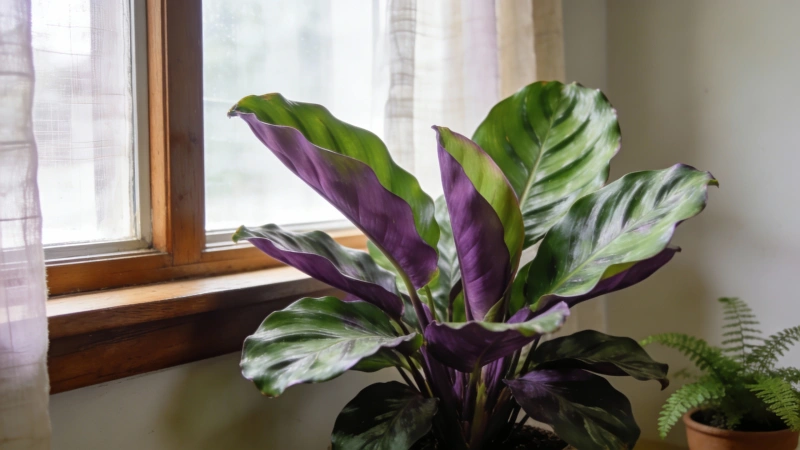
The plant will show you when the light is off. Too much shows up as faded, washed-out color, scorched brown edges, and leaves curling away from the source. Too little shows up as fading patterns, slow or leggy growth, and leaves that stop folding at night, which can mean the plant is stressed.
How to Water Your Prayer Plant
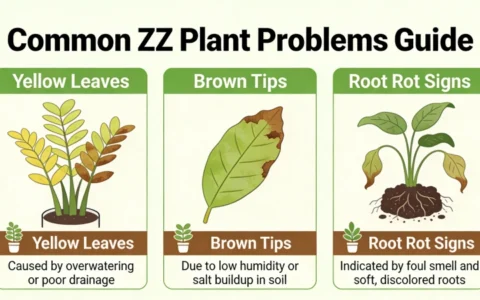
Keep the soil consistently moist but never soggy. Prayer plants don’t want to dry out completely, since their tropical roots expect steady moisture, but they hate standing water just as much, and it tips them into root rot fast. (When rot does set in, it’s almost always the roots suffocating in waterlogged soil, so the fix is less water and better airflow.)
My routine is simple. I check the soil with a finger about an inch deep, and if it’s dry, I water thoroughly until water runs from the drainage holes. Then I let it drain completely and never leave the pot sitting in a saucer of water.
Through the year I water about weekly in spring and summer (more in real heat) and every 10–14 days in fall and winter as growth slows. All of it depends on a pot with drainage holes. Without them, root rot is more or less a matter of time.
The Right Soil Mix
Prayer plants want a mix that holds moisture but still breathes: rich yet airy. A reliable blend is roughly three parts peat or coco coir to one part perlite, or a loose, well-draining leaf-mold-based potting mix. The perlite keeps the roots oxygenated between waterings, which lowers the risk of rot.
Water Quality: The Hidden Prayer Plant Killer
This is the change that made the biggest difference for me. Prayer plants are sensitive to the chemicals in tap water. Fluoride, chlorine, and hard minerals can build up in the soil over time and slowly harm the plant. The result is those maddening brown leaf tips that keep getting worse no matter what else you do.
I watered my first prayer plant with tap water for two months, doing everything else by the book, and the brown tips kept spreading. The moment I switched to distilled water, the new growth came in clean.
Water Quality Comparison
| Water Type | Rating | Notes |
|---|---|---|
| Rainwater | ⭐⭐⭐⭐⭐ | Best choice — free and natural |
| Distilled water | ⭐⭐⭐⭐⭐ | Easy to find at any grocery store |
| Filtered water (RO) | ⭐⭐⭐⭐ | Great if you have a filter |
| Tap water (left out 24 hrs) | ⭐⭐⭐ | Chlorine off-gasses, but fluoride remains |
| Fresh tap water | ⭐ | Not recommended — leads to brown tips |
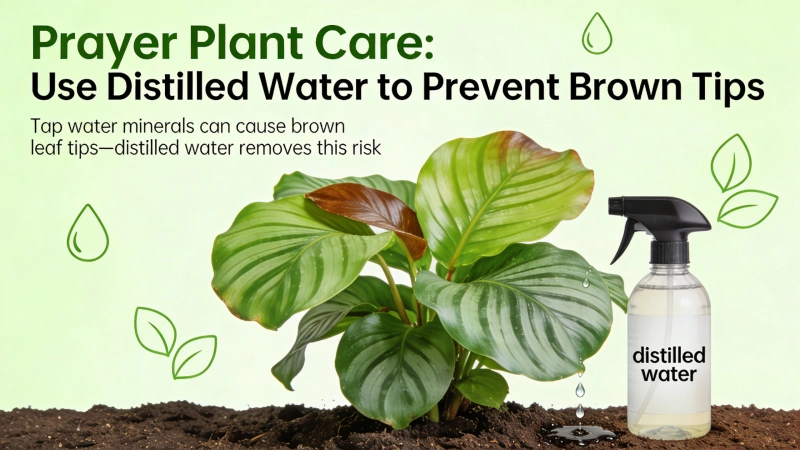
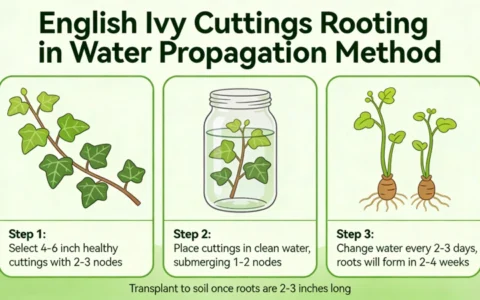
Prayer plants aren’t alone in this sensitivity. If you also grow English ivy, you may notice the same tap-water tip burn there.
My prayer plant has browning tips
by u/sweebeee in plantclinic
Humidity: The Key to Happy Prayer Plants
Humidity is the other make-or-break factor in prayer plant care. These plants evolved in Brazilian rainforests where humidity routinely tops 80%, while the average American home sits around 30–40%, and lower still in winter with the heat running. Starved of moisture in the air, they respond with brown, crispy tips and edges, curling leaves, and a generally unhappy look. Aim for 50–70%, ideally 60% or higher.
5 Ways to Increase Humidity
| Method | Effectiveness | My Experience |
|---|---|---|
| Humidifier | ⭐⭐⭐⭐⭐ | Best option — set it to 60% and forget it |
| Bathroom placement | ⭐⭐⭐⭐⭐ | Daily shower steam adds natural humidity |
| Pebble tray | ⭐⭐⭐⭐ | Simple DIY — pebbles plus water under the pot |
| Grouping plants | ⭐⭐⭐ | Plants create their own humid microclimate |
| Misting | ⭐⭐ | Temporary — evaporates within hours |

Before I bought a humidifier, I was forever fighting brown edges. Once I set it to 60%, the new growth finally came in healthy. If you’d like to grow other humidity-lovers, a steamy bathroom is one of the easiest homes you can give them.
Comment
by u/amyspace from discussion in houseplants
Temperature Requirements
Prayer plants prefer 65–80°F (18–27°C); if you’re comfortable, they usually are too. Their most active growth falls in a narrower band, around 64–72°F (18–22°C). What they don’t tolerate is instability: cold drafts from windows and doors, sudden temperature swings, blasts from heating or AC vents, and anything below 55°F (13°C), which can do permanent damage.

I learned this by parking mine near the front door. Every winter opening sent a rush of cold air over it, and after a few weeks of leaf drop I moved it somewhere more sheltered.
Fertilizing (Less Is More)
Over-fertilizing is another common cause of brown edges, and Marantaceae are unusually sensitive to fertilizer salts. It’s a third culprit behind the brown tips that people often blame on water and humidity alone. So I keep feeding light: a balanced liquid houseplant fertilizer at half strength, roughly every two weeks during spring and summer only, tapering off in fall and stopping completely in winter.
Two signs you’ve overdone itScorched, browning leaf margins are the obvious one. The subtler one shows up in cool weather: guttation, or small water droplets beading along the leaf edges, which often means there’s more fertilizer in the soil than the plant can use. If you suspect a buildup, flush the pot with several rounds of clean (distilled or filtered) water to dilute the salts, and skip feeding until it recovers.
Prayer Plant Seasonal Care Calendar
Prayer plants want different things across the year. This is the schedule I follow:
| Season | Watering | Fertilizing | Special Notes |
|---|---|---|---|
| 🌱 Spring | Weekly | Every 2 weeks (half strength) | Growth resumes; ideal time to divide |
| ☀️ Summer | Every 5–7 days | Every 2 weeks | Peak growth; watch for pests |
| 🍂 Fall | Every 10 days | Monthly, then stop | Growth slows; prepare for winter |
| ❄️ Winter | Every 10–14 days | None | ⚠️ Hardest season — humidity is critical |
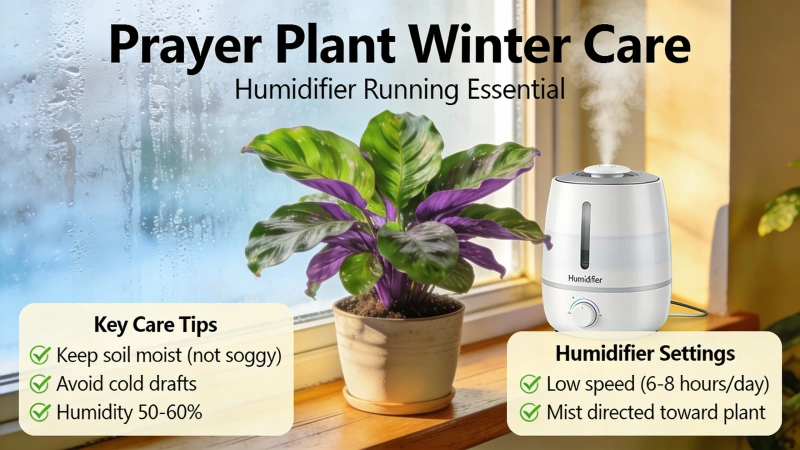
Winter warning: this is when many prayer plants struggle. Heated air is very dry and growth slows right down, so the priority shifts from watering to maintaining humidity.
My 18-Month Prayer Plant Journey: From Near-Death to Thriving
Here’s what happened with my first prayer plant, and how I turned it around.
Starting Point (April 2023)
I picked up a gorgeous Red Prayer Plant from my local nursery (those red veins against dark green were irresistible), set it on a living-room bookshelf, and watered it every Saturday with tap water. Simple enough, I thought.
What Went Wrong
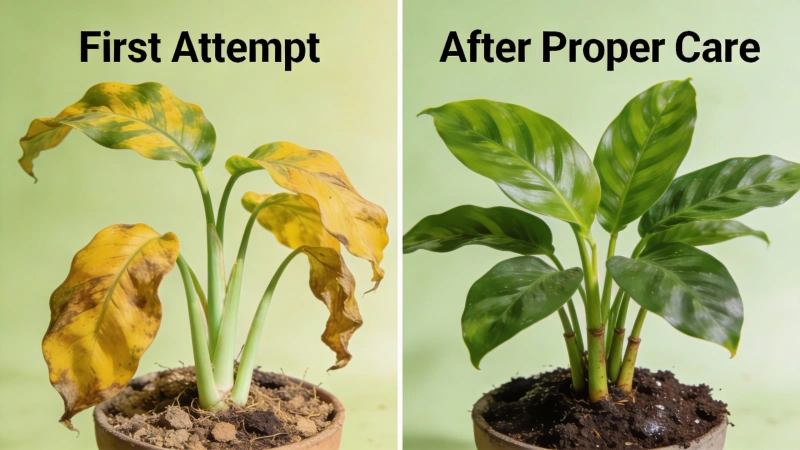
By week two, brown tips had appeared on several leaves, and I chalked it up to the plant settling in. By the end of month one the browning had spread and some leaves were curling, so, assuming the plant was thirsty, I started watering twice a week. That only made month two worse: yellowing leaves, more curling, and a lot of confusion on my part. By month three it looked so bad I nearly threw it out.
The Turning Point & What I Changed
Then I found a post from a fellow grower describing my exact problem, and the advice was simple: distilled water and a humidifier. I was skeptical, but desperate enough to try. I made four changes. I switched to distilled water and never looked back, added a small humidifier set to 60%, moved the plant near the bathroom for extra shower-steam humidity, and stopped overwatering, giving it a drink only once the top inch had dried.
The Results
- 3–4 weeks later: new growth emerged — and no brown tips
- 6 months later: fully recovered and visibly thriving
- 18 months later: five different prayer plant varieties on the shelf
- Bonus: two plants successfully propagated and gifted to friends
The lessons I took from it: water quality can matter more than watering frequency (I could have watered perfectly and the tap water would still have harmed the plant); most homes lack the humidity these plants want, especially in winter; and prayer plants aren’t truly “fussy,” just specific. Once you meet their needs, they’re remarkably rewarding.
Common Prayer Plant Problems (And How to Fix Them)
If your plant is showing distress, this table covers the problems I’ve run into:
| Symptom | Likely Cause | Solution |
|---|---|---|
| Brown leaf tips/edges | Tap-water chemicals; low humidity; over-fertilizing | Switch to distilled water; raise humidity; feed at half strength |
| Curling leaves | Underwatering; low humidity; temperature stress | Water thoroughly; boost humidity; check location |
| Yellowing leaves | Overwatering; root rot; nutrient deficiency | Reduce watering; check roots; fertilize in spring |
| Leaves not folding at night | Light issues; plant stress | Adjust light; address other stressors |
| Fading leaf patterns | Not enough light | Move to brighter indirect light |
| Slow / no growth | Winter dormancy; root-bound; needs feeding | Wait until spring; check whether it needs repotting |
| Brown spots on leaves | Leaf-spot disease; water sitting on leaves | Improve air circulation; avoid wetting foliage |
A Note on Pests and Leaf Diseases
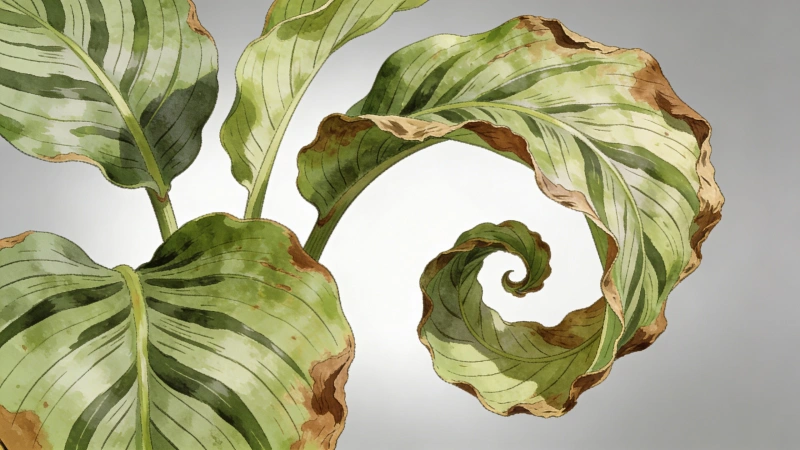
Beyond the tip-burn troubles, the Marantaceae family is prone to a few fungal leaf-spot diseases (leaf spot, brown spot, black spot) and to the usual sap-suckers: spider mites, thrips, and scale. The first line of defense is cultural. Snip off and destroy affected leaves promptly rather than composting them, improve air circulation, and keep water off the foliage. For a stubborn outbreak, treat with an appropriate fungicide (a zineb-type product is commonly used) or insecticide. My full pests & diseases guide walks through identification and treatment in more detail.
Emergency Treatment for Severely Curled Leaves
If the leaves are badly curled and won’t recover, give the plant a bottom soak: set the whole pot in a sink or tub of water for 30–45 minutes, let it drain completely, and raise the humidity right away. If there’s no improvement within 3–4 days, check the roots for rot.
How to Propagate Prayer Plants
Prayer plants are among the easier houseplants to propagate, and the most reliable method is division: splitting one plant into two or more. Here’s how I do it. In spring or early summer, while the plant is actively growing, slide it out of its pot and shake off the excess soil, then look for natural clumps of stems that already have their own roots. Gently tease those sections apart by hand and repot each into fresh, well-draining mix. Set them somewhere humid with the soil kept moist, and watch for new growth in 2–3 weeks. That’s your sign it worked.
Get the depth rightWhen you repot or divide, plant at the same depth the section sat before, with the soil surface level with the base of the stems. Too deep, and the plant struggles to push out new side shoots; too shallow, and it tends to flop over as it grows.
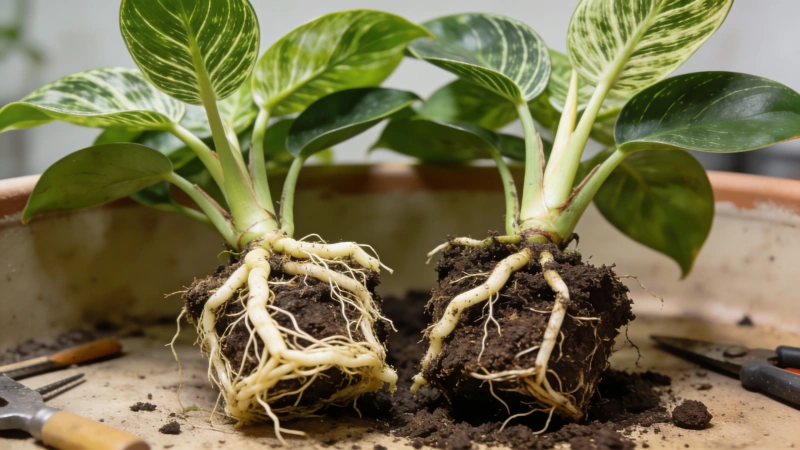
Done correctly, division usually succeeds, and both of mine took and thrived. For another plant that roots easily and makes a good holiday gift, see how to care for a Christmas cactus.
Watch: Prayer Plant Care Tips
This video covers the essentials, including the leaf-folding behavior:
Key Takeaways
If you remember nothing else:
- Water quality first: distilled, filtered, or rainwater — tap water is a leading cause of brown tips.
- Humidity 50–70%: a humidifier is the most reliable fix, especially in winter.
- Bright, indirect light: no direct sun; if it stops folding at night, it may be stressed.
- Moist, never soggy: water when the top inch is dry, in a pot with drainage holes.
- Feed lightly: half strength, spring–summer only — overfeeding scorches the edges too.
Frequently Asked Questions
Are prayer plants toxic to cats and dogs?
No. According to the ASPCA, Maranta leuconeura is non-toxic to cats and dogs, which makes it a good pick for pet owners who want bold foliage without the worry.
Why do my prayer plant’s leaves stay curled during the day?
Leaves that stay curled all day, not just at night, usually mean the plant is stressed. The usual causes are soil that’s too dry, humidity that’s too low, or temperature extremes. Water thoroughly, raise the humidity, and check for drafts or nearby heat.
How much light does a prayer plant need?
Bright, indirect light. A north-facing window, or a spot several feet from a sunny window, works well. Avoid direct sun, which scorches the leaves and fades their patterns.
Can I use tap water for my prayer plant?
Technically yes, but I don’t recommend it. The fluoride and chlorine in tap water can build up in the soil and cause brown tips. Distilled, filtered, or rainwater gives the best results; if you must use tap water, let it sit out for 24 hours first.
Does my prayer plant need special care in winter?
Yes. Winter is the hardest season, because heated air is very dry. Reduce watering to every 10–14 days, stop fertilizing entirely, run a humidifier, and keep the plant away from heating vents.
How often should I repot my prayer plant?
Every 1–2 years, or when roots grow out of the drainage holes. Prayer plants like being slightly root-bound, so there’s no rush. When you do repot, follow my repotting guide and go up only 1–2 inches in pot size.
Final Thoughts
Prayer plants have a reputation for being difficult, but they’re less fussy than specific. Water quality and humidity made the biggest difference for me, and once I’d addressed them, the rest of the routine was straightforward. I went from nearly killing my first prayer plant to keeping five healthy ones.
Have questions about your prayer plant? Drop them in the comments below — I’m happy to help.
Editorial Note: This article was written and edited by Spring Mei. AI tools may be used to assist with research and organizing information. The final content is reviewed before publication, and important factual claims are checked against reliable sources where appropriate. Personal experience is distinguished from general guidance, and methods are described as personally tested only when they have actually been tested.
Please indicate the source when reposting:https://gardeningtoolsgarden.com/how-to-care-for-a-prayer-plant/
Author: Spring Mei