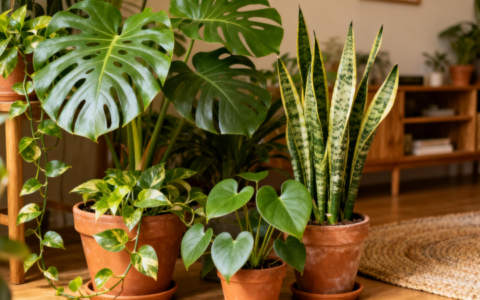
Are your Chinese money plant’s leaves curling, yellowing, or drooping? Or is your Pilea healthy but refusing to produce baby plants? A fixed watering calendar won’t answer either question. What helps is knowing which clues to check, what to change first, and when to leave the plant alone.
The Chinese money plant (Pilea peperomioides) does best in bright, indirect light, in a well-draining potting mix and a pot that drains, with moisture kept fairly even. This guide covers those basics, then adds a symptom chart for diagnosing leaf problems, a method for deciding when to water, three propagation approaches with a table comparing them, and a 30-day tracking sheet you can copy into your notes.
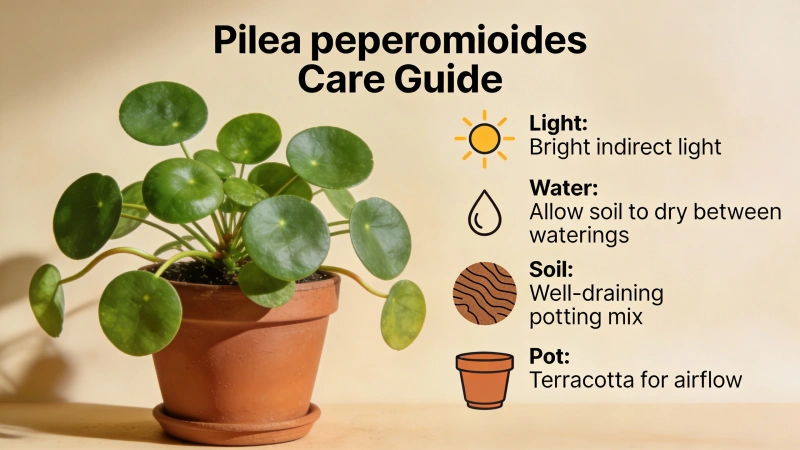
Quick answer: How do you care for a Chinese money plant? Give it bright, indirect light, away from hot sun and cold drafts. Water when the top inch or so (a few centimeters) of mix begins to dry, then let the excess drain. Use an airy indoor potting mix in a pot with drainage holes, and give the pot a quarter turn each time you water so growth stays even. Feed lightly during active growth, and separate established pups when you want to propagate.
If the leaves are curling: check soil moisture, drainage, temperature, and light before treating the plant. Leaf shape alone doesn’t tell you the cause.
Chinese Money Plant Care at a Glance
| Care factor | Good starting point | Adjust based on |
|---|---|---|
| Light | Bright, indirect light; gentle morning sun is often tolerated | Bleached patches, leaning, small new leaves |
| Water | Water when the top inch or so (a few cm) of mix begins to dry; drain fully | Pot weight, moisture deeper down, season |
| Soil | Loose, moisture-retentive but well-draining houseplant mix | How fast the root zone dries, pot and climate |
| Pot | Drainage holes; only modestly larger when repotting | Root mass, drainage and stability |
| Temperature | Ordinary warm indoor temperatures; avoid dropping below 50°F (10°C) | Cold drafts, radiators and heat vents |
| Humidity | Normal household levels often work | Persistently dry air and how the plant responds |
| Feeding | Light houseplant fertilizer during active growth, following the label | Growth rate, potting mix and salt buildup |
| Propagation | Separate well-developed offsets (pups) in spring or summer | Whether the offset already has roots |
| Pet safety | Generally regarded as non-toxic to cats and dogs | Still keep it away from pets that chew plants |
These recommendations draw on guidance from the Royal Horticultural Society and NC State Extension. Treat them as starting points rather than fixed measurements, since every home is different.
First, Make Sure You Have the Right “Money Plant”
The Chinese money plant is Pilea peperomioides, a member of the nettle family (Urticaceae) native to southwestern China. Its round leaves attach to their stalks near the center, which gives each one a coin or miniature lily-pad look. It is also sold as the pancake plant, UFO plant, missionary plant, and coin plant.
The common names overlap, and that causes confusion. “Money plant” sometimes refers to pothos (Epipremnum aureum), while “money tree” usually means Pachira aquatica. Their watering and propagation needs aren’t identical to Pilea’s. If your plant has long, trailing vines rather than a compact cluster of round leaves, start with our pothos care guide instead.
Pilea is not a desert succulent. Its fleshy leaves can handle a little dryness, but a root ball that stays bone-dry for long stretches isn’t ideal either. Aim for moisture without waterlogging.
How Much Light Does a Chinese Money Plant Need?
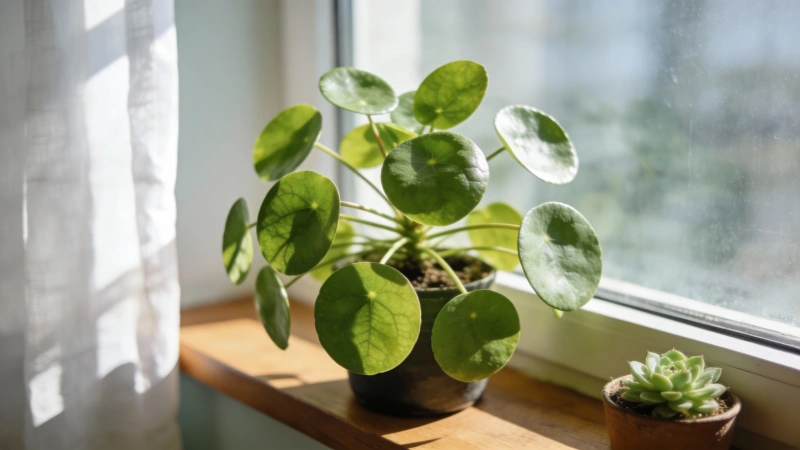
Bright, indirect light usually produces the most compact growth and healthy-looking foliage. An east-facing window with gentle morning sun is often a good spot. North-facing windows can work if the room is genuinely bright. In a strong south- or west-facing exposure, filter the hot afternoon sun or move the plant back from direct rays.
| What you see | Check first | Practical adjustment |
|---|---|---|
| Long bare stem and leaves reaching toward the window | How much daylight actually reaches the plant | Move it gradually toward a brighter position |
| Bleached, dry patches on the window-facing side | Hot direct sun, especially after a move | Filter midday and afternoon light; avoid sudden changes |
| Plant leaning to one side but otherwise healthy | A one-sided light source | Rotate a quarter turn whenever you water |
| Healthy leaves but little winter growth | Season and day length | Keep care steady; skip unnecessary fertilizer |
Skip rules like “always keep Pilea three feet from a window.” Glass, overhangs, season, window direction, and latitude all change how much light a spot actually gets. Watch how the plant does in its actual spot for one to two weeks. For more examples of healthy indoor light placement, see our rubber plant light and leaf-care guide.
Should you rotate a Pilea every two days?
You can, but you don’t have to. The RHS suggests giving upright plants a quarter turn each time you water so they grow more evenly, which is easier to keep up than a strict every-two-days routine.
How to Water a Chinese Money Plant Without Guessing
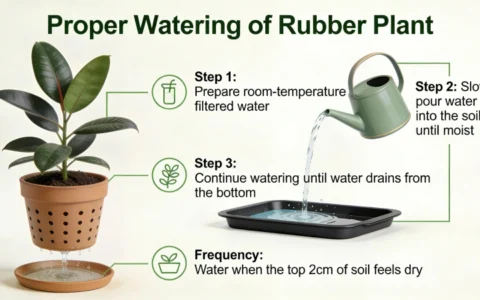
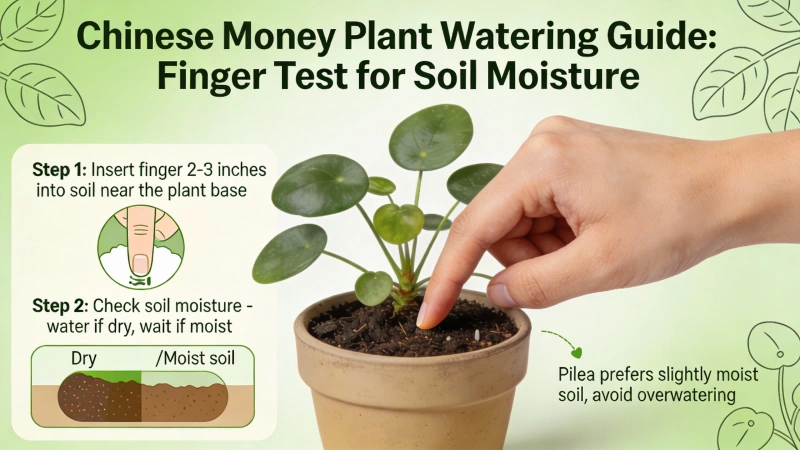
The best watering schedule is a soil check, not a fixed number of days. Pilea wants a well-aerated root zone that never stays soaked, but it doesn’t like repeated, severe drought either. The RHS recommends watering once the upper few centimeters of mix start to dry out.
The three-check watering method
- Check the upper mix. Feel the top inch or so (a few centimeters) of potting mix. If it’s still damp, check again later rather than watering automatically.
- Check the pot’s weight and deeper moisture. A heavy pot, or a wooden skewer that comes out noticeably damp, suggests more moisture remains below the surface. Small pots dry out faster than large ones.
- Water thoroughly when the mix is ready. Add water slowly until some drains out, let the pot finish draining, then empty the saucer or outer decorative pot. If the mix has shrunk away from the sides and repels water, rehydrate it gradually rather than splashing a little on top.
That’s why no universal weekly or biweekly schedule holds up. A small terracotta pot in a bright summer window can need water far sooner than a large plastic pot in a cool, dim room.
| Situation | What usually changes | What to do |
|---|---|---|
| Warm weather and active new leaves | Water use and evaporation may increase | Check more often, then water based on the mix |
| Short winter days | Growth and water use often slow | Stretch the interval between checks if the soil stays damp |
| Terracotta pot | Moisture can evaporate through the pot walls | Check sooner than you would with glazed ceramic |
| Plastic pot, oversized pot or dense mix | Wet soil may persist around the roots | Check drainage and root health; don’t water by the calendar |
| Wilting plant with wet mix | Roots may be stressed or damaged | Don’t assume thirst; investigate further |
| Wilting plant with very dry mix | Water deficit is more plausible | Rehydrate properly and watch the response |
If you grow several species, our pothos watering advice follows a similar decision process, though the right moisture threshold can differ by plant.
Yellow leaves plus sour-smelling or saturated mix: Simply holding off on water for two weeks isn’t a complete fix. Inspect the roots, and if you find soft or decaying ones, see the root rot diagnosis and treatment guide.
The Best Soil and Pot for Pilea peperomioides
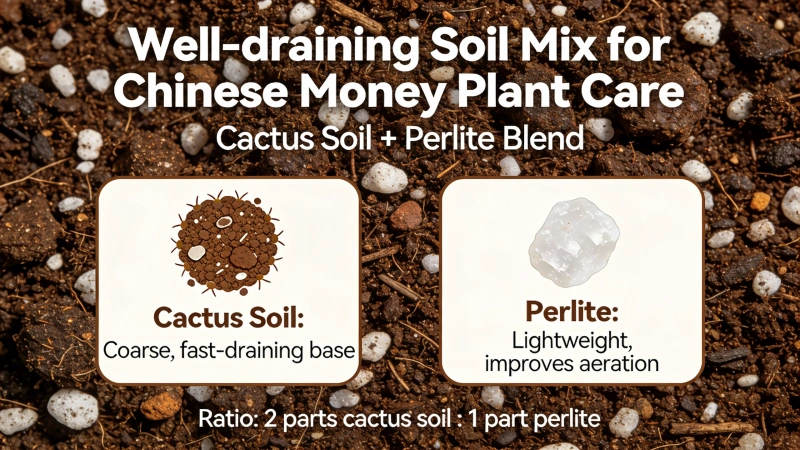
Pilea doesn’t need an extreme cactus-style mix with half perlite. A good indoor potting mix that holds a little moisture while draining the excess works well. If yours is dense or slow to drain, loosen it with an airy amendment such as perlite or fine bark, and adjust the balance to your conditions instead of treating any single recipe as mandatory.
Pot material and size
| Pot type | Helpful characteristic | Watch for |
|---|---|---|
| Unglazed terracotta | Porous walls can help the mix dry faster | May need more frequent checks in dry rooms |
| Plastic nursery pot | Lightweight; moisture usually lasts longer | Overwatering in dense mix, or when left in a water-filled cachepot |
| Glazed ceramic with holes | Decorative and stable | Drainage and pot weight matter more than appearance |
| Decorative pot without holes | Fine as an outer cover for a draining nursery pot | Standing water hidden inside |
Repot when the roots are crowded, water runs straight through the root ball, or the mix has broken down. Choose a container only modestly larger than the root mass. If the plant is healthy and still has room to grow, repotting just because a year has passed isn’t necessary.
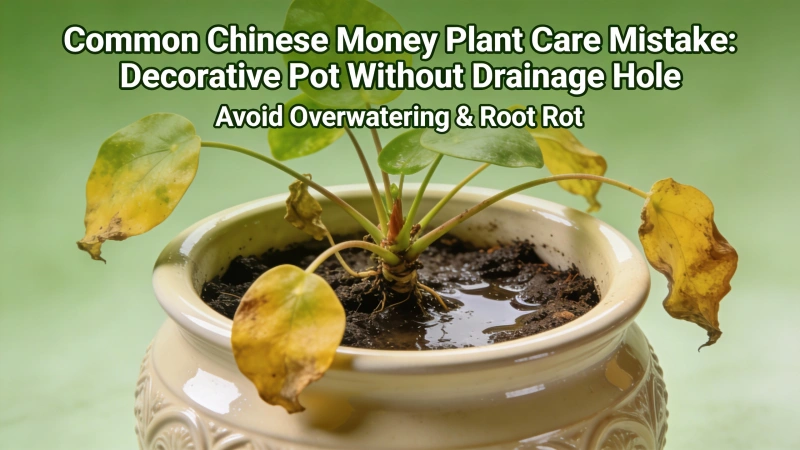
To judge whether a pot is too big, look at the roots and how much unused mix surrounds them, not just at the foliage. A large volume of mix around a small root system often dries slowly.
Temperature, Humidity, Fertilizer and Routine Maintenance
Temperature and humidity
Keep Pilea away from cold window drafts and from blasts of air from radiators or air-conditioning vents. Temperatures below about 50°F (10°C) are best avoided. Average household humidity is often adequate, and a humidifier isn’t mandatory for every plant.
If leaf edges dry out, check soil moisture, nearby heat sources, and root condition before blaming humidity. Pilea can lose moisture through its leaves, but humidity won’t fix the problem if the real cause is excess water around the roots.
Fertilizer
Feed modestly while the plant is actively growing, following the label directions on a balanced houseplant fertilizer. For a more conservative approach, start with a weak solution at longer intervals and see how new growth responds. Skip fertilizer if you suspect root damage. A white crust on the soil or scorched leaf tips is a reason to review your fertilizer use and water quality, not to increase the dose.
Leaf cleaning and rotation
Wipe dust from the leaves with a damp cloth when needed. Turn the pot periodically so the stem stays upright as it grows toward the light. Normal aging can leave the lower stem bare over time, which doesn’t automatically mean disease.
Why Are My Pilea Leaves Curling, Yellow or Drooping?
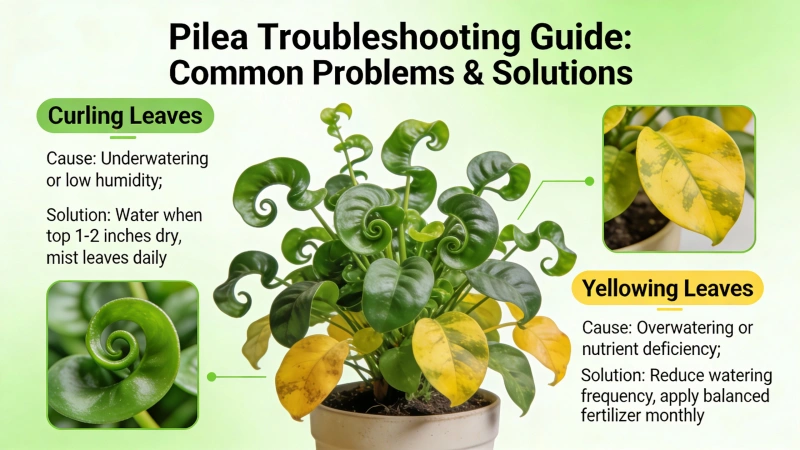
Start with a physical check. Curling is a symptom, not a diagnosis. The Royal Horticultural Society lists too little water, too much water, and inadequate light among the possible causes of curling or puckering leaves, and the direction of the curl, inward or outward, can’t pinpoint the problem on its own.
| Symptom | Possible causes | What to check next |
|---|---|---|
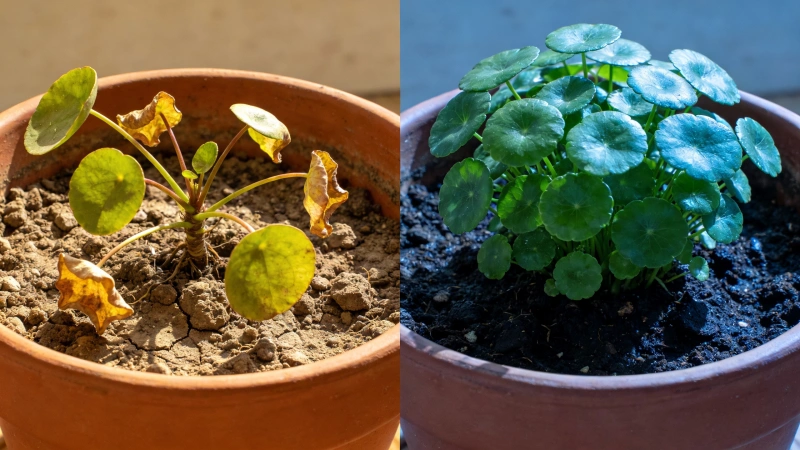
| Leaves curl or cup | Too little or too much water; low light; heat or cold stress | Moisture at root depth; recent temperature or placement changes |
| Bottom leaves turn yellow | Natural aging or excessively wet roots | One old leaf versus several; softness at the base; soil smell |
| Several leaves yellow together | Overwatering, root stress, a light change, nutrient problems or pests | Drainage, root condition, recent changes, signs of insects |
| Leaves droop and mix feels very dry | Insufficient water | Pot weight and how thoroughly water soaks in |
| Leaves droop but soil is wet | Stressed, oxygen-deprived or decaying roots | Drainage, root firmness, odor; don’t add water automatically |
| Brown, dry patches facing a window | Possible sun scorch | Intensity of direct sun; whether the plant was recently moved |
| Long bare stem and small new leaves | Low light, or simply age | Light availability and where new growth forms |
| Tiny pale speckles with moving mites | Spider mites | Leaf undersides, hand lens, white paper test |
How to diagnose yellow leaves in three minutes
- Count the affected leaves. One old lower leaf may just be reaching the end of its life. Several yellowing leaves, or a soft stem base, deserve closer attention.
- Check the mix, drainage and smell. Damp isn’t automatically bad, but mix that stays saturated, poorly aerated or foul-smelling is more concerning.
- Inspect both sides of a leaf. Look for insects, sticky residue, webbing or spreading lesions. If the symptoms began after you moved the plant, consider light or temperature shock.
For yellow-leaf diagnosis across other houseplants, see our complete yellow houseplant leaves troubleshooting guide and the Yellow Leaves topic hub.
What if you suspect root rot?
If the mix has stayed waterlogged, the stem base is soft, or the plant is collapsing, slide it out of the pot and look at the roots. Healthy roots generally feel firm, while dead or rotted roots may be soft and break apart. Cut away clearly decayed tissue with clean tools, discard the suspect old mix, and repot into an appropriately sized pot with drainage, using fresh, suitable mix. How much to water afterward depends on how much living root remains and how moist the new mix is, not on an arbitrary two-week drought rule.
The separate root rot treatment walkthrough covers the process in more detail. If the whole plant is badly damaged, our guide on how to save a struggling plant can help you prioritize what to inspect.
Are White Spots on Pilea Leaves Normal, or Are They Pests?
According to the RHS, small pale or whitish deposits on the underside of a Pilea leaf can be harmless mineral deposits or guttation residue. Not every white mark is harmless, though, so look closely before dismissing it.
| Appearance | Possible explanation | Next action |
|---|---|---|
| Tiny fixed whitish deposits; leaf otherwise healthy | Minerals or guttation residue | Monitor, and wipe gently if needed |
| White cottony clusters at stems or leaf joints | Mealybugs | Isolate the plant, confirm the pest, and use appropriately labeled controls |
| Pale speckling with tiny moving points, sometimes fine webbing | Spider mites | Try a white paper test and inspect leaf undersides |
| Expanding pale or brown patches with soft lesions | Possible leaf-spot problem or other injury | Remove heavily affected foliage if appropriate; improve conditions; diagnose before spraying |
If mites are confirmed, follow our spider mite identification and treatment guide. If tiny flies hover above chronically wet mix, see how to identify and manage fungus gnats in potting soil. White spots alone aren’t enough to diagnose either pest.
A filter pitcher won’t fix every leaf spot. The marks may not come from water minerals at all, and pitcher filters differ in what they remove. Identify the symptom first, then deal with the likely cause.
How to Propagate Chinese Money Plant Pups Step by Step
A healthy, mature Pilea peperomioides may form small offsets (“pups”) around the base. These are new growing points attached to the parent by underground stems or roots. Separating a pup that already has roots is usually the most straightforward way to make another plant.
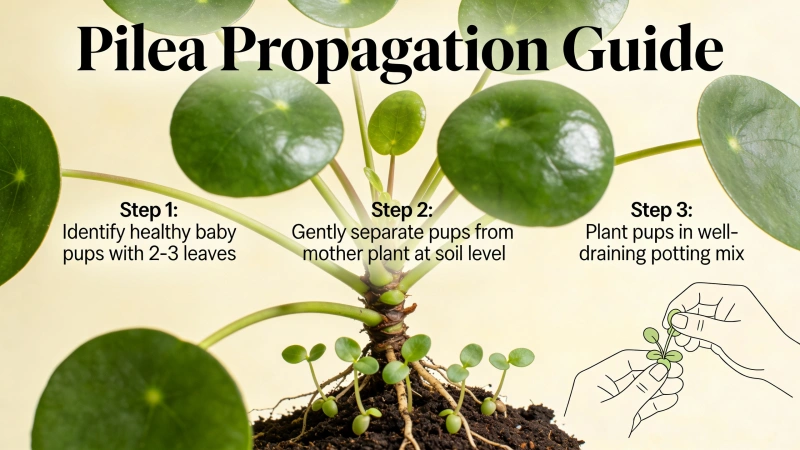
Before separating: the root check
Gently loosen the surface mix and inspect where the baby joins the parent. An offset with several healthy leaves and its own roots is a stronger candidate than a tiny shoot with none. Size varies, so a rigid two-inch cutoff is less useful than looking for roots and healthy growth.
Method A: Separate a pup that already has roots
- If the mix is extremely dry, water beforehand so the roots are less brittle. If possible, do this while the plant is actively growing.
- Loosen the mix gently and trace the underground stem connecting the pup to the parent.
- Use a clean knife or snips to cut the pup free, keeping as many roots attached as possible.
- Pot it in a small pot of fresh, airy potting mix, at roughly the same depth as before.
- Water enough to settle the mix, then let the excess drain. While the pup establishes, keep the mix lightly moist, never saturated.
- Place it in bright, indirect light. Watch for firmness and new growth instead of repeatedly pulling the pup up to check the roots.
Method B: Root a pup with few or no roots
If an offset separates without roots, it may still be possible to root it. Set the base or connecting stem in clean water, keeping the leaf stalks and crown above the surface, or plant it in a lightly moist, airy propagation mix. Keep it in bright, filtered light and watch for rot, then transfer it carefully once it has enough new roots to support itself. Results vary, so treat this as a backup method rather than a sure thing.
Method C: Leaf or stem cuttings
As the RHS notes, a single Pilea leaf can sometimes form roots. But roots on a leaf don’t prove it will produce a new leafy shoot. A cutting is more dependable when it includes viable stem or growing tissue, so for predictable results, stick with rooted offsets. For a broader comparison of propagation methods, see our spider plant propagation guide; spider plants produce their babies on runners rather than from underground offsets like Pilea’s.
| Starting material | Best approach | What to watch |
|---|---|---|
| Pup with established roots | Pot directly in fresh mix | Initial droop; fresh growth as the roots settle |
| Pup without roots | Root cautiously in water or an airy medium | Stem firmness; signs of rot; development of usable roots |
| Mature stem with growing tissue | Appropriate stem cutting technique | Viable nodes or shoots; stable moisture |
| Single detached leaf | Possible experimental rooting | Root development doesn’t guarantee a new plant |
Why Is My Chinese Money Plant Not Producing Babies?
The absence of pups doesn’t automatically mean something is wrong. Age, plant health, light, season, and growing conditions all influence when offsets appear. A small plant still establishing its roots may put its energy into its own foliage first.
Work through this checklist instead of fertilizing or repotting every few weeks:
Check before trying to force new pups
- Is the main plant producing reasonably healthy new leaves?
- Does it receive enough bright, indirect light?
- Is the potting mix loose and draining, without chronic sogginess?
- Have you allowed the plant time to establish in its current pot?
- Is it an active growing period, with adequate warmth?
- Have you avoided excessive feeding, pruning and unnecessary repotting?
If most answers are yes, wait and keep watching. No one can reliably promise a set number of pups within a set number of months, so be skeptical of claims that every Pilea will produce six or eight offsets on schedule.
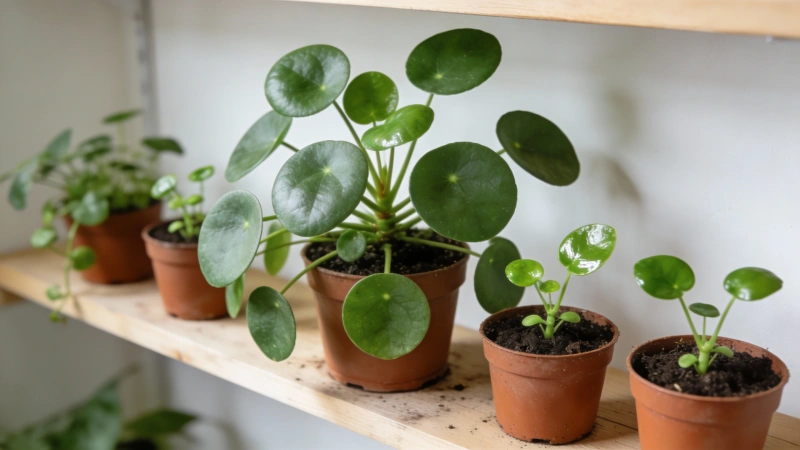
30-Day Pilea Care Tracker: See What Actually Changes
If you change light, watering, potting mix, fertilizer, and humidity all on the same day, it’s almost impossible to tell which change helped. This simple record lets you adjust one meaningful factor at a time, unless the problem is urgent, such as a collapsing stem.
| When | Check / action | What to record |
|---|---|---|
| Day 0 | Photograph the top and underside of 3 leaves; inspect the mix and pot drainage | Number of yellow leaves, type of curl, pot weight, recent moves |
| Day 3–4 | Check the upper mix and look for new symptoms; don’t water automatically | Soil moisture; any drooping or fresh spots |
| Day 7 | Take photos from the same angle; rotate the pot when watering if appropriate | Changes in leaf firmness and new growth |
| Day 14 | Compare leaves and examine the undersides for pests | New injury versus old marks; pest activity |
| Day 21 | Review whether the last care change helped | How the root zone is drying; what new leaves look like |
| Day 30 | Assess growth and adjust one variable if needed | Overall direction, not just one damaged leaf |
Yellow or scorched leaves may never turn green again, so judge progress by new growth, stem stability, and how quickly fresh damage appears. The tracker is a way to monitor the plant, not a promise of recovery within 30 days.
Copy into your plant-care notes
- Date, plant location and pot type
- Top soil moisture: wet / damp / dry
- Pot weight: heavy / medium / light
- Leaves curling, yellowing or dropping: number affected
- Live pests seen: yes / no / uncertain
- Watered today: yes / no
- One care adjustment made, and the date
- New leaf or pup growth observed
Is a Chinese Money Plant Safe for Cats and Dogs?
Pilea peperomioides is generally considered non-toxic to cats and dogs, and NC State Extension describes it as suitable for homes with pets and children. Even so, keep it away from pets that habitually chew foliage, since plant material can cause digestive upset even without a specific toxin.
If pet safety is a big factor in choosing plants, note that the snake plant, by comparison, is toxic to cats and dogs when ingested.
Frequently Asked Questions About Chinese Money Plant Care
How often should I water a Chinese money plant?
There’s no reliable fixed interval. Check whether the top inch or so (a few centimeters) of mix has started to dry, and if the root zone is ready, water thoroughly and let the excess drain. How often that happens depends on light, season, humidity, pot size and pot material.
Why are my Pilea leaves curling inward or outward?
Both shapes can occur with different kinds of stress. Check water availability, drainage, light and temperature rather than diagnosing from the curl direction alone. If the mix is wet and the leaves are soft, look into root health before adding water.
Why are the bottom leaves on my Pilea turning yellow?
An occasional older lower leaf may yellow naturally. Several yellow leaves, a soft stem base, an unpleasant odor or continuously wet mix suggest an environmental or root problem. The pattern, texture and growing conditions tell you more than the color alone.
Why does my Chinese money plant have tiny white dots?
Small underside deposits may be minerals or guttation residue. Cottony clusters can indicate mealybugs, while stippling with tiny moving mites suggests spider mites. Look closely before deciding the spots are harmless.
Can you propagate Chinese money plant from one leaf?
A leaf can sometimes develop roots, but that doesn’t guarantee a new shoot or a complete plant. Rooted offsets, or cuttings with viable growing tissue, are more dependable.
When should I separate Pilea pups?
Once they’re strong enough to grow on their own, ideally with several leaves and some attached roots. Spring or early summer is convenient because plants are usually actively growing, but root development matters more than size.
Why is my Pilea not growing pups?
It may still be immature or settling in. Review light, new growth, watering and season, then give it time. Don’t try to force pups with heavy feeding or frequent repotting.
Does my Chinese money plant need a terracotta pot?
No. Terracotta can help the mix dry faster, but plastic and glazed pots also work as long as drainage and watering are managed. A drainage hole and a suitable mix matter more than pot material.
Can Pilea tolerate low light?
It may survive in a dimmer room, but low light commonly leads to stretched or uneven growth. Bright, indirect light is the better target for compact foliage and vigorous growth.
Do I need to mist my Chinese money plant?
Not routinely. Normal household humidity often works well. Misting doesn’t fix a dry root zone, poor drainage or a cold draft, and repeatedly wetting the leaves may encourage leaf problems.
Final Takeaways: Care for the Plant in Front of You
A reliable Pilea routine comes down to bright, indirect light, an airy but moisture-retentive mix, good drainage, watering based on the soil, and patient propagation from healthy offsets. The harder skill is telling a leaf that signals a real problem from one that is simply aging.
Use the 30-day tracker rather than changing five things at once. And if your plant is healthy but hasn’t produced pups yet, give it time. A thriving parent plant is a better foundation for propagation than a stressed one.
Our Plant Care Guides library has more indoor foliage advice and related plant profiles.
References and Further Reading
- Royal Horticultural Society: How to Grow Pilea — light, watering, rotation, propagation and troubleshooting.
- NC State Extension: Chinese Money Plant — plant identification, conditions, pests and pet safety.
- Penn State Extension: Pilea as a Houseplant — potting, indoor pests and propagation.
- Royal Horticultural Society: Pilea Plant Guide — general genus care and growing conditions.
Editorial Note: This article was written and edited by Spring Mei. AI tools may be used to assist with research and organizing information. The final content is reviewed before publication, and important factual claims are checked against reliable sources where appropriate. Personal experience is distinguished from general guidance, and methods are described as personally tested only when they have actually been tested.
Please indicate the source when reposting:https://gardeningtoolsgarden.com/how-to-care-for-a-chinese-money-plant/
Author: Spring Mei