Snake plant leaves turning yellow? Check where the yellowing starts, whether the tissue feels firm or mushy, and how wet the potting mix is before changing anything. A soft yellow leaf at the base of the plant needs a different response from a firm older leaf, a sun-bleached patch, or the natural gold margin on a variegated snake plant.
This diagnosis-first guide focuses on why a Dracaena trifasciata (formerly Sansevieria trifasciata) turns yellow and what to do next. It includes a practical symptom chart, a decision path for inspecting roots, instructions for managing suspected rot, and a 30-day recovery tracker. For normal light, feeding and propagation care, see our separate complete snake plant care guide.
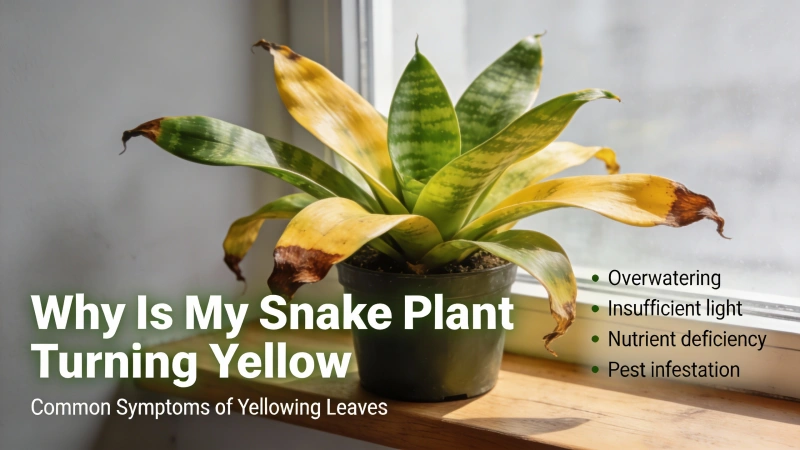
Quick answer: Why is my snake plant turning yellow? Excess moisture and poor drainage are important possibilities, especially when yellowing begins at a soft or darkened leaf base. But dry, wrinkled leaves may signal drought; a pale patch on the sun-facing side suggests sunscald; sudden yellowing after a cold draft suggests chilling; and one aging outer leaf can be normal. Check the root zone and leaf texture before watering, fertilizing, pruning or repotting.
Urgent sign: If several leaves are collapsing at the base, the plant feels loose in the pot, or you find slimy roots and an unpleasant odor, inspect the root system promptly. Waiting for a potentially rotting crown to “dry out on its own” can allow damage to advance.
The 3-Minute Snake Plant Yellow Leaf Diagnosis
Yellowing can be caused by more than one condition at the same time. For example, insufficient light slows water use, and an oversized pot may hold moisture longer. The most reliable first step is to collect three observations rather than guess from color alone.
- Look at the location: Is the yellowing at the leaf base near the soil, on the oldest outside leaf, at the tip, on a sun-facing side, or scattered as tiny pale dots?
- Check the texture: Is the leaf upright and firm, limp but dry, wrinkled, translucent, or soft and mushy where it meets the rhizome?
- Check moisture below the surface: Insert a clean wooden skewer toward the bottom of the root zone and inspect it for damp mix. Check that the pot has a drainage hole and isn’t holding runoff inside a decorative container. Compare with the pot’s weight if you know how it feels when dry.
Then choose the matching path:
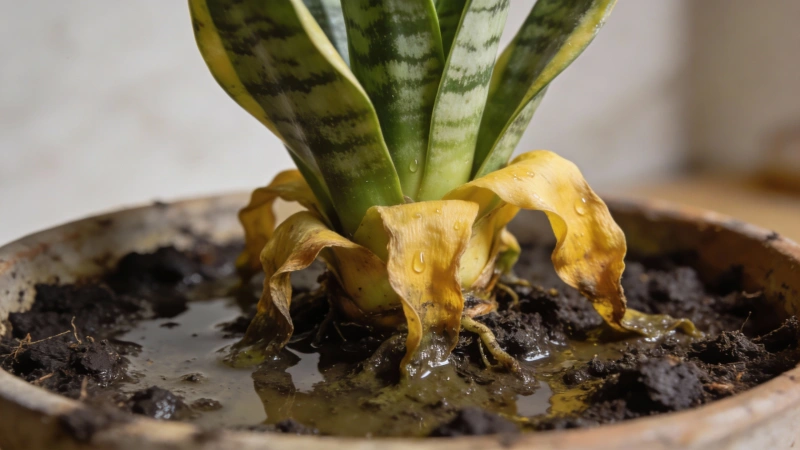
Yellow and mushy at the base, with wet soil
High concern for root or crown problems. Remove the plant from standing water; assess whether the rhizome or roots are soft. If the base is collapsing or there is a bad smell, proceed to the root inspection section rather than just waiting another week to water.
Wrinkled or folding leaves, with dry soil throughout
Consider underwatering. Confirm that the potting mix is dry at root depth and that the roots are reasonably healthy. If it is simply dry, water thoroughly and let the pot drain; monitor remaining foliage rather than expecting a fully yellow leaf to turn green.
Firm leaf with a pale sun-facing patch
Check whether you recently moved the plant closer to a bright south- or west-facing window. Sunscald often affects exposed tissue; adjust the light gradually and watch for new damage, not recovery of the existing dry patch.
Only one older, outer leaf is turning yellow
Natural leaf senescence is possible if the rest of the plant is firm, roots are healthy and new growth is unaffected. Watch for progression before unpotting a healthy plant unnecessarily.
Snake Plant Yellow Leaves: What the Pattern Tells You
This chart is designed for actual troubleshooting, not a claim that any one leaf color proves one disease. Always combine the visual clue with a moisture, temperature or pest check.
| Yellowing pattern | Likely possibilities | Check before acting | First response |
|---|---|---|---|
| Yellow from the bottom; base feels soft | Excess moisture, root or crown decay | Drainage, firm versus mushy rhizome, root texture | Inspect if soft/collapsing; don’t add more water |
| Yellow from the bottom; firm outer leaf | Older leaf aging, or environmental stress | Does yellowing stay on one oldest leaf? Is rest healthy? | Observe before cutting or repotting |
| Yellow and dry or crispy; leaves wrinkled | Prolonged drought, dry damage, sometimes sun or cold exposure | Root-zone dryness, light and recent temperature changes | Correct the confirmed cause; water if truly dry |
| Yellow patch on one window-facing side | Sunscald, especially after sudden exposure | Direct sunlight pattern, recent movement | Acclimate more gradually to intense light |
| Many leaves yellow suddenly | Cold shock, waterlogged roots or another abrupt stress | Cold window, recent drafts, damp pot, recent move | Stabilize conditions; inspect base if soft |
| Tiny pale specks or stippling | Spider mites or other feeding pests | Leaf undersides, moving dots, fine webbing | Confirm pest before treating |
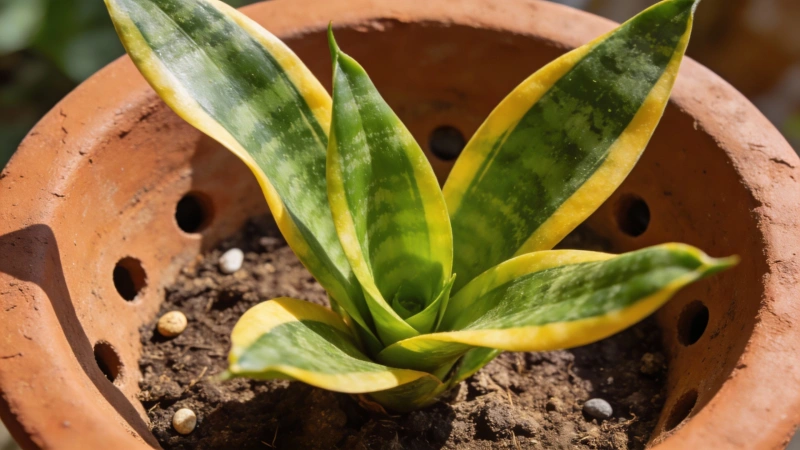
| Yellow margins on a healthy ‘Laurentii’ | Normal variegation | Even, stable yellow bands on firm leaves | No treatment needed |
| Yellow tips with crusty soil or burned edges | Salt accumulation, fertilizer excess, past stress | Recent fertilizer, pot drainage, dry leaf edges | Correct feeding or water issues after checking roots |
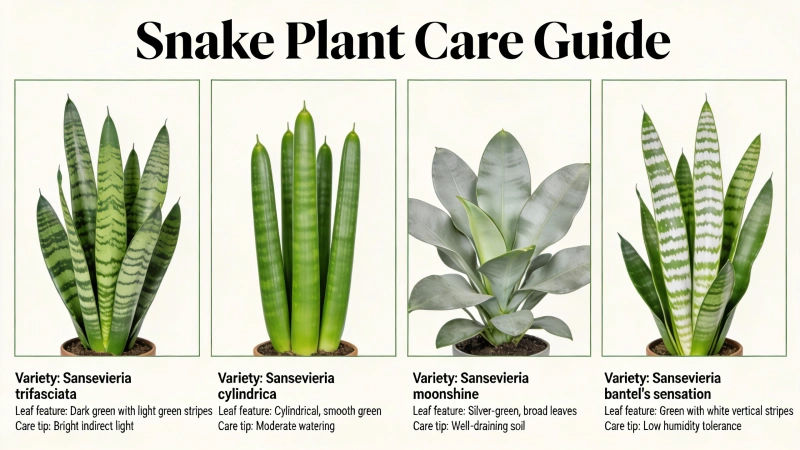
Don’t mistake normal variegation for disease. On ‘Laurentii’ and other yellow-edged snake plants, the gold striping is part of the cultivar’s appearance. New, irregular yellow patches or tissue that becomes soft and collapses are different. A yellow leaf tip is also not the same symptom as a yellow, mushy base.
9 Reasons Snake Plant Leaves Turn Yellow
1. The potting mix stays wet for too long
Snake plants tolerate dry periods because their thick leaves and rhizomes store water. Roots still need oxygen. Waterlogged media, a sealed outer pot, a very large pot, or low-light conditions can keep the root zone damp for longer than the plant can tolerate. Yellowing, reduced vigor and leaf drop can follow even before obvious rot is visible.
Check: Is water collecting inside the outer planter? Does the pot have working drainage holes? Does a deep skewer stay wet while the top inch looks dry? Have you continued the same watering schedule after moving the plant into less light?
What to do: Empty standing water and pause irrigation while assessing the root zone. If the roots and base are firm, correct the drainage problem and resume watering based on actual dry-down. If the base is soft or the plant is collapsing, move to the root inspection steps below.
2. Root rot or crown rot has already begun
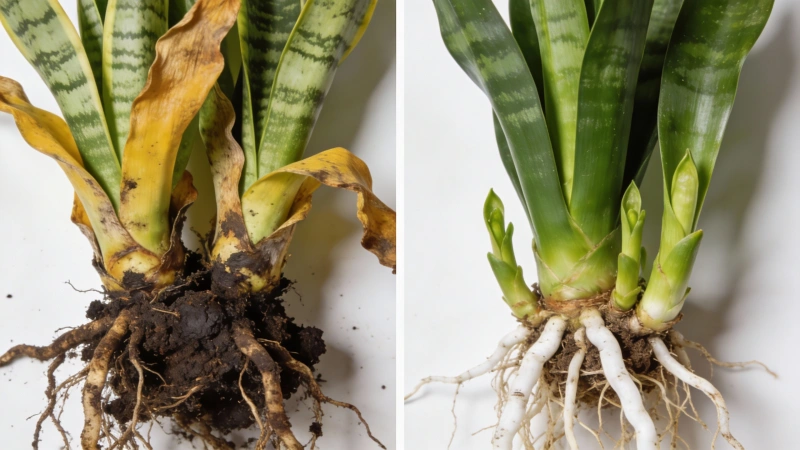
Root and crown rot are more serious than simply having damp soil. Some disease organisms thrive in excess moisture; prolonged oxygen deprivation can also damage roots. Affected roots may be soft, disintegrating or missing their outer tissue, while the base of a snake plant leaf or its underground rhizome can become dark, translucent or mushy.
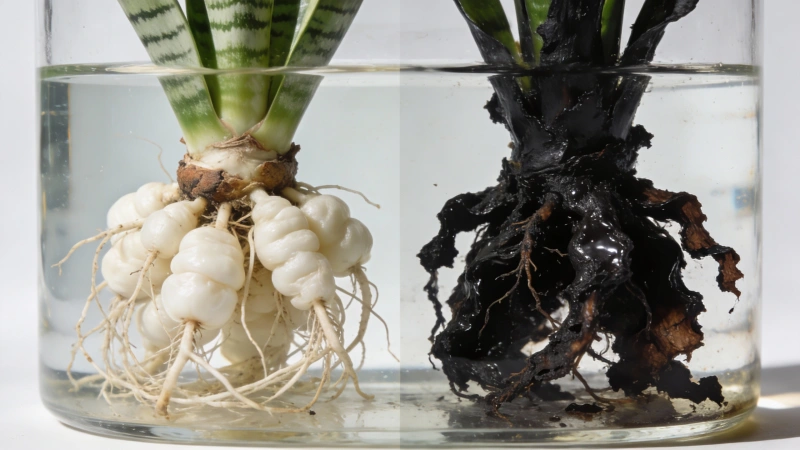
Check: A bad smell, a leaf detaching easily from a rotten base, or a plant that wobbles because its root system has deteriorated are reasons to unpot and inspect. Do not diagnose from dark root color alone, because healthy snake plant roots may be cream, tan or orange-brown; firmness and integrity matter.
What to do: Separate clearly decayed material from healthy firm tissue and correct the environment. Use our step-by-step houseplant root rot treatment for the more detailed rescue workflow. Root rot is not reliably cured by a universal homemade hydrogen-peroxide soak or a fixed two-week drought.
3. Prolonged underwatering or poorly rewetting soil
Snake plants are drought-tolerant, not drought-proof. After a very long dry period, foliage may wrinkle, fold inward, lose firmness and eventually yellow or dry at the tips. Some peat-based mixes become hard to wet after drying extensively, allowing a quick watering to run down the sides of the pot without moistening the root ball.
Check: Does the pot feel unusually light? Is the mix dry well below the surface? Does water pass through immediately while the center remains dry? Are leaves wrinkled rather than mushy at the base?
What to do: If the roots are sound, rehydrate the potting mix evenly with room-temperature water and allow it to drain. Do not compensate by leaving the pot permanently submerged. Monitor texture in still-green leaves; a completely yellow or dead leaf is unlikely to regain its original color.
4. Sudden exposure to intense direct sunlight
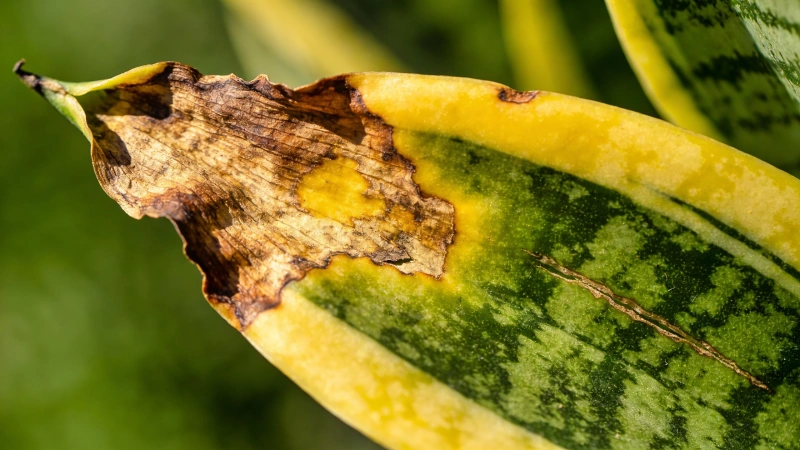
Snake plants can grow with some direct sunlight, particularly once acclimated, and North Carolina State Extension notes their broad light tolerance. Problems occur when a plant grown in shade is abruptly moved into strong sunlight. Exposed tissue can become bleached, yellow or dry and brown.
Check: Is damage concentrated on leaves facing the window or patio? Did the problem begin soon after a change in placement? Is the injured tissue dry rather than mushy?
What to do: Use a sheer curtain, move slightly away from intense afternoon exposure, or gradually acclimate the plant if brighter light is desired. Old scorched patches do not heal; assess whether new foliage stays healthy.
5. Too little usable light
“Low-light tolerant” does not mean a snake plant can thrive in a windowless room without artificial lighting. Lower light slows photosynthesis and water use. The result may be almost no new growth, weaker foliage and an increased risk that soil stays damp for too long. Low light alone cannot be confidently diagnosed from one yellow leaf.
Check: Is the plant several rooms away from the nearest window? Is it receiving only brief overhead lighting? Does the soil take much longer to dry since the plant was moved?
What to do: Relocate it gradually to a brighter position with indirect light, or provide a suitable grow light if natural light is inadequate. Reduce watering frequency as needed by moisture observations, not by an arbitrary winter schedule.
6. Cold drafts and sudden temperature changes
Tropical snake plants do not tolerate freezing and may develop yellow or water-soaked damaged areas after chilling, especially if the pot is also wet. A sudden cold exposure can affect several leaves at once, creating a different pattern from the slow yellowing of a single older leaf.
Check: Is foliage pressed against cold winter glass, exposed to an exterior door, or beneath direct air-conditioning airflow? Did the yellowing begin after a cold night or a relocation?
What to do: Provide a stable, comfortably warm position and avoid cold drafts. Keep severely damaged tissue dry and watch for softening. If the crown turns mushy, inspect for rot rather than assuming it is only cold scorch.
7. Fertilizer salts and root stress
Snake plants are not heavy feeders. Excess fertilizer or mineral buildup in a pot can injure roots, and damaged roots may cause tip burn, pale foliage or leaf decline. Nutrient deficiency is possible but should not be your first assumption when the plant is already growing in wet soil or has damaged roots.
Check: Have you fertilized repeatedly at full concentration? Is there a white crust on the mix or pot rim? Are roots firm? Does the container drain properly? Have you recently used softened water that may contain additional sodium?
What to do: Stop unnecessary feeding. If the plant has healthy roots and an adequately draining pot, address accumulated salts with appropriate clean-water irrigation or repotting when needed. Do not flush a severely rotted plant with more water. Only consider nutrient corrections after moisture, drainage, light and root health are assessed.
8. Spider mites, mealybugs or physical leaf damage
Small pale dots can merge into a yellowish appearance. Spider mites may leave stippling and sometimes fine webbing, while mealybugs resemble white cottony clusters near leaf joints. Damaged foliage can also result from friction, bumps or past handling rather than a spreading disease.
Check: Use a flashlight and examine both sides of leaves. Tap a suspicious leaf over white paper and watch for moving tiny specks. Look for cottony material or other identifiable insects. Are marks restricted to one area that was physically bent?
What to do: Identify the actual pest first. Our spider mite identification and treatment guide provides a targeted approach; avoid putting arbitrary detergent or oil mixtures on an already stressed leaf.
9. Normal aging or naturally yellow variegation
Occasional loss of an older outer leaf is part of plant aging. The important distinction is whether one older leaf gradually yellows while the rest stays firm, or whether multiple leaves suddenly soften, discolor or collapse. Similarly, the yellow edges of a cultivar such as ‘Laurentii’ are intentional coloration, not a deficiency that needs fertilizer.
Check: Are only the oldest outer leaves affected? Are new shoots firm? Is the root zone healthy? Does the yellow band have a stable, symmetrical pattern typical of the cultivar?
What to do: Observe rather than immediately repotting or applying chemicals. A fully dead outer leaf can be removed cleanly; normal variegated tissue should be left alone.
How to Check Snake Plant Roots Without Damaging Them
You do not need to unpot every snake plant with one yellow leaf. Root inspection is most useful when the leaf bases are soft, a sour smell is present, the plant is unstable, or the media stays wet along with progressive yellowing.
- Protect the work area and gently slide the root ball out of the container. Squeeze a flexible nursery pot if necessary rather than pulling hard on leaves.
- Brush away enough loose mix to view the roots and rhizome. You do not need to strip or wash every healthy root clean to make a diagnosis.
- Firm, intact roots and rhizomes: often indicate viable tissue. Their exact color can vary with age and potting medium.
- Soft, sloughing, hollow or foul-smelling roots: indicate dead or decayed tissue. A soft or discolored rhizome is especially concerning because it can compromise several leaves at once.
- Choose the least disruptive correction that fits what you found. A firm healthy root ball in a poorly draining pot may need a better container and watering routine, while a decaying rhizome needs a rescue decision.
Root rot can arise in saturated conditions and may involve soil-borne organisms. Wisconsin Horticulture notes that accurately identifying a specific pathogen may require expert diagnosis; treating an unknown disease with a random fungicide is not appropriate.
Important distinction: Excess moisture does not automatically mean every root is infected, and a brown-colored root is not automatically rotten. Conversely, waiting for all roots to turn black before responding to a collapsing crown can be too late. Use texture, integrity, odor, and symptoms together.
How to Save a Snake Plant with Yellow, Mushy Leaves
If inspection confirms significant decayed roots or a soft leaf base, act on the damaged tissue and the growing conditions. This is an adaptable rescue process, not a guaranteed survival formula.
- Isolate and evaluate: move the plant away from other pots while you work. Determine whether the underground rhizome and at least some roots or growing points remain firm.
- Remove visibly dead tissue: use clean, sharp pruners to cut away soft, collapsing or rotting sections. Avoid removing firm healthy roots just because they are tan or brown. Clean tools between diseased cuts.
- Assess the remaining plant: if the rhizome is completely mushy, recovery of that portion may be impossible. If a separate firm rhizome division is present, it may be possible to save it without the diseased portion.
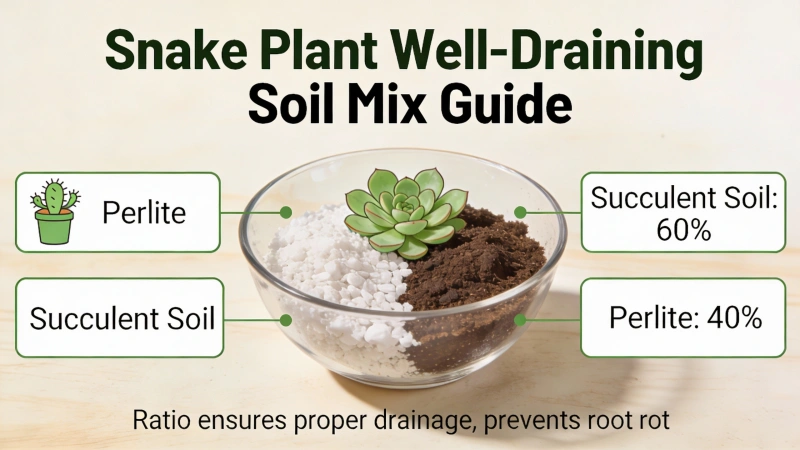
- Correct the pot and mix: use a clean pot with drainage and an airy, well-drained mix appropriate for a drought-tolerant plant. Choose a pot proportionate to the reduced root system; do not leave the plant sitting in water inside a cachepot.
- Provide stable conditions: place the plant in bright, indirect light with comfortable temperatures. Avoid harsh sun, heavy fertilizer, and repeated unnecessary disturbance during recovery.
- Manage moisture based on the plant and mix: if fresh roots are present and the mix needs moisture, water appropriately and drain it; if there are substantial fresh cuts or few roots, be more conservative and monitor carefully. There is no evidence-based universal rule to withhold all water for exactly 14 days or add a fixed fraction of a cup later.
- Monitor the right signs: check whether surviving leaves remain firm, further bases soften, or new growth appears. Yellowed or previously damaged tissue may remain discolored even after the underlying problem is controlled.
For a more complete general rescue workflow, including when to consider propagation as a backup, see how to save a dying houseplant. You can also browse our root rot topic hub for related articles.
What about hydrogen peroxide or cinnamon? The original version of this article included no reliable species-specific evidence that a standard homemade soak or cinnamon dusting cures established snake plant root rot. Those are not required steps here. Prioritize removing clearly decayed material, correcting drainage, and providing suitable recovery conditions.
Should You Cut Off Yellow Snake Plant Leaves?
Fully yellow, dry, or rotting leaves will not become fresh green leaves again. But you don’t need to cut every leaf with a small yellow area. The decision depends on how much healthy tissue remains and whether the base is decaying.
- Remove promptly: tissue that is black, mushy, collapsing or clearly decayed at the base, especially if it threatens adjacent growth.
- Optional cosmetic removal: a fully yellow or brown outer leaf that is dry and no longer useful to the plant.
- Usually leave for now: a mostly firm green leaf with a small dry patch. It can still contribute to the plant while the cause is corrected.
- Never remove: healthy yellow variegated edges simply because they are yellow.
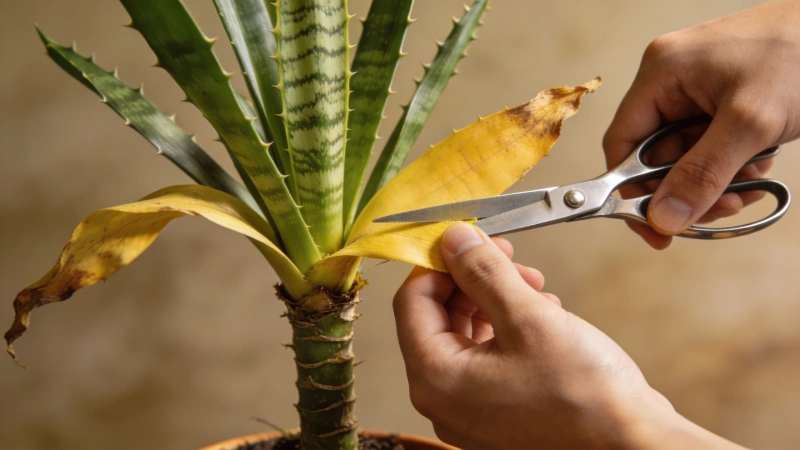
Use clean, sharp pruners and cut the unwanted leaf near its base without damaging nearby healthy rhizomes or leaves. Discard soft, rotting material rather than placing it on the potting surface. Removing a leaf will not by itself fix the water, light or root problem that caused the discoloration.
How to Keep Your Snake Plant from Turning Yellow Again
Check moisture at root depth, not just the soil surface
A finger test in the upper inch can be misleading in a deep pot. For snake plants, allow the potting mix to dry sufficiently through the root zone between waterings, then water thoroughly and let excess water leave the container. A wooden skewer and learned pot-weight comparison are more informative than a fixed once-a-week reminder.
Fix hidden drainage problems
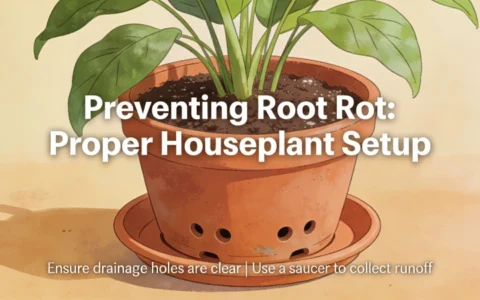
The drainage hole must not be blocked, and runoff should never remain around the inner nursery pot. Terracotta may dry faster than plastic, but neither material can compensate for stagnant water trapped in a decorative outer pot. Mix quality and plant size matter too.
Match watering to light and temperature
When you move the plant to a darker spot, it usually consumes water more slowly. Near a cold window in winter, damp potting mix can persist longer and foliage is at risk of chilling. Do not use the same watering interval automatically after moving the plant or when seasonal conditions change.
Look for pest clues without immediately spraying
Every few weeks, inspect leaf undersides and the base of new shoots. If you see tiny flies emerging from damp mix, they may be fungus gnats rather than a cause of leaf yellowing; they can nevertheless be a useful clue that conditions remain moist. Our fungus gnat troubleshooting guide explains the separate pest problem.
Use plant-specific advice rather than generic Dracaena assumptions
Snake plants are classified within Dracaena, but their succulent-style watering needs differ from those of many broad-leaved Dracaena houseplants. If you grow more than one species, compare our Dracaena plant care guide before copying a watering rule across different plants.
30-Day Snake Plant Recovery Tracker
A photo of the same marked leaf and a short moisture record are often more valuable than guessing how much the plant has improved. This log is for observations, not mandatory pesticide or watering dates.
| Check | What to examine | What counts as progress |
|---|---|---|
| Day 0 | Photograph affected leaves; record wet/dry status at root depth; inspect base and roots if indicated | You have a baseline and a plausible diagnosis, rather than an unexplained treatment |
| Day 3–4 | Check for newly soft bases, additional yellowing and trapped runoff | No new collapse; moisture conditions improving appropriately |
| Day 7 | Compare the same leaves; observe surviving growth and any new pest signs | Stable firm tissue; no new damage |
| Day 14 | Review conditions and roots only if symptoms continue; do not unpot repeatedly without reason | Progressive yellowing has stopped or slowed |
| Day 30 | Compare photos; check healthy new growth and stability of remaining leaves | No continuing softening and, where conditions allow, signs of renewed growth |
Copy this one-minute inspection checklist
- Date and plant cultivar (if known)
- Which leaf changed: outer / center / several / sun-facing
- Leaf texture: firm / wrinkled / crispy / mushy
- Root-zone moisture: dry / slightly damp / wet
- Base and roots checked? If so: firm / soft / uncertain
- Recent changes: window / cold draft / watering / fertilizer / repotting
- Action taken and next inspection date
What if the plant is not improving? Reconsider the diagnosis. A plant with persistent yellowing and firm roots may be reacting to light, temperature or another stressor; a plant with continuing softening needs a renewed assessment for decay. Take photos and consult a local university Extension service when the cause is uncertain.
Frequently Asked Questions About Yellow Snake Plant Leaves
Why is my snake plant turning yellow at the base?
A soft yellow base, especially with wet mix, suggests excess moisture or crown/root rot. If the base is firm and only one of the oldest outer leaves is yellow, normal aging remains possible. Check the root zone and base texture before deciding to water or unpot.
Why is my snake plant turning yellow and soft?
Soft, translucent or mushy yellow tissue is more concerning than dry, cosmetic yellowing. Inspect for standing water and a soft rhizome. If several leaves are collapsing, act promptly to evaluate potential decay rather than following a routine watering schedule.
Why is only one leaf on my snake plant yellow?
One older outer leaf may be reaching the end of its life, particularly if new leaves and the rest of the plant are healthy. Isolated physical injury, sunscald and localized rot can also affect one leaf. Location and texture help distinguish them.
Can a yellow snake plant leaf turn green again?
Fully yellow or necrotic tissue generally does not return to its original healthy green appearance. A partially affected, firm leaf may remain useful, and correctly adjusting conditions can protect new growth. Healthy yellow variegation is normal and should not be “treated.”
Should I water a snake plant with yellow leaves?
Only after determining what is happening in the root zone. If the potting mix is wet and the leaf base is soft, more water can worsen the problem. If the root zone is truly dry and leaves are wrinkled, careful watering may be appropriate. Yellow coloring alone does not determine the answer.
Do I need to repot if my snake plant has one yellow leaf?
Usually not, if the roots, base and other leaves look healthy. Repotting is more justified when the growing medium does not drain, there is evidence of root decay, or the container is inappropriate for the root system.
Can direct sunlight turn snake plant leaves yellow?
Yes. A shade-grown plant abruptly moved into intense sun can develop bleached or dry yellow patches, often on the exposed side. Snake plants can tolerate some direct sun when acclimated, so the recent change in exposure matters.
Is my snake plant dying if several leaves turn yellow?
Not necessarily, but widespread yellowing deserves prompt attention. Check the pot, soil and rhizome before choosing a treatment. Severe rot can make recovery uncertain; healthy firm rhizome sections and intact roots improve the possibility of saving part of the plant.
Is ‘Laurentii’ supposed to have yellow leaves?
‘Laurentii’ normally has distinct yellow or gold margins around green leaf centers. That stable variegation is not a yellowing disease. New irregular yellow patches, soft areas or collapse are reasons to investigate further.
Bottom Line: Diagnose the Yellowing Before You Treat It
Snake plant yellowing is a useful warning sign, but it is not a complete diagnosis. Combine the location of the yellowing, leaf-base texture, and root-zone moisture. Those three observations usually identify the next sensible action: monitor a naturally aging leaf, correct a light or temperature problem, carefully water a drought-stressed plant, or inspect a collapsing base for rot.
For other species-specific problems, visit the yellow leaves resource category or our general houseplant yellowing guide. These resources cover different plants and broader causes, while this article focuses specifically on snake plant symptoms.
Research and Further Reading
This guide is informed by university horticulture and integrated plant-health resources. The advice is intended for general home growing; a specific laboratory pathogen diagnosis cannot be made from leaf color alone.
- NC State Extension Gardener Plant Toolbox: Snake Plant (Dracaena trifasciata) — drought tolerance, drainage, light and pest considerations.
- Missouri Botanical Garden: Why Are the Leaves on My Indoor Plant Yellowing? — multiple possible causes of yellowing, natural leaf aging and environmental stress.
- University of Missouri Extension: Caring for Houseplants — distinguishing watering, temperature and root damage.
- Wisconsin Horticulture: Root and Crown Rots — root pathogens, saturated conditions and diagnosis cautions.
Editorial Note: This article was written and edited by Spring Mei. AI tools may be used to assist with research and organizing information. The final content is reviewed before publication, and important factual claims are checked against reliable sources where appropriate. Personal experience is distinguished from general guidance, and methods are described as personally tested only when they have actually been tested.
Please indicate the source when reposting:https://gardeningtoolsgarden.com/why-is-my-snake-plant-turning-yellow/
Author: Spring Mei