This guide explains how to care for common soil-grown Dracaena types, how to judge watering frequency, and how to diagnose yellow leaves and brown tips. Whether you grow a red-edged Dracaena marginata (dragon tree), a corn plant (Dracaena fragrans), or a variegated cultivar, use the checks below to adjust care to your plant and growing conditions.
Quick answer: How do you care for a Dracaena indoors?
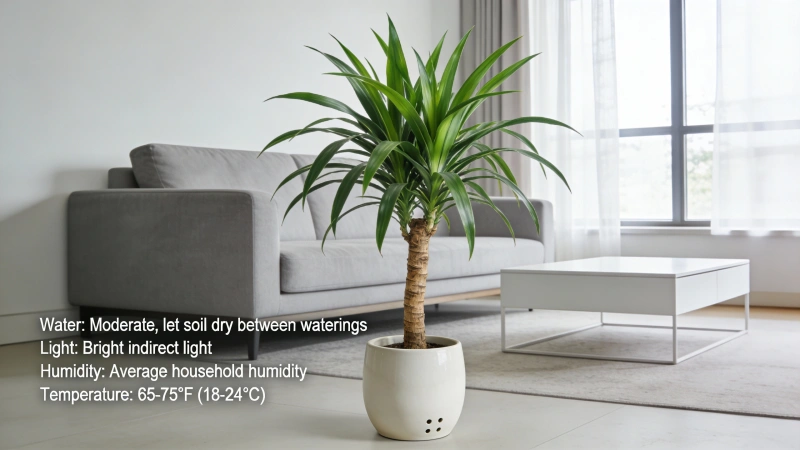
Place your Dracaena in bright, indirect light, use a pot with drainage holes, and water according to soil moisture rather than a fixed calendar. For many soil-grown types, let the upper part of the potting mix dry somewhat before watering thoroughly, then empty the saucer. Keep the plant in a stable, warm room and investigate persistent brown tips by checking moisture, water quality, fertilizer salts, humidity, and root health.
| Care factor | Practical starting point | What to watch |
|---|---|---|
| Light | Bright, indirect light; some species tolerate medium or lower light | Leggy growth and fading variegation signal insufficient light |
| Watering | Check moisture about 1–2 inches (2.5–5 cm) below the surface; adjust to pot size and species | Persistently wet mix or very dry roots both cause stress |
| Water quality | Tap water may work; consider rainwater, distilled water, or tested low-fluoride water if tip burn persists | Brown tips have several causes, not just fluoride |
| Potting mix | Airy indoor potting mix in a container with drainage | Compact, waterlogged mix increases root problems |
| Temperature | Typical warm indoor temperatures, roughly 65–80°F (18–27°C) | Protect from chilling and sudden drafts |
| Fertilizer | Modest feeding during active growth, according to label directions | Excess fertilizer contributes to salt-related tip burn |
| Pets | Keep Dracaena out of reach of cats and dogs | ASPCA lists Dracaena as toxic to both |
1. Identify Your Dracaena: Different Types, Different Expectations
“Dracaena” is a genus, not one single houseplant. Advice that works for a narrow-leaved dragon tree may need adjusting for a broad-leaved corn plant. It helps to identify your plant before interpreting a symptom or changing its care routine.
| Plant sold as | Identification clues | Care implication |
|---|---|---|
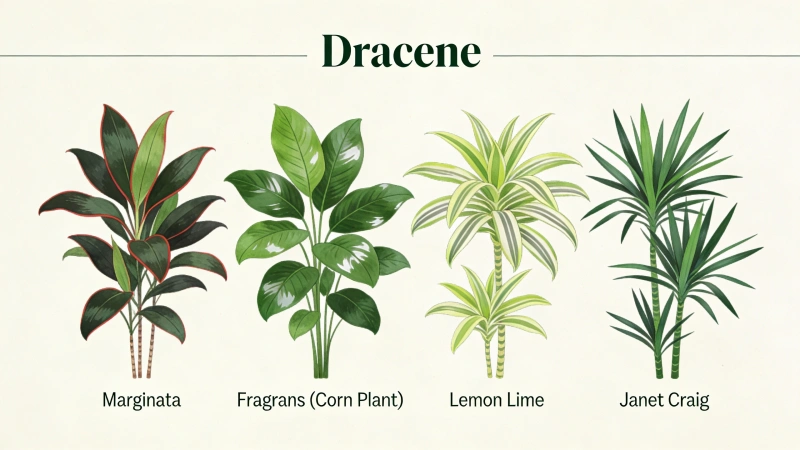
| Dracaena marginata / dragon tree D. reflexa var. angustifolia in some classifications |
Long, thin green leaves, often with red edges, atop slender woody canes | Watch for tip burn, chilling injury, and waterlogged roots |
| Corn plant D. fragrans |
Broader, arching leaves emerging from thick canes; green or striped cultivars | Often grows slowly in low light; avoid persistently soggy potting mix |
| ‘Lemon Lime’ / ‘Janet Craig’ | Variegated yellow-green foliage or glossy dark-green leaves, respectively | Colorful cultivars benefit from good filtered light; low light slows growth |
| Lucky bamboo D. sanderiana |
Relatively thin canes with narrow leaves, sometimes grown in water | Water-grown care differs from Dracaena in soil; do not apply every potting-mix rule |
| Snake plant D. trifasciata in modern taxonomy |
Stiff upright, sword-shaped leaves emerging from the base | A different growth habit and watering preference; see the dedicated snake plant guide |
These names can be confusing because horticultural trade names and botanical classifications change. NC State Extension’s Dracaena plant guide lists several of the commonly grown types. If yours is the upright, stiff-leaved plant, follow our snake plant care guide rather than copying a corn plant’s watering habits.
2. Dracaena Light Requirements: Where Should You Place It?
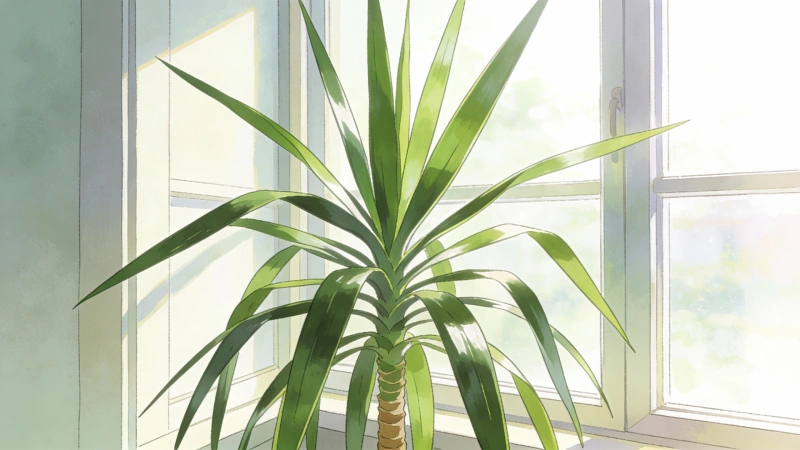
Bright, indirect light is a good starting point for most soil-grown Dracaenas. A plant may survive in lower light, but survival does not mean it is growing at its best. Low light usually means slower growth, smaller or more widely spaced leaves, and potentially weaker variegation.
| Location | What to expect | What to do |
|---|---|---|
| Bright east-facing window | Often a useful mix of morning sun and indirect light | Watch new growth for signs of improvement |
| Near a south- or west-facing window | Good brightness, but stronger direct afternoon rays can scorch foliage | Use a sheer curtain or move the pot back if bleached patches appear |
| North-facing window or farther inside a room | Often tolerable but growth can be slow | Move closer to usable daylight if leaves become sparse |
| Dark hallway with almost no natural light | Not a reliable long-term growing location | Use an appropriately positioned grow light or a brighter room |
How to tell if the light is wrong
- Insufficient light: stretched, widely spaced growth, small new leaves, very slow growth, or declining variegation.
- Too much sudden sun: bleached patches or dry, sharply defined brown marks on exposed leaves, especially after moving a shade-grown plant.
- Normal adjustment: a little older-leaf drop after relocation can occur, but widespread continuing decline deserves a full check of roots, temperature, and watering.
Make changes gradually and reassess new growth. A leaf already scorched by sunlight will not return to its former color.
3. How Often Should You Water a Dracaena? Use This Decision Test
There is no reliable number of days that works for every Dracaena. A small pot in bright light may dry much faster than a large pot in a cool, dim room. Pot size, species, light, temperature, humidity, and growing medium all affect water use. For many soil-grown Dracaenas, check the upper 1–2 inches (2.5–5 cm) of mix and water when that layer has dried somewhat, while making sure the deeper root zone is not still saturated. Treat this as a starting point, not a rigid rule. The University of Illinois Extension also recommends checking potting media rather than watering by the calendar. For the general method used across indoor plants, see our guide to how to water houseplants; this page focuses on the adjustments that matter for Dracaena.
The three-check watering method
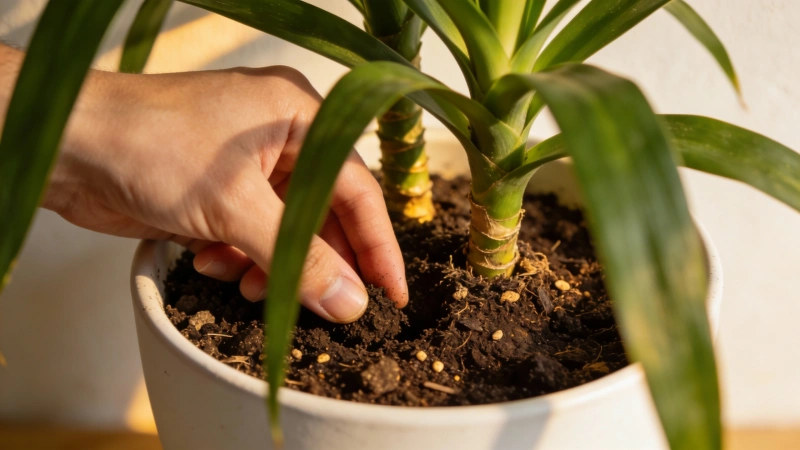
- Check the upper mix. Push a finger or clean wooden skewer roughly 1–2 inches (2.5–5 cm) into the potting mix. For a larger pot, also assess whether the deeper root zone is staying saturated.
- Check the container. Make sure there is a drainage hole and no standing water in the saucer or decorative outer pot. If the mix is still damp, wait and reassess.
- Water thoroughly when appropriate. When the mix has dried to the degree suitable for your plant, apply room-temperature water until some drains from the base, then empty the saucer.
What changes in winter? When light and plant growth decrease, the potting mix may dry more slowly, so check it less often or wait longer between waterings as needed. In a heated, sunny room, however, the opposite may occur. Let the pot tell you.
Overwatered vs. underwatered Dracaena
| Check | Possible overwatering / root trouble | Possible underwatering |
|---|---|---|
| Potting mix | Stays wet for many days; poor drainage | Dry throughout; pot feels unusually light |
| Leaves | Yellowing, drooping, or softening can occur | Drooping, curling, or dry brown edges can occur |
| Roots | Damaged roots can become soft and break apart | Roots may be dry or desiccated |
| Next action | Check roots and pot drainage before adding more water | Rehydrate appropriately and confirm the mix absorbs water |
Yellow leaves plus moist soil are warning signs, not proof of root rot. If the lower stem is soft, the pot smells sour, or roots are slimy and disintegrating, follow our detailed root rot identification and treatment guide instead of simply extending the time between waterings.
4. Why Are My Dracaena Leaf Tips Turning Brown?
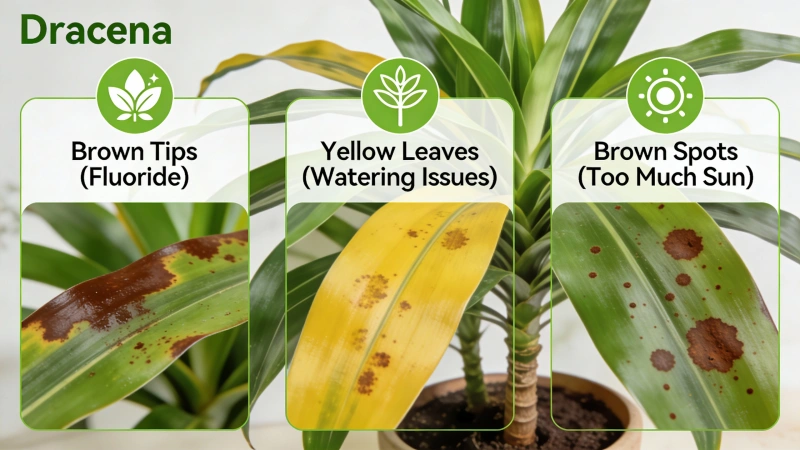
Brown leaf tips are a symptom, not a diagnosis. Dracaenas can develop tip burn from several overlapping causes: dry air, inconsistent watering, accumulated fertilizer salts, water chemistry, cold drafts, or root stress. Iowa State University Extension lists these major categories, including water quality in sensitive plants such as Dracaena.
Check these four causes in order
| Clue | Possible explanation | Best next step |
|---|---|---|
| Tips brown during dry winter weather; plant near heat vent | Low humidity or drafts | Move away from forced hot air; check indoor humidity |
| Soil swings from bone-dry to very wet | Inconsistent watering or root stress | Use a moisture check and inspect drainage |
| White crust on pot rim or mix; frequent fertilizer use | Soluble salt buildup | Reduce fertilizer; consider replacing salty mix or flushing only if drainage is good |
| Repeated tip burn despite otherwise good care; sensitive cultivar | Water chemistry, including possible fluoride or salts | Review water source and try a documented low-fluoride alternative |
| Brown tips plus soft stem or yellowing while wet | Possible root damage | Inspect roots before choosing any treatment |
Does tap water cause brown tips on Dracaena?
It can, but not in every home. Some Dracaena cultivars are sensitive to fluoride and excess soluble salts. University of Florida IFAS guidance identifies fluoride, boron, and salts among possible causes of tip or edge injury in commercially grown Dracaena. That does not mean every municipal tap-water supply will damage every plant. UF/IFAS Dracaena cultural guidelines document this sensitivity.
If brown tips keep appearing despite suitable moisture, light, and fertilizer use, examine your local water report or try a small, documented water-source change. Distilled water, collected clean rainwater where suitable, or a verified fluoride-reducing reverse-osmosis system may be useful. A standard pitcher labeled “filtered” is not automatically a fluoride-removal filter. The CDC’s filter selection guide recommends checking the actual substances a system is certified to reduce.
Two myths to skip: Letting tap water sit overnight is not a reliable way to remove dissolved fluoride. Switching to “filtered water” only helps with fluoride if the specific filtration system reduces it. Also, no water change will turn already brown leaf tissue green again.
How to test whether a change helps
- Photograph the same two or three representative leaves and note how many new tips are affected.
- Correct any obvious drainage, fertilizer, humidity, or draft problems first.
- If water chemistry is still a reasonable suspect, use one consistent low-fluoride water source and keep other conditions steady.
- Watch developing leaves over several weeks. Do not judge improvement from old brown tissue.
Should you cut the brown tips off?
For appearance, you may trim only the dry, dead portion with clean scissors, following the natural taper of the leaf. Leave a narrow margin of dry tissue rather than cutting into healthy green leaf. Trimming is cosmetic; preventing fresh damage requires fixing the actual cause.
5. Dracaena Troubleshooting: Yellow Leaves, Brown Spots, Drooping, and Pests
This is the section to use when you are unsure what to change. Begin with the pattern of damage, then confirm it with the soil, roots, environment, and pest inspection.
| What you see | What might be happening | What to check first |
|---|---|---|
| One old lower leaf turns yellow occasionally | Normal leaf aging is possible | Is the rest of the plant producing healthy leaves? |
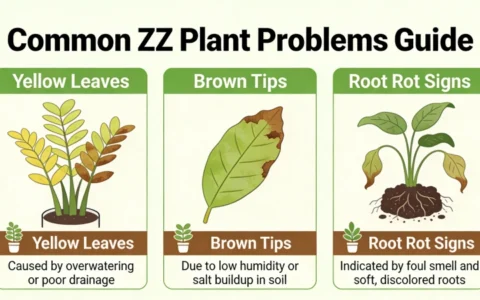
| Several leaves yellow together; mix stays wet | Overwatering, poor drainage, or root problems | Roots, drainage hole, potting mix, and watering history |
| Dry brown tips on otherwise healthy leaves | Dry air, erratic watering, salts, or water chemistry | Use the four-cause brown-tip check |
| Bleached or tan patches on sun-facing leaves | Sudden intense sunlight / scorch | Was the plant recently moved closer to direct sun? |
| Drooping leaves with very dry potting mix | Water stress | Does the mix accept water, and is the pot extremely light? |
| Stunted or leggy growth | Insufficient usable light | Window exposure and recent new leaf size |
| Fine webbing or pale stippling | Possible spider mites | Undersides of leaves and a white-paper mite test |
| Small dark flies near damp potting mix | Possible fungus gnats | Whether the potting mix stays wet too long |
| Sticky leaves or raised bumps on stems | Scale or other sap-feeding pests | Close-up inspection of stems and leaf undersides |
For general yellowing patterns, refer to why houseplant leaves turn yellow. If you see pinpoint stippling and webbing, use the spider mite identification and treatment guide. Tiny flies hovering above damp soil point to a different problem: see how to identify and manage fungus gnats.
When should you inspect the roots?
Do not unpot a healthy plant whenever one lower leaf turns yellow. A root inspection is more justified when several warning signs occur together, such as continuing yellowing, consistently wet soil, a sour smell, a soft lower stem, or poor drainage. If you suspect an advanced problem, see how to assess and save a struggling houseplant for a broader recovery approach.
6. Best Soil, Pot Size, and Repotting for Dracaena
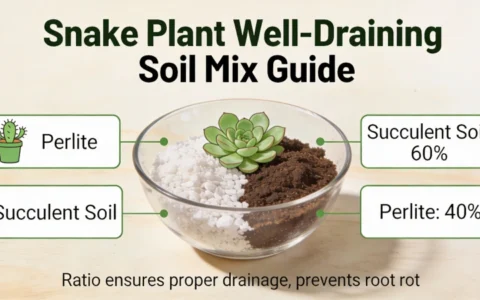
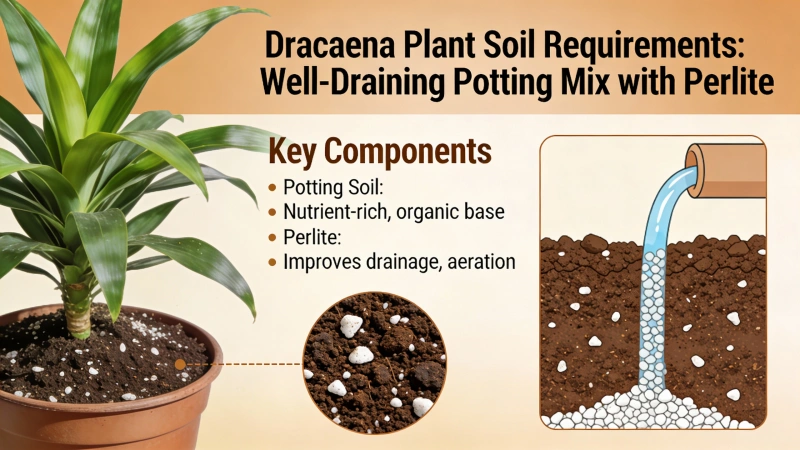
Most soil-grown Dracaenas do well in an indoor potting mix that holds some moisture but drains freely and retains air spaces. A common starting blend is about three parts quality indoor potting mix to one part perlite, but it is not a universal formula. Adapt it to the plant, the original mix, and your growing conditions. Never assume a bag labeled “fast draining” makes up for a container with no drainage hole.
When should you repot?
- Roots densely circle the root ball or grow from drainage holes.
- Water runs through immediately because the container is packed with roots, or the old mix no longer wets evenly.
- The plant becomes unstable or top-heavy.
- There is confirmed root trouble or the mix has broken down badly.
Repotting every fixed two or three years is not necessary for every Dracaena. When needed, move into a container only modestly larger than the root ball, with an effective drainage opening. Healthy roots should be handled gently: unnecessary complete root washing can increase transplant stress.
A low-stress Dracaena repotting sequence
- Choose a draining pot close to the existing root-ball size.
- Ease the plant out and assess root condition; remove only clearly dead or damaged tissue.
- Place fresh medium around the root ball without packing it tightly.
- Water enough to settle the mix and allow excess to drain, unless a specific diagnosed root condition calls for different care.
- Put the plant back in suitable filtered light, avoid heavy fertilizer immediately, and monitor the soil as it acclimates.
7. Temperature, Humidity, Fertilizer, and Leaf Cleaning
Temperature and humidity
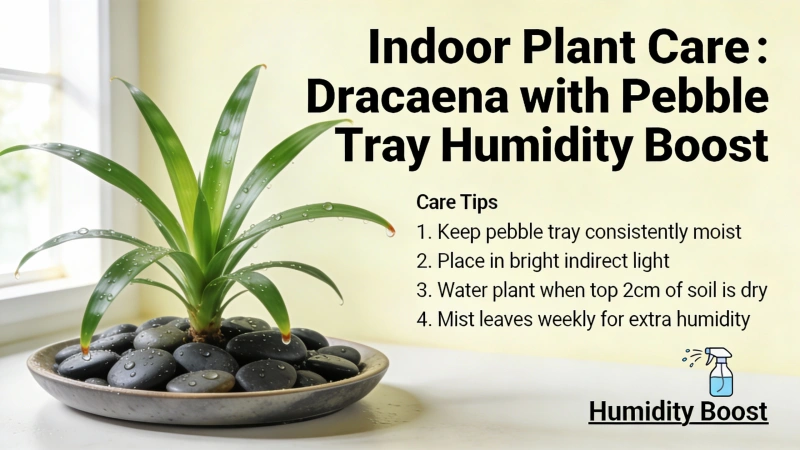
Dracaenas generally prefer stable warm rooms rather than cold windowsills, outdoor chill, or direct blasts from heating and air-conditioning vents. Ordinary indoor humidity can be adequate, although dry air may contribute to leaf-tip injury in some homes. A room humidifier can help in very dry conditions; keep the area ventilated and avoid creating persistently wet foliage.
Pebble trays and grouping houseplants may change the local microclimate slightly, but they are not reliable cures for extensive brown-tip damage. Address the moisture, water chemistry, and salt factors as well.
How much fertilizer does a Dracaena need?
Dracaenas are not heavy feeders indoors. Use a fertilizer appropriate for foliage plants only during periods of active growth, at the rate and interval shown on the label. In dim conditions or during very slow growth, reduce feeding. Fertilizer salts can contribute to leaf-tip burn, so applying more fertilizer is not a good first response to brown tips.
Cleaning Dracaena leaves
Wipe dust from leaves gently with a soft, damp cloth. Do not apply milk, mayonnaise, oils, or leaf-shine mixtures: they are unnecessary and can leave residue. Cleaning is also a useful time to check the leaf undersides for scale, mealybugs, and mites.
8. How to Prune and Propagate a Dracaena
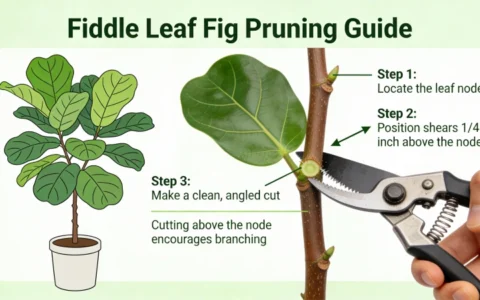
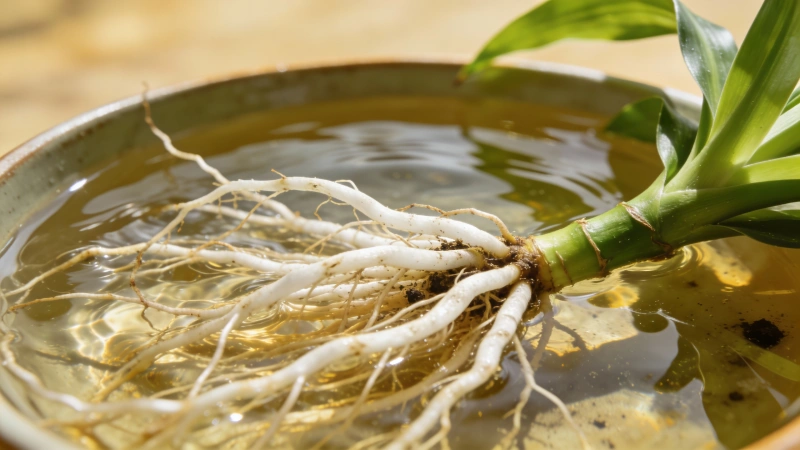
Many cane-forming Dracaenas, including dragon trees and corn plants, can be propagated from stem cuttings. The Penn State Extension houseplant propagation guide specifically lists Dracaena among plants that respond well to cane/stem sections with nodes. Rooting times vary with plant health, temperature, light, and cutting size. Read the Penn State propagation guidance.
Method A: Root a leafy top cutting
- Choose a healthy, actively growing cane and use a clean, sharp blade.
- Cut a top section with a useful length of stem and at least one viable node; avoid taking material from a visibly rotting stem.
- Remove lower foliage that would be buried or submerged. Keep leaves above the water or propagation medium.
- Root the cutting in an airy, lightly moist propagation mix, or use a clean water container if appropriate for that plant and your preferred method.
- Keep it warm and in bright, indirect light. Check regularly for root development and rot; do not promise roots on a specific date.
- Transfer a sufficiently rooted cutting carefully into an appropriate potting mix and monitor moisture as it establishes.
Method B: Propagate a bare cane section
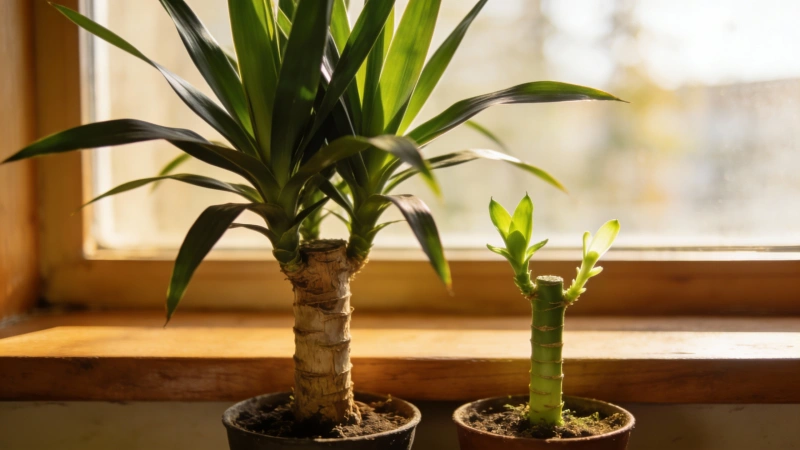
Where a healthy woody cane is long and bare, sections with intact nodes can be rooted in a propagation medium. Mark the original top and bottom before cutting so you preserve orientation for vertical planting, or place pieces horizontally where appropriate. Keep the medium lightly moist, not saturated, and give the process time. This approach makes use of bare-stem material that would otherwise be discarded after pruning.
Will the original cane branch after pruning?
Often, dormant buds below a cut develop into new shoots, but the number of new branches is not guaranteed. Some canes produce one shoot, others more than one, and a stressed plant may respond slowly. Prune during active growth when possible and allow the plant to recover in stable light and temperature.
9. Four-Week Dracaena Care & Recovery Tracker
This simple tracker makes the article useful beyond a one-time read. It is especially helpful when you’re dealing with brown tips or yellow leaves and need to tell whether the next leaves are healthier.
| When | What to check | What counts as progress |
|---|---|---|
| Day 0 | Photograph 3 marked leaves; record soil moisture, window location, watering source, fertilizer, and any pests | You have a baseline rather than a guess |
| Day 7 | Recheck soil, roots if indicated, and new damage; avoid changing every variable | No rapid new yellowing or softening |
| Day 14 | Compare photos under similar light; inspect newly emerging tips and any pests | Fewer new symptoms even if old marks remain |
| Day 28 | Review watering, drainage, water source, and new growth; decide if further changes are necessary | Stable leaves, sound roots, and improved new growth where season permits |
Copyable weekly Dracaena checklist
- Date / plant type / pot size
- Light: filtered bright / medium / very low
- Potting mix: dry near surface / partly moist / persistently wet
- Watered today? amount / source / drained?
- New brown tips or yellow leaves? number and location
- Visible pests, sticky residue, or webbing?
- New leaf or cane growth noticed?
- One change made this week (if any)
Interpret the tracker carefully: Dracaenas can grow slowly, especially in winter or lower light. No new leaf in 28 days is not, by itself, evidence of failed care. The goal is to eliminate active decline and establish a repeatable routine, not promise a dramatic transformation by a deadline.
10. Is Dracaena Toxic to Cats and Dogs?
Yes. The ASPCA lists Dracaena species as toxic to cats and dogs. Reported signs can include vomiting, drooling, reduced appetite, and other symptoms. Keep plants where pets cannot chew them; if ingestion is suspected, contact your veterinarian or a pet poison service rather than waiting for symptoms. The ASPCA’s Dracaena entry provides species-level safety details.
If you need another foliage plant, do not assume that a different Dracaena cultivar is pet-safe. Check the exact botanical name against a trusted veterinary toxicity list before purchasing.
Dracaena Care: Frequently Asked Questions
How often should I water a Dracaena plant indoors?
Check the potting mix rather than setting a strict interval. For many soil-grown Dracaenas, allow some of the upper mix to dry, then water thoroughly and drain the saucer. Container size, light, temperature, and the plant type determine how quickly this happens.
Why are my Dracaena leaf tips turning brown?
Possible causes include dry air, erratic watering, fertilizer salt buildup, fluoride or other water chemistry issues, cold drafts, and root stress. Start with the brown-tip diagnosis table and avoid assuming every case is caused by tap water.
Can I water a Dracaena with tap water?
Sometimes, yes. Local tap-water chemistry varies. If a fluoride-sensitive Dracaena develops repeated brown tips despite otherwise suitable care, consider testing a documented low-fluoride water source. A generic carbon pitcher may not reduce fluoride.
Should I cut the brown tips off my Dracaena?
You can trim only the dead dry section for appearance, using clean scissors, without cutting deeply into living green tissue. This will not cure the underlying stress and old tissue will not grow back.
Why are the lower leaves on my Dracaena turning yellow?
Occasional older-leaf yellowing can be part of normal aging. Several leaves yellowing quickly, especially alongside wet mix, soft stems, or poor root condition, calls for a check of drainage and the root zone.
Can Dracaena grow in low light?
Some types tolerate medium-to-low light, but they generally grow more slowly and may become leggy. Bright, filtered light is a better target for vigorous growth and colorful variegated foliage.
Can you propagate Dracaena from a stem cutting?
Yes, many cane-forming Dracaenas root from top or cane cuttings with viable nodes. Use clean tools, warm conditions, indirect light, and an appropriate propagation medium. Rooting times and new shoot numbers vary.
Is it safe to keep a Dracaena around pets?
No Dracaena should be considered safe for a pet that chews houseplants. The ASPCA identifies Dracaena as toxic to cats and dogs. Keep it securely out of reach and seek veterinary advice if ingestion occurs.
Final Dracaena Care Checklist
If you remember only a few things: give your Dracaena a stable place with usable light, check moisture before watering, let excess water drain, and treat brown tips as a diagnostic clue rather than an automatic reason to change water brands. Healthy future leaves are a better measure of success than whether older scars disappear.
Explore the site’s houseplant care guides for related indoor plants, including ZZ plant care if you are comparing hardy, low-maintenance foliage plants.
Research Sources and Further Reading
This guide distinguishes common care starting points from diagnosis-specific advice. Plant response varies by species, cultivar, pot size, water chemistry, and home environment.
- NC State Extension — Dracaena plant identification and species.
- Iowa State University Extension — brown tips and edges in houseplants.
- University of Florida IFAS — cultural guidelines for interiorscape Dracaena.
- University of Illinois Extension — how to water houseplants.
- CDC — choosing home water filters and checking chemical reduction claims.
- Penn State Extension — propagating houseplants by stem cuttings.
- ASPCA — Dracaena toxicity to cats and dogs.
Editorial Note: This article was written and edited by Spring Mei. AI tools may be used to assist with research and organizing information. The final content is reviewed before publication, and important factual claims are checked against reliable sources where appropriate. Personal experience is distinguished from general guidance, and methods are described as personally tested only when they have actually been tested.
Please indicate the source when reposting:https://gardeningtoolsgarden.com/how-to-care-for-a-dracaena-plant/
Author: Spring Mei