

Introduction
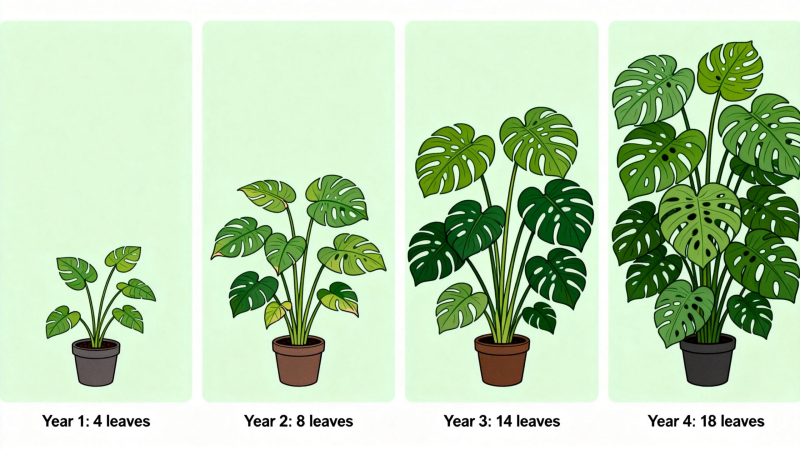
I bought my first Monstera three years ago. It had just four small, heart-shaped leaves—not a single split or hole in sight.
I was convinced I’d have those gorgeous, Instagram-worthy fenestrated leaves within months. Spoiler: I didn’t. Instead, I got yellow leaves, leggy stems, and a plant that looked like it was giving up on life.
Fast forward to today, and that same Monstera now has 18 leaves, stands over 4 feet tall, and finally looks like the tropical showstopper I dreamed about. The newest leaves? Full of those signature Swiss cheese holes.
The difference wasn’t luck. It was learning what Monstera actually needs—and more importantly, what mistakes to avoid.
In this guide, I’ll share everything I’ve learned about Monstera care. You’ll get practical tips on light, watering, soil, and how to encourage those coveted leaf splits. I’ll also cover the problems I ran into and how I fixed them.
Whether you just brought home your first Monstera or you’re troubleshooting a struggling plant, this guide has you covered.
Quick Answer: Monstera Care at a Glance
In short: Monstera thrives in bright, indirect light. Water when the top 2-3 inches of soil are dry—typically every 1-2 weeks. Use well-draining soil with perlite and bark. Fertilize monthly during the growing season (April-September). Provide a moss pole or stake for climbing support.
The two most common mistakes? Too little light and overwatering. Both lead to yellow leaves and no fenestrations.
Monstera Quick Care Chart
| Care Factor | Recommendation |
|---|---|
| Light | Bright, indirect |
| Water | When top 2-3″ soil is dry |
| Humidity | 50-60%+ ideal |
| Temperature | 65-85°F (18-29°C) |
| Fertilizer | Monthly (growing season only) |
| Repotting | Every 1-2 years |
What Is a Monstera Plant?
Monstera deliciosa goes by many names: Swiss Cheese Plant, Split-leaf Philodendron, or simply “that plant from Instagram.”
It’s native to the tropical rainforests of Central America and southern Mexico. In the wild, Monstera grows as a climbing vine, scaling massive trees to reach sunlight. According to Wikipedia, wild specimens can reach up to 70 feet tall.
Indoors? You’re looking at a max of about 9 feet—still impressive for a houseplant.
The National Garden Bureau even declared 2025 the “Year of the Monstera,” celebrating its popularity and easy-care nature.
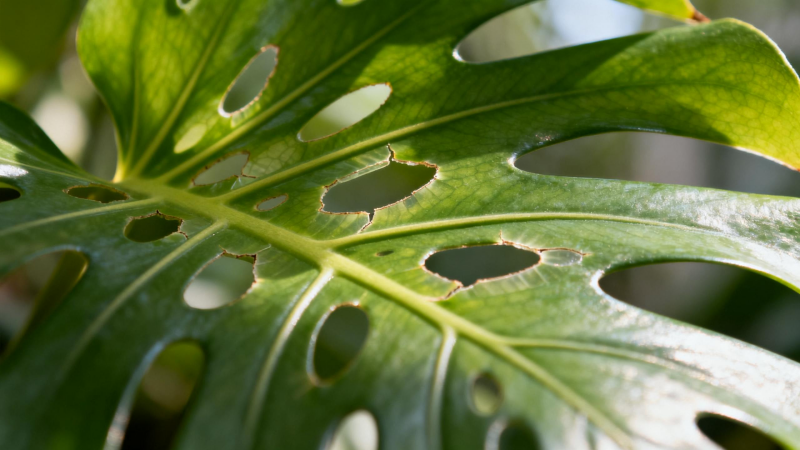
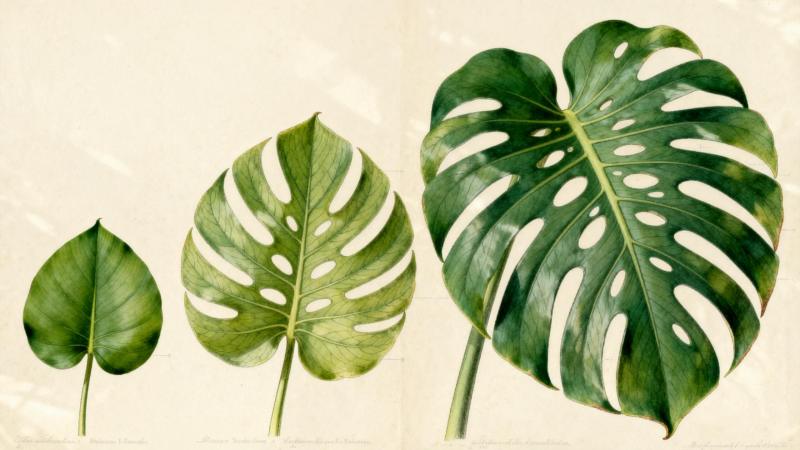
Why the holes? Those iconic fenestrations (the fancy word for leaf holes and splits) serve a purpose. In nature, they allow sunlight to pass through upper leaves and reach lower foliage. Pretty clever, right?
How Much Light Does a Monstera Need?
Light is the single most important factor for a happy Monstera. Get this wrong, and everything else becomes an uphill battle.
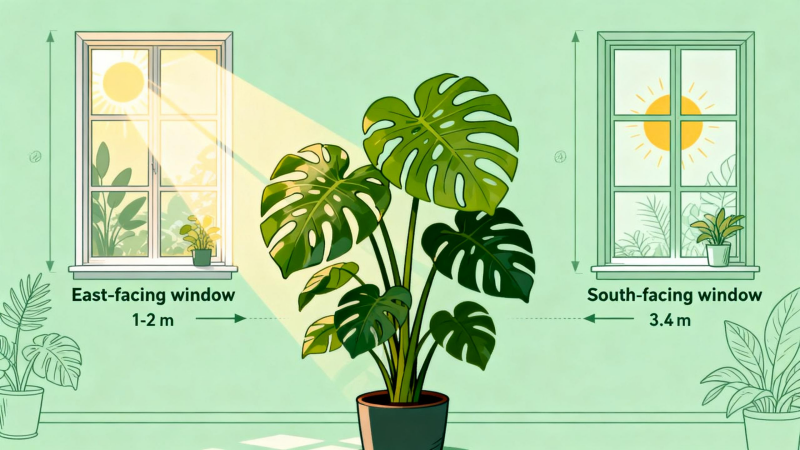
The ideal: Bright, indirect light. Think near a window where sunlight fills the room but doesn’t directly hit the leaves.
I learned this the hard way. My first Monstera sat in a north-facing room for six months. It survived, but it was miserable—leggy stems, pale leaves, and zero fenestrations.
When I moved it to an east-facing window with bright morning light, everything changed. Eight months later, I saw my first split leaf.
Signs Your Monstera Needs More Light
- Leaves stay solid with no splits or holes
- Stems become long and stretched (leggy growth)
- Leaf color looks pale or washed out
- Growth slows down significantly
Signs of Too Much Direct Light
- Brown, crispy patches on leaves (sunburn)
- Bleached or faded leaf color
- Curling leaf edges
Pro Tip: Rotate your pot a quarter turn every time you water. This ensures all sides get equal light exposure and prevents lopsided growth.
If your space doesn’t get much natural light, don’t worry. You might want to start with more shade-tolerant plants while you figure out your home’s light situation. Something like a Snake Plant handles low light much better than Monstera.
How Often Should I Water My Monstera?
Here’s the golden rule: Water when the top 2-3 inches of soil are dry.
For most homes, this means watering every 1-2 weeks during spring and summer. In winter, you can stretch it to every 3-4 weeks since growth slows down.
But forget rigid schedules. Your Monstera doesn’t know it’s Saturday.
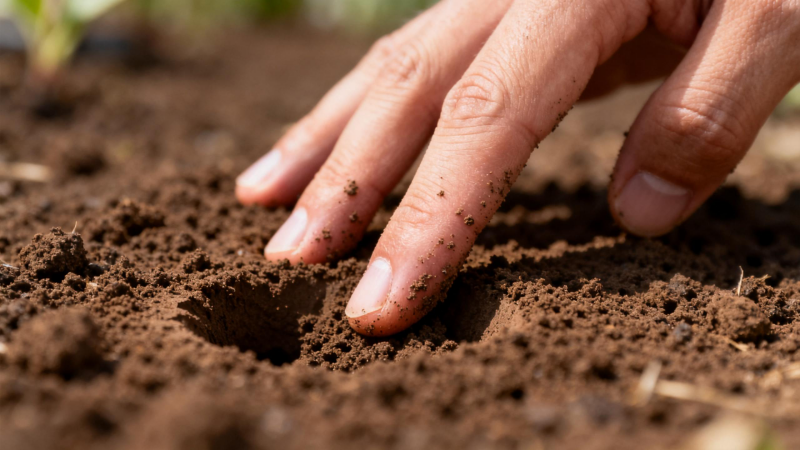
My method: I stick my finger into the soil up to my second knuckle. If it feels dry, I water. If it’s still damp, I wait a few more days.
How to Water Properly
- Water thoroughly until it drains from the bottom holes
- Empty the saucer after 30 minutes—don’t let your plant sit in water
- For large pots that are hard to move, use a turkey baster to remove excess water (this trick saved me!)
Overwatering vs. Underwatering: How to Tell the Difference
Watering Problem Diagnosis
| Symptom | Overwatering | Underwatering |
|---|---|---|
| Leaves | Yellow, soft, mushy | Yellow with crispy brown edges |
| Soil | Soggy, may smell musty | Pulling away from pot edges |
| Stems | Black, soft at base | Wrinkled, droopy |
Overwatering is the #1 killer of Monstera plants. When in doubt, wait another day before watering.
Comment
byu/RegularMousse00 from discussion
inhouseplants
Best Soil Mix for Monstera
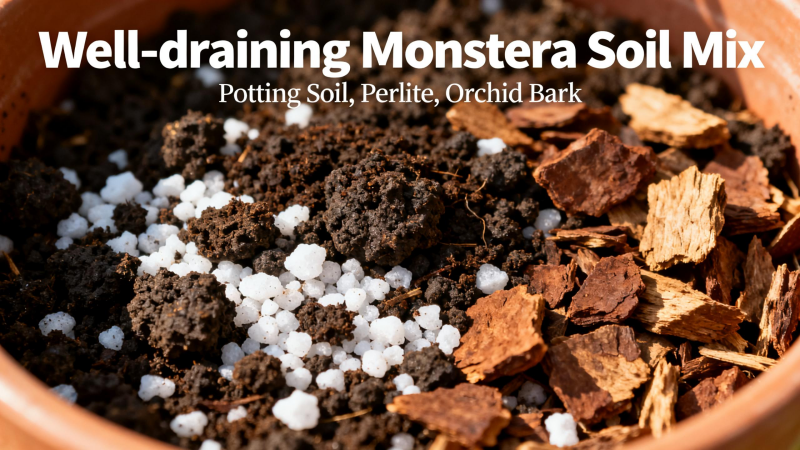
Monstera roots need air. Standard potting soil holds too much moisture and can suffocate the roots, leading to root rot.
My go-to mix:
- 2 parts indoor potting soil
- 1 part perlite
- 1 part orchid bark
This combination drains quickly while retaining just enough moisture. Your roots will thank you.
When and How to Repot
Look for these signs that your Monstera needs a bigger home:
- Roots growing out of drainage holes
- Soil dries out within a day or two
- Growth has stalled despite good light
- Plant becomes top-heavy and tips over
Best timing: Early spring, just before the growing season kicks off.
Pot size: Go up only 1-2 inches in diameter. Too big a jump means the soil stays wet too long.
My mistake: I once repotted into a pot way too large. The soil stayed soggy for weeks, and I nearly lost the plant to root rot. Lesson learned.
Creating the Perfect Environment: Humidity and Temperature
Monstera is surprisingly adaptable, but it does best in conditions that mimic its tropical home.
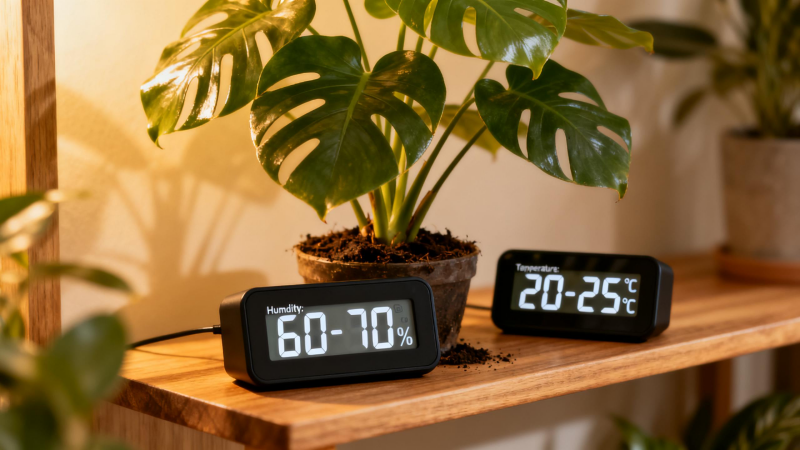
Ideal humidity: 50-60%. Most homes sit around 30-50%, which is usually fine. But if you notice brown, crispy leaf edges, humidity might be the issue.
Ideal temperature: 65-85°F (18-29°C). Keep your Monstera away from cold drafts, air conditioning vents, and heating units.
Warning: Temperatures below 50°F can cause cold damage. Never leave your Monstera outside overnight if temperatures drop.
How to Increase Humidity
- Use a humidifier – The most effective option
- Pebble tray – Fill a tray with pebbles and water, place pot on top
- Group plants together – They create a mini humid microclimate
What I don’t recommend: Misting. It sounds nice but provides only temporary humidity. Plus, constantly wet leaves can invite fungal problems.
If you’re building an indoor jungle, pairing your Monstera with other tropical plants helps everyone thrive. Pothos makes an excellent companion—it has nearly identical care needs and looks beautiful alongside Monstera.
How to Feed Your Monstera
Fertilizing isn’t complicated, but timing matters.
When to fertilize: Only during the growing season—April through September.
Frequency: Once a month works for most liquid fertilizers. Some people prefer half-strength every two weeks.
What to use: A balanced liquid fertilizer (like 10-10-10 or 5-2-3 NPK) does the job.
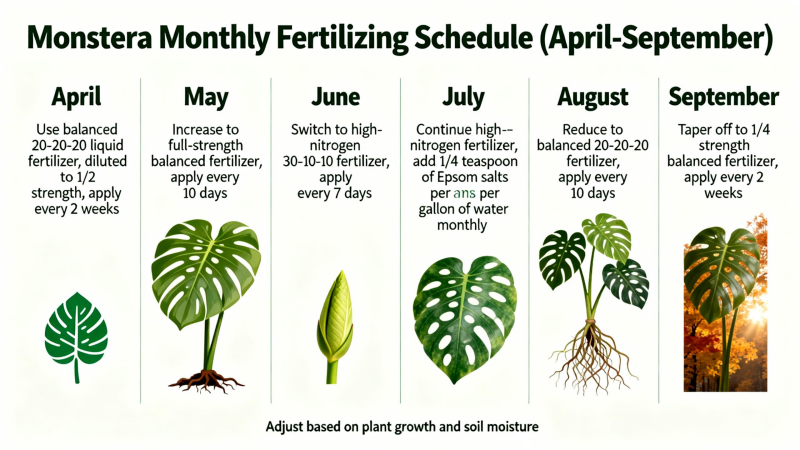
Winter care: Stop fertilizing or reduce to once every 6-8 weeks. Your Monstera isn’t actively growing, so it doesn’t need extra nutrients.
Warning: More fertilizer isn’t better. Overfertilizing causes salt buildup in soil, leading to brown leaf tips and root damage. If you see white crusty buildup on the soil surface, flush it with plain water.
How to Get Your Monstera Leaves to Split
This is the question I get asked most. And honestly? It’s what frustrated me most during my first year.
The truth: You need three things—adequate light, plant maturity, and climbing support.
Why Your Monstera Leaves Have No Holes
Reason #1: Not enough light This is the most common cause. In low light, Monstera maximizes every bit of leaf surface for photosynthesis. It can’t “afford” to put holes in leaves.
Reason #2: Your plant is too young Most Monstera need 2-3 years to start producing fenestrated leaves. Patience is essential.
Reason #3: No climbing support In nature, fenestrations appear as Monstera climbs higher toward light. Without something to climb, your plant may not feel the need to develop splits.
Reason #4: Recently propagated Cuttings often produce juvenile leaves at first. They need time to mature again.
My Experience Getting Fenestrations
My Monstera went eight months without producing a single fenestrated leaf. I kept waiting, kept watering, kept hoping. Nothing.
At that point, it sat in a north-facing room. I assumed Monstera could handle low light since everyone said it was “easy.”
Finally, I moved it to an east-facing window with bright morning light. I also added a moss pole to encourage upward growth.
Six months later, I spotted my first split—just two small holes, but I was thrilled.
Now, three years in, the newest leaves have the full Swiss cheese pattern. The largest one has eight fenestrations. The difference was simply giving the plant what it actually needed.
After 2 years my Monstera finally put out its first fenestrated leaf!
byu/Snoo_39873 inhouseplants
Tips to Encourage Splits
How to Get Fenestrated Leaves
| Factor | What to Do |
|---|---|
| Light | Move to a brighter location (indirect light) |
| Support | Add a moss pole or bamboo stakes |
| Patience | Wait 2-3 years for maturity |
| Nutrition | Fertilize monthly during growing season |
| Climbing | Train aerial roots onto the support |
Why Your Monstera Needs Support
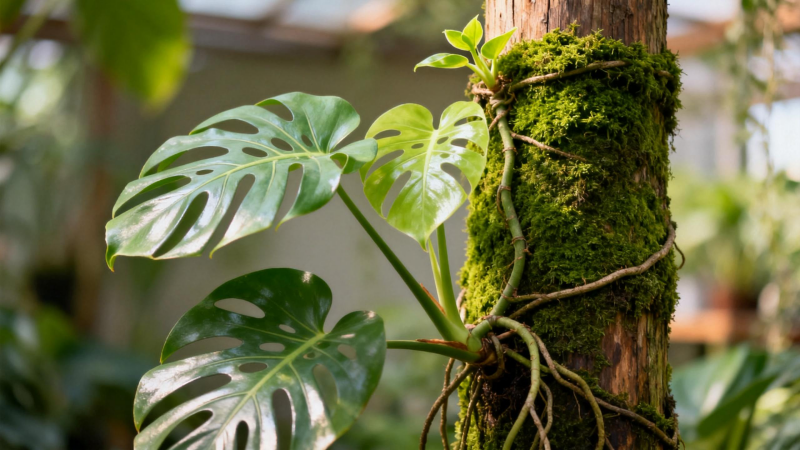
Monstera is a climbing plant. In nature, it scales trees using aerial roots to anchor itself.
Without support indoors, several things happen:
- The plant sprawls and tips over
- Leaves stay smaller
- Fenestrations may not develop
I learned this lesson dramatically. I was dusting leaves one day when the whole plant toppled off its shelf. Several stems ripped from the main plant. After that disaster, every single one of my Monstera gets support.
Support Options
Moss pole: Closest to natural conditions. Aerial roots can actually grow into the damp moss.
Bamboo stakes: Budget-friendly and effective. Use 3-4 stakes arranged in a square for stability.
Trellis: Good for creating specific shapes or training growth direction.
How to attach: Use soft Velcro plant tape or cloth strips. Never use wire—it can cut into stems as they grow.
How to Propagate Monstera Successfully
Propagating Monstera is surprisingly easy—if you follow one critical rule.
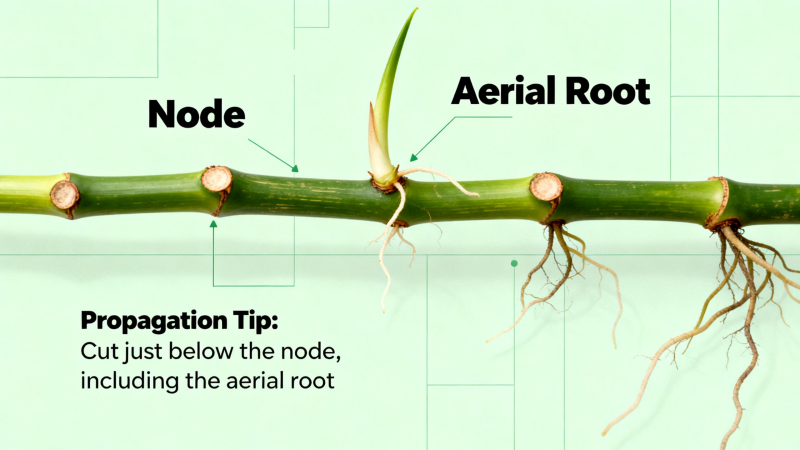
You MUST include a node.
A node is the small bump on the stem where leaves emerge. It’s also where new roots will grow. According to the University of Minnesota Extension, cuttings without nodes cannot develop roots and will eventually die.
What NOT to Do
❌ Cutting just a leaf without a node – It’ll look pretty in water for a while, then slowly yellow and die
❌ Cutting too short without aerial roots – Lower success rate
❌ Propagating in winter – Growth is too slow; risk of rot increases
Comment
byu/ImaginationWild5999 from discussion
inpropagation
Step-by-Step Water Propagation
- Find a healthy stem with at least one node (look for a bump or aerial root)
- Using clean, sharp scissors, cut 1-2 inches below the node
- Remove lower leaves; keep 1-2 at the top
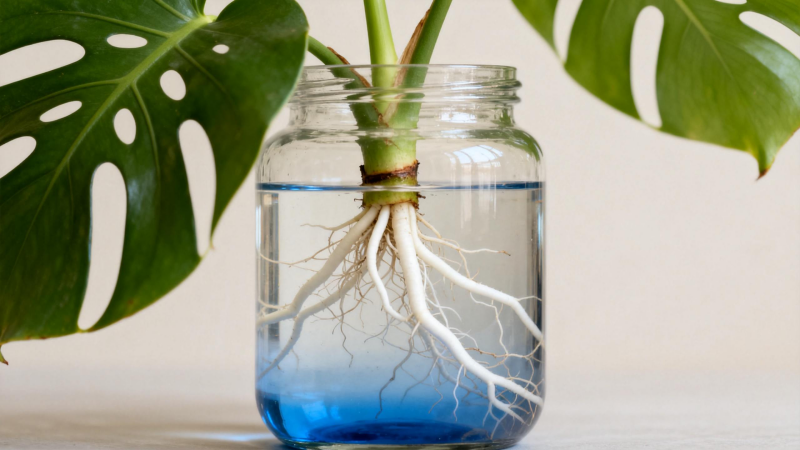
- Place cutting in clean water with the node submerged
- Change water every 3-4 days to prevent bacterial growth
- Wait 2-4 weeks for roots to develop
- Once roots reach 4-6 inches, transplant to soil
Timeline Expectations
- Visible roots: 2-4 weeks
- Ready to transplant: 1-2 months
- First new leaf: 2-3 months after planting
The propagation method is almost identical to Pothos propagation. If you’ve successfully propagated Pothos before, Monstera will feel familiar.
Troubleshooting Your Monstera: Common Problems and Solutions
Even with the best care, problems happen. Here’s how to diagnose and fix the most common issues.
Yellow Leaves
Yellow leaves are the #1 complaint I hear from Monstera owners. The frustrating part? Multiple things can cause them.
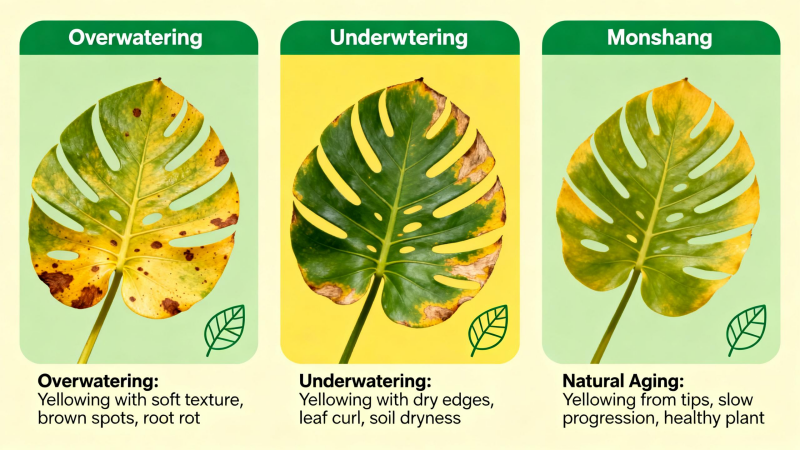
Cause #1: Overwatering (most common) Check your soil. If it’s soggy or smells musty, you’re watering too much. Let the soil dry out before watering again.
Cause #2: Underwatering Look for crispy brown edges alongside the yellowing. Is your soil bone dry and pulling away from the pot? Time to water more consistently.
Cause #3: Insufficient light Pale yellow leaves combined with slow growth often signal a light problem. Move to a brighter spot.
Cause #4: Normal aging Here’s some good news: lower, older leaves naturally yellow and die as the plant matures. If it’s just one or two bottom leaves and the rest look healthy, don’t panic.
Brown Leaf Tips
Brown, crispy leaf tips usually point to one of these issues:
- Low humidity – Increase moisture in the air with a humidifier
- Water quality – Chlorine and fluoride in tap water can cause browning; try filtered or distilled water
- Overfertilizing – Flush soil with plain water to remove salt buildup
Drooping Leaves
Droopy Monstera leaves mean the plant is stressed—but the cause could be opposite extremes.
- Underwatered: Soil is dry, leaves perk up after watering
- Overwatered: Soil is wet, roots may be rotting
- Root rot: Stems feel soft at the base, may smell bad
Always check soil moisture before assuming the problem.
No New Growth
If your Monstera hasn’t pushed out new leaves in months:
- Winter slowdown – Completely normal; growth resumes in spring
- Low light – Move to a brighter location
- Rootbound – Check if roots are circling the pot; may need repotting
- Nutrient deficiency – Resume fertilizing in growing season
Quick Problem Diagnosis
| Problem | Likely Cause | Quick Fix |
|---|---|---|
| Yellow leaves (bottom only) | Natural aging OR overwatering | Check soil; reduce watering if wet |
| Yellow leaves (entire plant) | Root rot | Inspect roots; repot if needed |
| Brown crispy tips | Low humidity | Add humidifier or pebble tray |
| No leaf splits | Insufficient light | Move to brighter spot |
| Leggy, stretched growth | Not enough light | More light + prune leggy stems |
| Drooping leaves | Over or underwatering | Check soil moisture first |
Dealing with Pests: Common Monstera Bugs and How to Fight Them
I wish I could say my Monstera never had pests. But that would be a lie.
The good news? Most infestations are manageable if you catch them early.
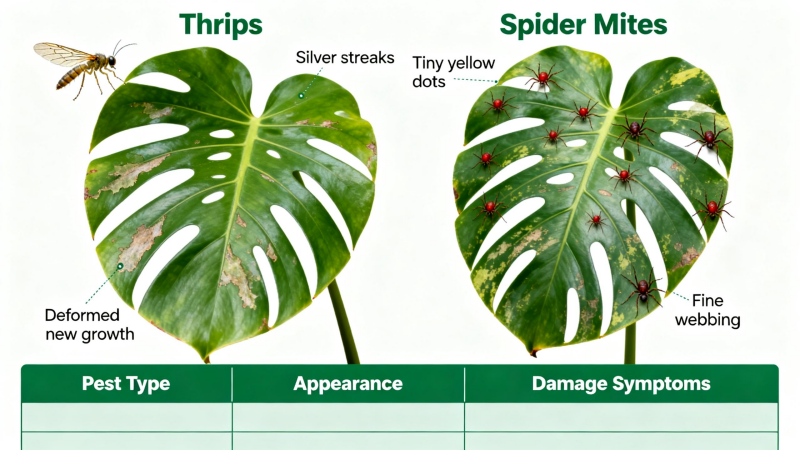
Thrips
Thrips are tiny, slender insects—usually white, yellow, or brown. They’re hard to spot until the damage appears.
Signs of thrips:
- Silver or bronze streaks on leaves
- Tiny black dots (their droppings)
- Small, white larvae on leaf undersides
- Leaves look dry and stippled
Why they’re tricky: Thrips reproduce fast. Their lifecycle is about 45 days, and females lay eggs inside plant tissue.
How to treat:
- Use a lint roller to physically remove adults from leaves (yes, really—it works!)
- Spray with neem oil solution (follow package dilution + add a few drops of dish soap)
- For severe cases, use insecticidal soap
- Repeat treatment every 5-7 days for at least 2-3 weeks
- Monitor closely—one treatment rarely eliminates them completely
Spider Mites
Spider mites thrive in dry, warm conditions. They’re almost microscopic.
Signs of spider mites:
- Fine webbing on leaf undersides
- Tiny dots moving on leaves (use a magnifying glass)
- Leaves look dusty or stippled
- Yellowing in patches
How to treat:
- Increase humidity—mites hate moisture
- Rinse leaves with a strong stream of water
- Apply neem oil or insecticidal soap
- Isolate the affected plant to prevent spread
Prevention Tips
Prevention beats treatment every time. Here’s what I do:
- Quarantine new plants for 2-4 weeks before adding them to your collection
- Inspect regularly – Check leaf undersides every time you water
- Keep leaves clean – Wipe with a damp cloth monthly to remove dust and spot pests early
- Maintain humidity – Dry conditions invite spider mites
While checking your Monstera for pests, you might notice other uninvited guests around your plants. If you spot spiders building webs nearby, check out our guide on How to Get Rid of Spiders for safe removal methods.
And if you move your Monstera outdoors during summer (which it loves!), watch out for other garden pests. Stink bugs are notorious hitchhikers that can follow plants back inside.
Is Monstera Toxic to Pets?
Yes. Monstera is toxic to cats and dogs.
According to the ASPCA Poison Control Center, Monstera contains calcium oxalate crystals. If chewed or ingested, it can cause:
- Oral irritation and burning
- Excessive drooling
- Difficulty swallowing
- Vomiting
The good news: It’s rarely life-threatening. The bad news: It’s still painful and unpleasant for your pet.
My recommendation: Keep Monstera out of reach. Place it on a high shelf, use a plant stand, or keep it in a room pets don’t access.
If you suspect your pet has chewed on Monstera, contact your vet or the ASPCA Animal Poison Control Center (888-426-4435).
Frequently Asked Questions About Monstera Care
How fast does Monstera grow?
In ideal conditions—bright indirect light, proper watering, warm temperatures—Monstera can produce 1-2 new leaves per month during the growing season. Growth slows significantly (or stops entirely) in winter.
Can I keep Monstera in low light?
Technically yes, but it won’t thrive. Expect slower growth, smaller leaves, and no fenestrations. For those iconic split leaves, bright indirect light is non-negotiable.
Should I mist my Monstera?
Misting provides a temporary humidity boost but isn’t very effective long-term. A humidifier or pebble tray works much better for consistent humidity. Plus, constantly wet leaves can invite fungal issues.
Why are my Monstera’s aerial roots so long?
This is completely normal! Aerial roots help the plant climb and absorb moisture from the air. You have options:
- Tuck them back into the soil
- Guide them onto a moss pole
- Trim them if they bother you (it won’t hurt the plant)
Can I grow Monstera outdoors?
Yes, but only in USDA zones 10-12 where temperatures stay above 50°F year-round. Outdoor Monstera can grow much larger than indoor plants.
If you plant directly in the ground, be aware of potential issues like moles disturbing the root system.
When will my Monstera produce fruit?
Rarely, if ever, indoors. Monstera needs very specific tropical conditions—high humidity, warmth, and maturity—to flower and fruit. Most homes simply can’t replicate those conditions.
The fruit is edible when fully ripe (it tastes like a mix of banana and pineapple), but unripe fruit is toxic. Unless you live in a tropical climate with outdoor Monstera, don’t count on harvesting fruit.
Related Plants You Might Love
If you enjoy caring for Monstera, you’ll probably love these tropical houseplants with similar needs:
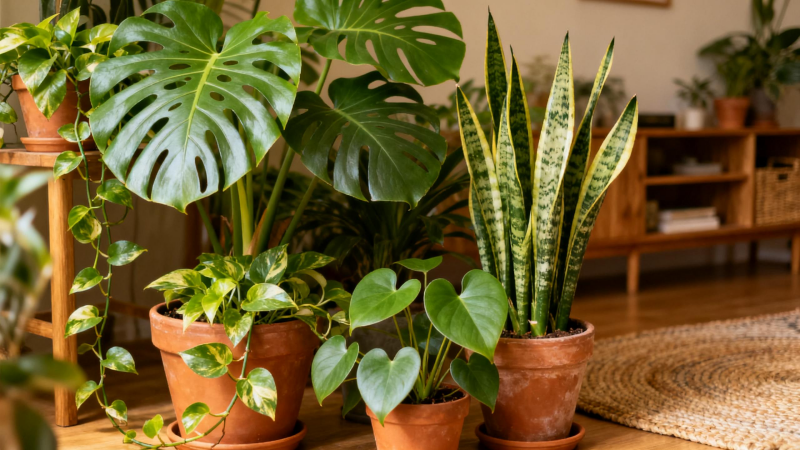
Pothos – Even more forgiving than Monstera. Tolerates lower light, propagates easily, and comes in many beautiful varieties. Perfect for beginners or filling out your plant collection.
Snake Plant – Nearly indestructible. Handles low light, infrequent watering, and neglect like a champ. Great for darker corners where Monstera wouldn’t thrive.
Philodendron – Monstera’s close cousin. Many varieties exist, from trailing types to large upright plants. Similar care requirements.
Monstera adansonii – A smaller “Swiss Cheese” variety with even more holes than deliciosa. Perfect if you love the look but have limited space.
Conclusion: You’ve Got This
Caring for Monstera really comes down to three things: bright indirect light, proper watering, and patience.
Three years ago, I started with a tiny plant and zero experience. I made plenty of mistakes—too little light, too much water, no support. My Monstera nearly died more than once.
But here’s what I learned: Monstera is resilient. Once you understand what it needs, it rewards you with incredible growth and those stunning fenestrated leaves everyone loves.
Today, my original 4-leaf plant has grown into an 18-leaf showpiece that dominates my living room. I’ve propagated it three times, sharing the love with friends and family.
You can absolutely do this too.
Start simple. Give your Monstera bright light, let the soil dry between waterings, and add a stake when it gets tall. Check on it regularly. Adjust when you see problems.
Before you know it, you’ll be the one giving Monstera advice to friends.
Now I’d love to hear from you: What’s your biggest Monstera challenge? Drop a comment below and let’s troubleshoot together!
For a visual walkthrough of Monstera care basics, this video covers watering, light requirements, and repotting:
This article was created by a professional team. AI tools were used during the research and writing process to enhance efficiency and quality. All information has undergone manual verification and editing to ensure accuracy and practicality. We are committed to providing readers with objective and valuable content.
Publisher::meiruth558@gmail.com,Please indicate the source when reposting:https://gardeningtoolsgarden.com/how-to-care-for-monstera-15-tips-i-learned-after-3-years-2025/
