Updated October 2026. The care advice below draws on university Extension references.
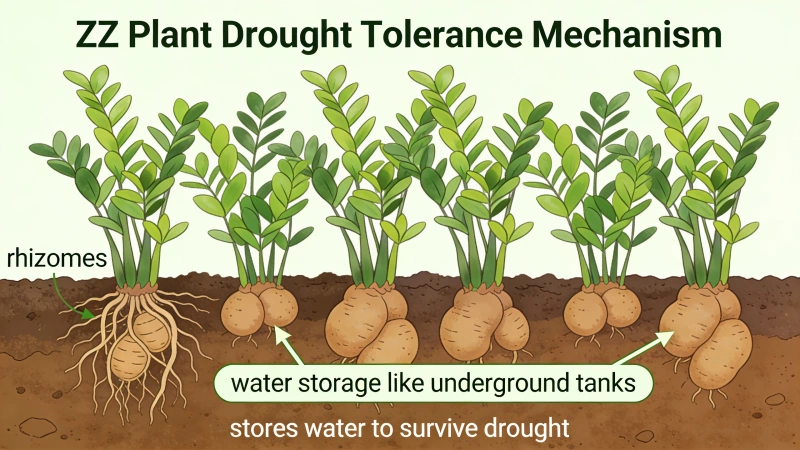
ZZ plant care comes down to one fact: Zamioculcas zamiifolia stores water in thick underground rhizomes, so it handles dry spells far better than constantly wet soil. Most indoor problems trace back to watering too often, poor drainage, or too much time in very low light.
For the essentials, see the care chart below. If your plant is already yellowing, drooping, or developing a soft base, jump to the yellow-leaf diagnosis or the root-rot section.
ZZ Plant Care at a Glance
| Care factor | Best practice | Common mistake |
|---|---|---|
| Light | Bright indirect light; tolerates low light | Harsh direct sun or long-term near-darkness |
| Water | Water thoroughly after the mix has dried well | Watering every week by calendar |
| Soil | Loose, well-drained potting mix | Dense mix that stays wet for many days |
| Pot | Drainage hole; only slightly larger than root/rhizome mass | Oversized decorative pot with trapped water |
| Temperature | Warm indoor conditions; about 65–90°F (18–32°C) | Cold drafts and prolonged temperatures below about 50°F (10°C) |
| Humidity | Normal household humidity is usually sufficient | Misting as a substitute for proper watering |
| Fertilizer | Light feeding during active growth | Frequent or strong fertilizer on a slow-growing plant |
| Main warning sign | Yellowing + damp soil + soft base = investigate roots/rhizomes | Adding more water because the plant looks droopy |
For more beginner-friendly houseplants, browse the Plant Care Guides. If your main challenge is a dark room, start with the low-light plants guide.
What Is a ZZ Plant?
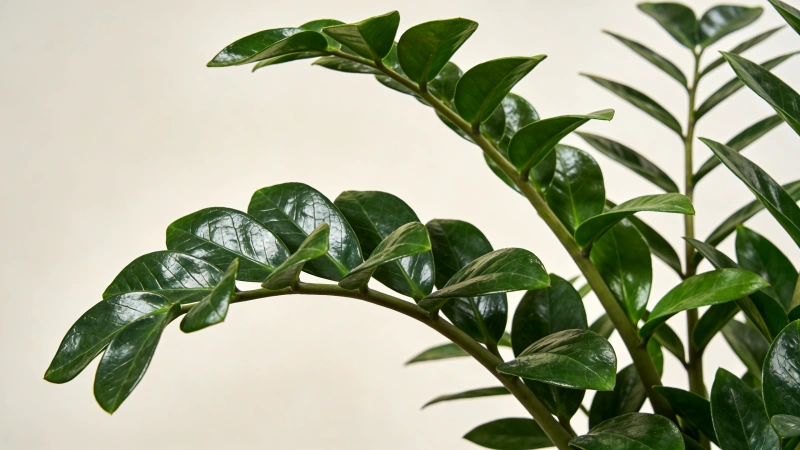
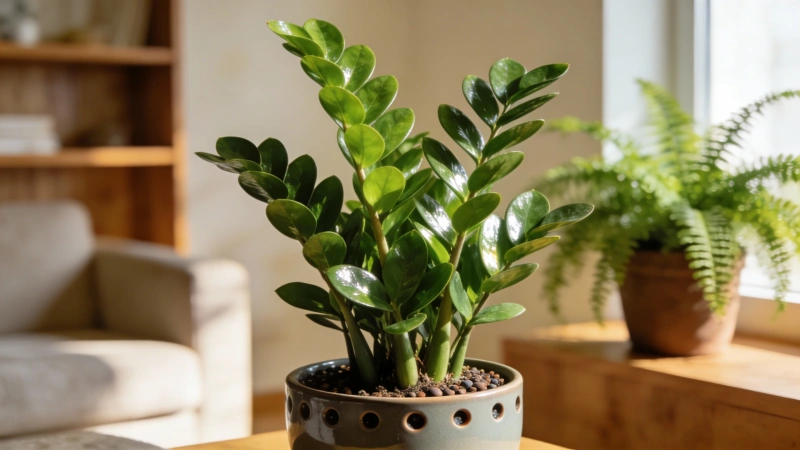
The ZZ plant (Zamioculcas zamiifolia) is a slow-growing aroid native to tropical Africa. Its glossy leaflets grow on thick, upright leaf stalks that emerge directly from underground rhizomes. Those rhizomes store water, which explains both the plant’s drought tolerance and its sensitivity to waterlogged soil.
North Carolina State Extension describes the ZZ plant as a low-maintenance houseplant that tolerates very low light but does best in bright indirect light and should dry out between waterings. UF/IFAS likewise recommends well-drained potting soil and warns against letting the plant sit in water.
ZZ Plant Light Requirements: Low Light Tolerant, Not Light-Free
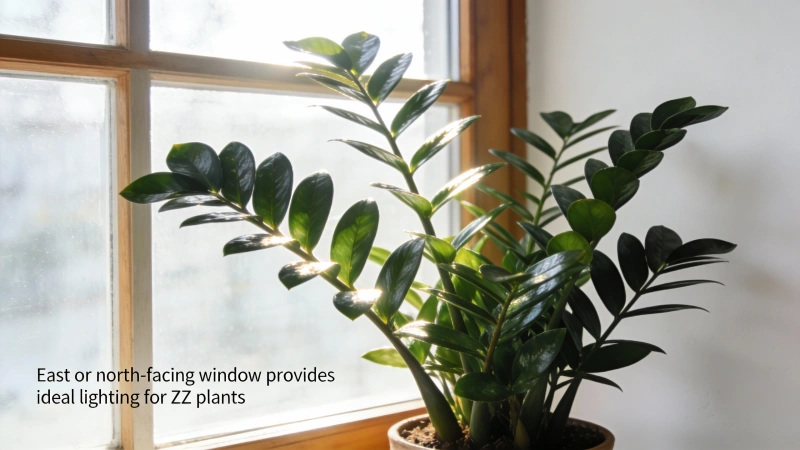
Best light: bright, indirect light. A ZZ plant can survive and grow in lower-light interiors, which is why it is common in offices, but growth is usually slower and less compact. A windowless room works only if the plant gets adequate artificial light, since no green plant can live indefinitely in complete darkness.
Direct, intense sun can scorch or brown the foliage, especially if the plant was moved suddenly from a dim room to a sunny window. When moving a ZZ plant into brighter conditions, increase the light gradually.
How to tell whether the light is right
- Good light: upright growth, firm glossy foliage, and occasional new shoots.
- Too little light: very slow growth, leaning toward the light, and long, weak-looking growth.
- Too much direct sun: pale, bleached, or brown scorched patches on the window-facing side.
If you’re comparing plants for dim interiors, see the snake plant care guide and our low-light houseplant guide.
How Often Should You Water a ZZ Plant?
Don’t water a ZZ plant on a rigid schedule. A useful starting point is to check the soil every 1–2 weeks in warm, bright conditions, and less often in cool or low-light conditions, and to water only when the mix has dried well. In many homes that works out to roughly every 2–4 weeks, with longer intervals in winter or low light.
Checking the soil beats “water every Sunday” because drying speed depends on pot size, pot material, season, temperature, airflow, soil mix, and light.
Use This Watering Decision Rule
- Push a finger or wooden skewer several inches into the potting mix.
- Lift the pot if practical. A dry pot is noticeably lighter than a recently watered one.
- If the lower mix still feels cool or damp, wait.
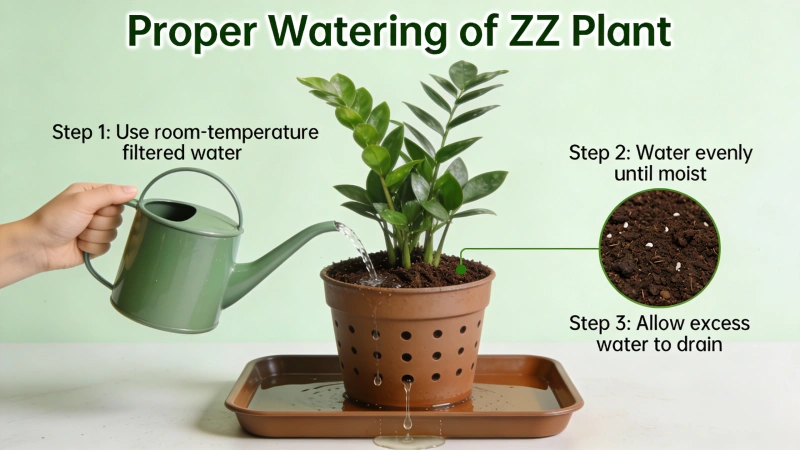
- If the mix is dry and the pot feels light, water thoroughly until water runs out of the drainage hole.
- Empty the saucer or cachepot so the roots don’t sit in runoff.
| Growing condition | What usually happens | Watering approach |
|---|---|---|
| Bright indirect light + warm room | Mix dries faster | Check more often; water after dry-down |
| Low light | Plant uses water more slowly | Expect a longer interval between waterings |
| Large plastic or glazed pot | Moisture can remain longer | Check deeper in the pot before watering |
| Terracotta + airy mix | Pot dries faster | Check a little more frequently |
| Cool winter conditions | Growth and water use slow | Extend the dry period; never water just because a date arrives |
NC State Extension offers a seasonal reference point of about twice a month in summer and about once a month in winter, but only when the soil has dried. The dryness condition matters more than the calendar.
For a broader look at soil-first watering, see the houseplant watering schedule guide. If you’re already dealing with soft stems or a sour-smelling pot, skip ahead to root rot.
Best Soil and Pot for a ZZ Plant
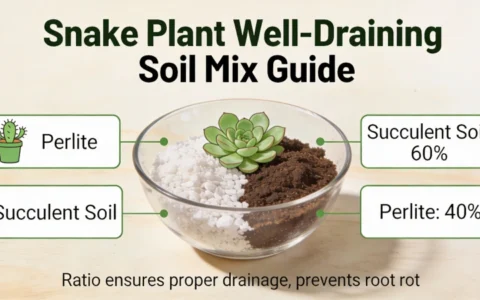
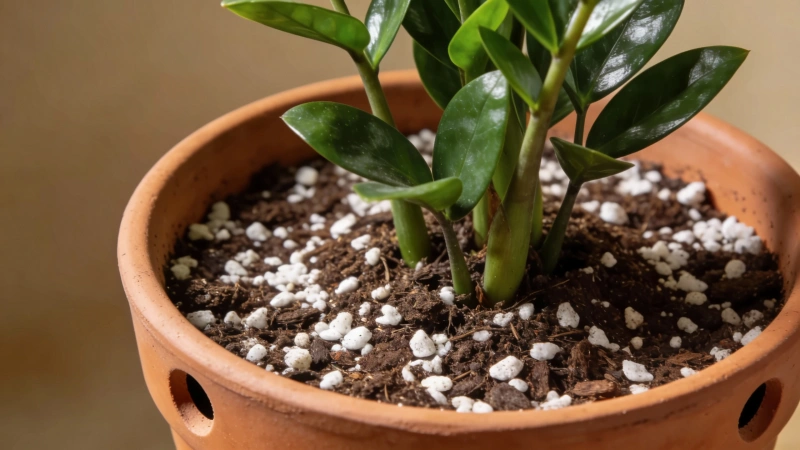
A ZZ plant needs air around the roots and reliable drainage more than it needs a specialty mix. UF/IFAS recommends a well-drained peat- or bark-based potting soil. If your houseplant mix is dense, you can lighten it with coarse material such as perlite, pumice, or orchid bark.
A practical starting blend is:
- 2 parts quality indoor potting mix
- 1 part perlite or pumice
- Optional: a small amount of fine orchid bark for extra structure and airflow
The exact ratio matters less than the result: the mix should absorb water evenly, drain freely, and not stay saturated for a week.
Choose the Right Pot
- Drainage hole: essential.
- Size: choose a pot only modestly larger than the rhizome/root mass.
- Material: terracotta dries faster; plastic and glazed ceramic retain moisture longer.
- Cachepots: fine for decoration, but remove or drain the inner nursery pot after watering.
Our pots and planters guide and soil and fertilizer guide cover container materials and mix components in more detail.
Temperature and Humidity
ZZ plants prefer warm indoor conditions. UF/IFAS gives a preferred range of roughly 65–90°F (18–32°C) and notes that growth may slow and injury can occur below about 50°F (10°C).
Keep the plant away from freezing windows, cold drafts, and strong HVAC airflow. Average household humidity is normally adequate, so routine misting is unnecessary. Misting doesn’t replace watering at the roots, and it can leave foliage wet without helping a dry root ball.
Winter care tipIndoor ZZ plants often grow much more slowly in winter, so check moisture less often. The risky combination is cool conditions plus wet potting mix: the plant uses water slowly while the root zone stays saturated.
How to Fertilize a ZZ Plant
ZZ plants grow slowly and don’t need heavy feeding. UF/IFAS recommends a low-dose liquid fertilizer only a few times a year, while NC State suggests a balanced liquid houseplant fertilizer once or twice a year.
A conservative plan for a typical indoor plant is to feed lightly in spring or summer, following the product label, and to skip fertilizer when the plant is stressed, newly repotted, sitting in cold conditions, or not actively growing.
Don’t use fertilizer to “fix” yellow leaves before you’ve checked the soil and roots. Yellowing caused by overwatering won’t improve with extra fertilizer, and fertilizer salts can add stress to damaged roots.
Why Are My ZZ Plant Leaves Turning Yellow?
Overwatering is an important cause, but yellow leaves are a symptom, not a diagnosis. The pattern, the soil condition, and the firmness of the leaf stalk base tell you more than color alone.
| What you see | Most likely cause | What to do first |
|---|---|---|
| Several stems yellowing + wet soil + soft base | Overwatering / root or rhizome rot | Stop watering and inspect the root zone |
| One older lower leaflet slowly turns yellow; plant otherwise healthy | Natural aging | Monitor; no emergency treatment needed |
| Yellowing + very dry mix + wrinkled or limp foliage | Severe underwatering | Water thoroughly once, then return to normal dry-down |
| Pale or bleached patches on the sunny side | Excess direct sun | Move to bright indirect light |
| Slow weak growth with very little light | Insufficient light | Move gradually to a brighter location |
| Yellowing soon after a cold draft or cold window exposure | Temperature stress | Move to a warmer stable location |
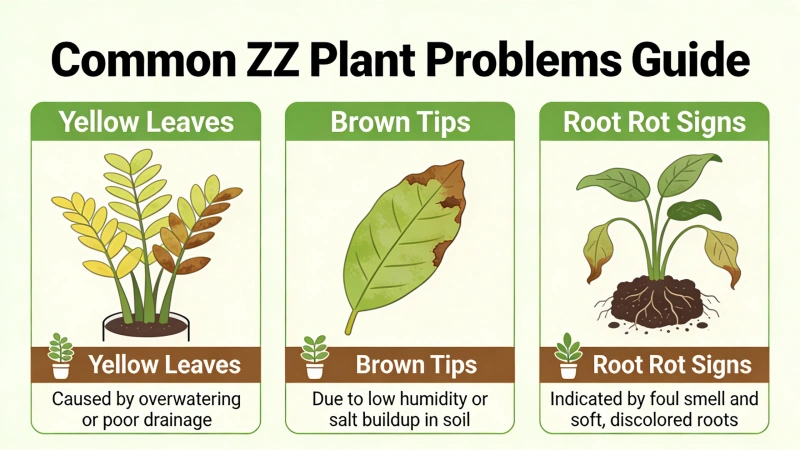
If yellowing is your main problem, compare it with the broader houseplant yellow leaves guide and the Yellow Leaves problem hub.
What Does an Overwatered ZZ Plant Look Like?
Watch for a combination of symptoms rather than a single leaf:
- multiple leaves or entire leaf stalks yellowing at once;
- soil that remains damp for many days;
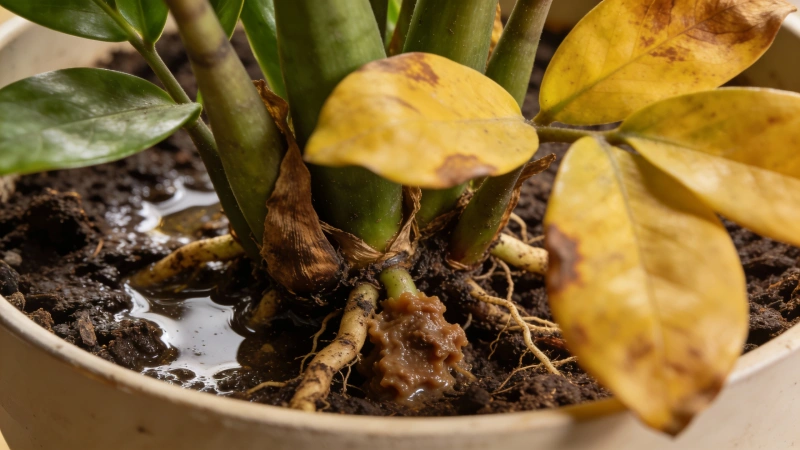
- soft, dark, or collapsing tissue near the soil line;
- a sour or unpleasant smell from the potting mix;
- brown or black mushy roots/rhizome tissue when unpotted.
What Does an Underwatered ZZ Plant Look Like?
Underwatering is less dangerous in the short term because the rhizomes hold reserves. A very dry ZZ plant may show wrinkled leaflets, drooping growth, potting mix pulling away from the pot edge, or leaf drop after an extended drought. If the mix is dry all the way through, water deeply once rather than giving frequent small sips.
Brown Tips, Brown Spots and Pests
Brown tips can follow prolonged dryness, salt buildup, or physical damage. Large bleached-to-brown patches are more consistent with sun scorch. ZZ plants have relatively few pest problems, but NC State Extension notes scale insects as one to watch for. Inspect stems and leaf undersides for immobile brown bumps or sticky residue.
If pests turn up on nearby houseplants, the pests and diseases hub can help you compare symptoms before you treat.
ZZ Plant Root Rot: How to Check and What to Do
UF/IFAS warns that root rot can develop when a ZZ plant stays in poorly drained, overly wet soil for an extended period. If the soil is damp and the base is soft, don’t keep adding water while you wait for the leaves to improve.
Step-by-Step Root Check
- Stop watering. Remove any standing water from the saucer or outer pot.
- Slide the plant from its pot. Support the base so you don’t tear healthy roots.
- Inspect roots and rhizomes. Healthy tissue should feel firm. Rotting tissue is typically soft and dark and may smell unpleasant.
- Remove clearly rotten tissue with a clean, sharp tool. Keep as much firm, healthy tissue as possible.
- Repot into fresh, well-drained mix in a clean pot with drainage.
- Resume watering cautiously. Let the new mix dry out appropriately before watering again, rather than giving frequent small drinks.
For a more detailed rescue, see the root rot treatment guide or browse the Root Rot problem hub. If the whole plant is declining and the cause is still unclear, see how to save a dying plant.
When and How to Repot a ZZ Plant
ZZ plants don’t need frequent repotting. Repot when the rhizomes are crowding the container, the pot is deforming or cracking, roots are escaping the drainage holes, or the potting mix has broken down and drains poorly.
Choose a new pot only slightly larger than the old one. An oversized pot holds more wet soil around a relatively small root system, which slows drying.
Simple Repotting Method
- Water only if needed before repotting; avoid working with a saturated root ball.
- Remove the plant and inspect the rhizomes.
- Trim only dead or rotten tissue; healthy, firm rhizomes should remain intact.
- Add fresh, well-drained mix around the root system at approximately the same planting depth.
- Set the plant back in bright indirect light and avoid unnecessary fertilizer while it settles.
For container sizing and step-by-step technique, see the houseplant repotting guide.
How to Propagate a ZZ Plant
ZZ plants can be propagated by division or cuttings. NC State Extension lists division and leaf cuttings as propagation methods. The tradeoff is speed: division gives you an established plant immediately, while cuttings may take months to form a rhizome and produce visible new growth.
Method 1: Division — Fastest
Use division when repotting a mature plant that has several separate rhizome clusters. Gently separate natural sections, keeping roots attached to each division, then pot each section in a small container with drainage.
Method 2: Leaf or Leaflet Cuttings — Slow but Simple
Healthy leaf material can eventually form roots and a small rhizome. Insert the cut end into a lightly moist, airy medium and be patient. New growth can take months, so don’t assume a cutting has failed just because nothing appears above the soil quickly.
Method 3: Whole Leaf Stalk Cutting
A healthy leaf stalk can also be rooted in water or an airy potting medium. This method still takes patience, because the cutting must form roots and a rhizome before it can push substantial new top growth.
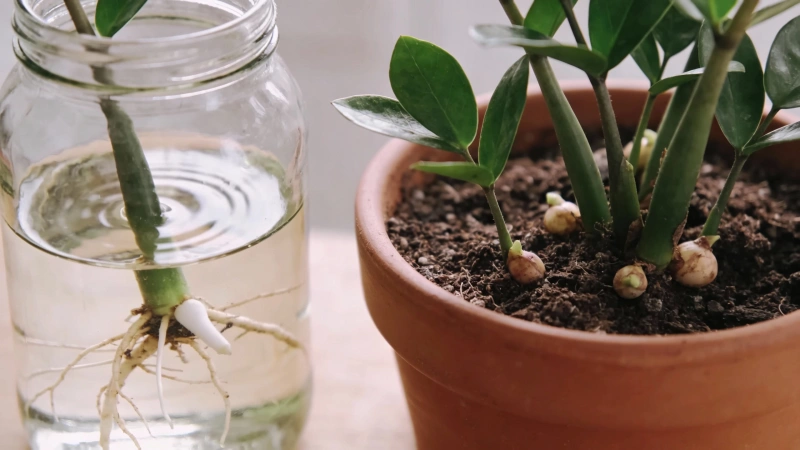
Compare methods in the plant propagation guide. If you want a houseplant that roots more quickly from cuttings, see the pothos care guide.
Is a ZZ Plant Toxic to Cats, Dogs or Children?
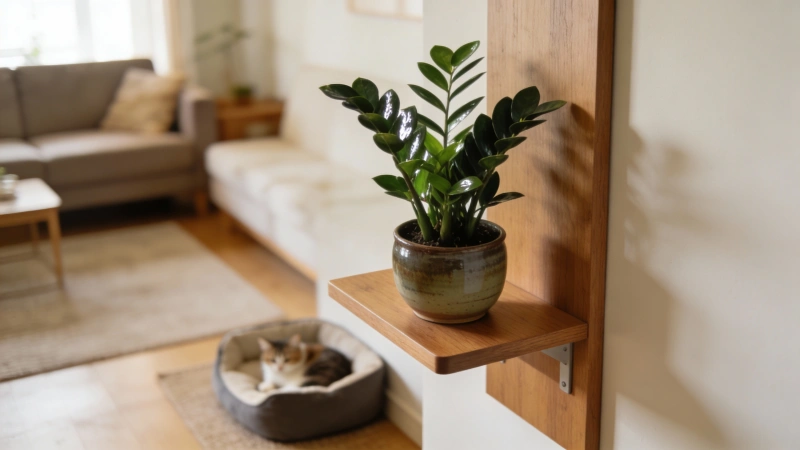
Yes. ZZ plant tissue contains calcium oxalates and should not be chewed or eaten. UF/IFAS reports that ingestion can cause immediate pain or burning in the lips, mouth, tongue, or throat, and may also cause vomiting or diarrhea. NC State also lists the ZZ plant as toxic to cats and dogs.
Keep the plant out of reach of pets and small children that chew plants. If a person or pet is exposed and develops symptoms, contact a medical professional, a poison-control service, or a veterinarian rather than relying on home treatment.
ZZ Plant vs. Other Easy-Care Houseplants
| Plant | Low-light tolerance | Watering tolerance | Best for |
|---|---|---|---|
| ZZ plant | Very good | Excellent drought tolerance; dislikes wet soil | Offices, beginners, forgetful waterers |
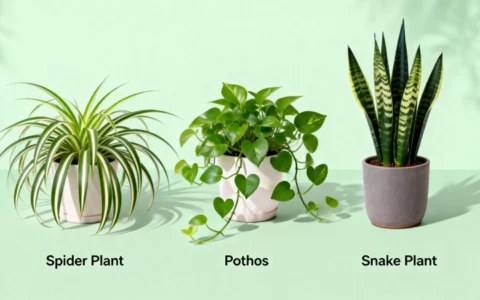
| Snake plant | Very good | Also drought tolerant | Low-light rooms and simple care |
| Succulents | Usually lower | Very drought tolerant | Bright windows and dry conditions |
| Pothos | Good | More forgiving of moderate moisture | Trailing growth and fast propagation |
Frequently Asked Questions About ZZ Plant Care
How often do you water a ZZ plant?
There’s no single schedule that works in every home. Check the potting mix and water after it has dried well. For many indoor plants that works out to roughly every 2–4 weeks, but bright, warm conditions dry the mix faster and cool, low-light conditions dry it much more slowly.
Does a ZZ plant need sunlight?
It needs light, though not intense direct sun. Bright indirect light usually gives the best growth. ZZ plants tolerate low light and even artificial office lighting better than many houseplants, but complete darkness is not suitable.
Can a ZZ plant live in a windowless office?
Yes, if the office has adequate artificial lighting. NC State notes that ZZ plants can grow at very low light levels, including in fluorescent-lit interiors. Growth will usually be slower than in bright indirect light.
Why are my ZZ plant leaves turning yellow?
Check soil moisture first. Several yellowing stems with wet soil or soft bases point to overwatering or root/rhizome rot. A single older lower leaflet can simply be aging. Very dry soil, direct sun, and cold stress can also cause yellowing.
Should I mist a ZZ plant?
Usually not. Average indoor humidity is generally enough, and misting is not a substitute for watering the root zone. Focus on light, drainage, and correct watering instead.
What is the best soil for a ZZ plant?
Use a loose, well-drained potting mix. UF/IFAS recommends a well-drained peat- or bark-based potting soil. If your mix stays wet too long, add coarse material such as perlite, pumice, or fine orchid bark.
How fast does a ZZ plant grow?
ZZ plants grow slowly. Growth picks up with adequate light, warmth, and appropriate watering, but it isn’t a fast-growing vine, and long pauses between new shoots can be normal.
Do ZZ plants like to be root bound?
They can tolerate a snug pot, but severe crowding isn’t the goal. Repot when the rhizomes are deforming the container, drainage is poor, roots are escaping heavily, or the potting mix has degraded.
Can yellow ZZ leaves turn green again?
A fully yellow leaf generally won’t return to healthy green. Correct the underlying cause, and judge recovery by the condition of the remaining foliage and new growth rather than waiting for old yellow tissue to reverse.
Is a ZZ plant toxic to pets?
Yes. ZZ plants contain calcium oxalates and should be kept away from cats, dogs, and other pets that chew plants. Contact a veterinarian if ingestion causes symptoms.
Key Takeaways
- Use a soil-first watering rule: wait for the mix to dry well instead of watering by calendar.
- Give more light than the minimum: low light is tolerated, but bright indirect light usually produces better growth.
- Prioritize drainage: an airy mix and a pot with a drainage hole reduce root-rot risk.
- Diagnose yellow leaves by pattern: wet soil, several yellow stems, and soft tissue mean something very different from one aging leaflet.
- Feed lightly: ZZ plants grow slowly and don’t need frequent fertilizer.
- Keep it away from pets and small children: the plant contains calcium oxalates.
Related Guides
Sources Reviewed
- North Carolina State Extension — Zamioculcas zamiifolia
- University of Florida IFAS Extension — Florida Foliage House Plant Care: ZZ Plant
- University of Florida IFAS Extension — Common Poisonous Houseplant Species
For more indoor plant guides, visit the Plant Care Guides.
Editorial Note: This article was written and edited by Spring Mei. AI tools may be used to assist with research and organizing information. The final content is reviewed before publication, and important factual claims are checked against reliable sources where appropriate. Personal experience is distinguished from general guidance, and methods are described as personally tested only when they have actually been tested.
Please indicate the source when reposting:https://gardeningtoolsgarden.com/how-to-care-for-zz-plant/
Author: Spring Mei