Updated October 2026 · Beginner guide to indoor succulent watering, light, soil, root rot, propagation and common problems
Succulent care gets simpler once you stop treating every succulent as the same plant. The basic pattern is consistent: strong light, fast-draining soil, a pot that drains and a wet-dry watering cycle. But Echeveria, Haworthia, Aloe, Aeonium, Lithops, Sempervivum and holiday cacti don’t all want the same sun exposure or seasonal watering.
For most indoor succulents, the safest starting rule is to water the entire root ball thoroughly, let the excess drain, then wait until the root zone has dried before watering again. Give the plant enough light to stay compact at the same time. Too much water combined with too little light is a common route to soft leaves, stretched growth and root rot.
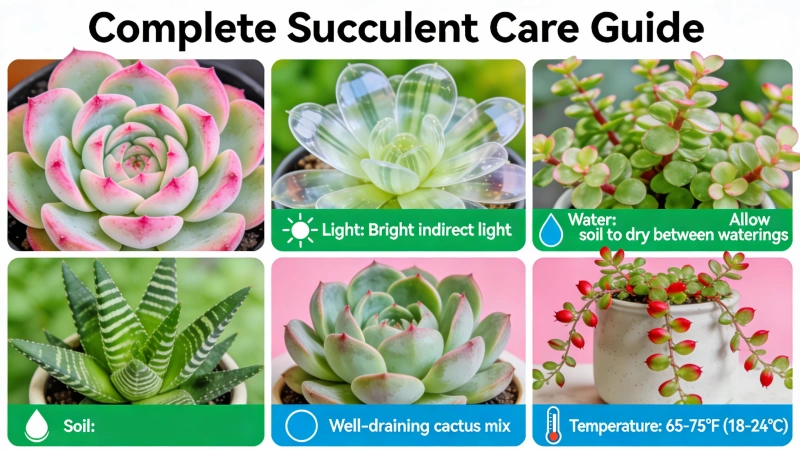
Succulent Care at a Glance
| Care factor | Good starting point | Common beginner mistake |
|---|---|---|
| Water | Soak the root ball, drain completely, then wait for the root zone to dry | Small drinks on a fixed weekly schedule |
| Light | Abundant bright light; exact sun tolerance depends on species | Dark shelves, or sudden exposure to intense sun |
| Soil | Sharp-draining cactus/succulent mix with substantial mineral material | Dense moisture-retentive mix that stays wet too long |
| Pot | Drainage hole; size close to the root system | Oversized or sealed decorative container |
| Humidity | Average household humidity is suitable for most common types | Closed humid terrariums for dry-growing species |
| Fertilizer | Light feeding during active growth | Heavy year-round feeding |
| Biggest diagnostic clue | Soft/yellow + wet soil suggests a different problem than wrinkled + dry soil | Diagnosing every soft leaf as “needs water” |
For general indoor-plant fundamentals, browse the Plant Care Guides. If watering is your main problem, the houseplant watering guide explains how your environment changes drying speed.
What Is a Succulent?
A succulent is a plant adapted to store water in thickened leaves, stems or roots. Succulence evolved in many unrelated plant families, so “succulent” describes a growth strategy rather than one botanical family. All cacti are succulents, but not all succulents are cacti.
Many succulent species use Crassulacean Acid Metabolism (CAM), a photosynthetic pathway that can reduce water loss by shifting much of their gas exchange to nighttime. CAM isn’t a reason to treat every succulent the same, though, and it doesn’t turn a small bedroom plant into a meaningful overnight air cleaner. For practical care, light, roots, drainage and species identity matter far more.
Not All Succulents Need the Same Care
A compact Echeveria, a translucent Haworthia, a winter-growing Aeonium, an outdoor Sempervivum and a tropical Christmas cactus are all succulents, but their ideal conditions can differ substantially.
| Type | Light tendency | Watering note | Important exception |
|---|---|---|---|
| Echeveria / Graptopetalum | High light | Allow thorough dry-down between waterings | Insufficient indoor light quickly causes etiolation |
| Haworthia / Gasteria | Bright filtered light; often more shade tolerant | Wet-dry cycle | Harsh midday sun can scorch some types |
| Aeonium | Bright light | Water according to active growth, not a universal summer calendar | Many Aeoniums have unusual seasonal growth/dormancy patterns |
| Sempervivum | Strong outdoor light | Dry between waterings | Often performs better outdoors than as a permanent indoor plant |
| Christmas cactus | Bright filtered light | Does not want the same prolonged dry treatment as desert rosette succulents | It is an epiphytic forest cactus with different care |
Because of these differences, the advice below is a general framework, and your plant’s scientific name should override any generic calendar. For one important exception, see the Christmas cactus care guide.
How to Water Succulents: Use the Root Zone, Not the Calendar
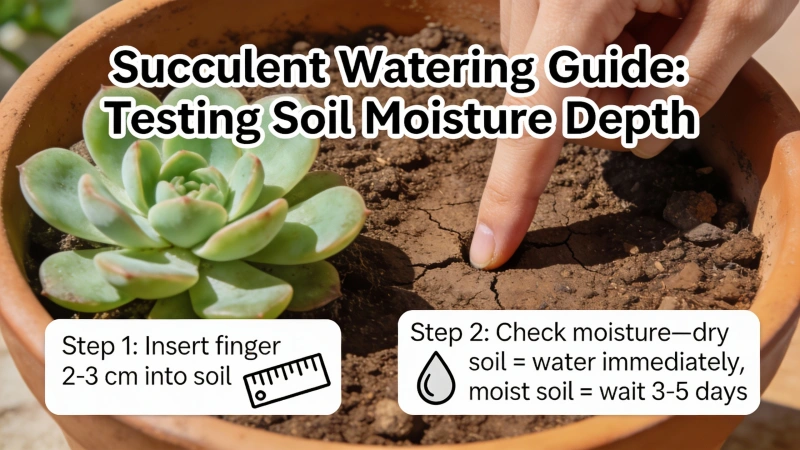
Iowa State University Extension recommends a wet-dry cycle: thoroughly wet the entire root ball, let the excess drain, then allow the mix to dry before watering again. There is no reliable watering interval for every indoor succulent. Every two or three weeks may be a rough starting observation in some conditions, but the actual interval changes with the species, light, pot size and material, potting mix, temperature and season. Use root-zone moisture—not the calendar—as your trigger. For broader indoor-plant watering basics, see our guide to how to water houseplants; the dry-down advice here is tailored to succulents.
The Soak-and-Dry Method
- Confirm the root zone is dry enough. Don’t judge from the top crust alone.
- Water the potting mix thoroughly. Keep going until water exits the drainage hole.
- Let the pot drain completely. Empty saucers and decorative cachepots.
- Wait. Don’t add small “maintenance sips” while the lower mix is still damp.
- Repeat only when the plant and root zone are ready.
How Do You Know the Root Zone Is Dry?
In a tiny 2-inch pot, a finger test may be enough. In a deeper container, “the top 1–2 inches are dry” can mislead you. Combine several clues:
- Wooden skewer or chopstick: push it toward the lower root zone; damp, dark wood or wet mix sticking to it means wait.
- Pot weight: learn how the pot feels right after watering and when fully dry.
- Drainage-hole check: feel or inspect the lower mix if you can reach it.
- Leaf condition: some species become slightly softer or less plump as stored water is used.
If you’re unsure how to assess moisture deeper in the pot, our guide to using a soil moisture meter explains how to use one as an additional check. Treat a meter reading as one clue alongside pot weight, a wooden skewer and the plant’s condition—not as a stand-alone watering schedule.
Overwatered vs. Underwatered Succulent
| Clue | Too wet / root stress | Too dry |
|---|---|---|
| Leaves | Soft, translucent, yellowing or dropping unusually easily | Wrinkled, thinner, deflated or less firm |
| Soil | Still damp long after watering | Dry through the root zone |
| Stem/base | May become dark, soft or unstable if rot develops | Usually remains firm unless drought is extreme |
| First move | Stop watering and diagnose drainage/root health | Water thoroughly once, then drain |
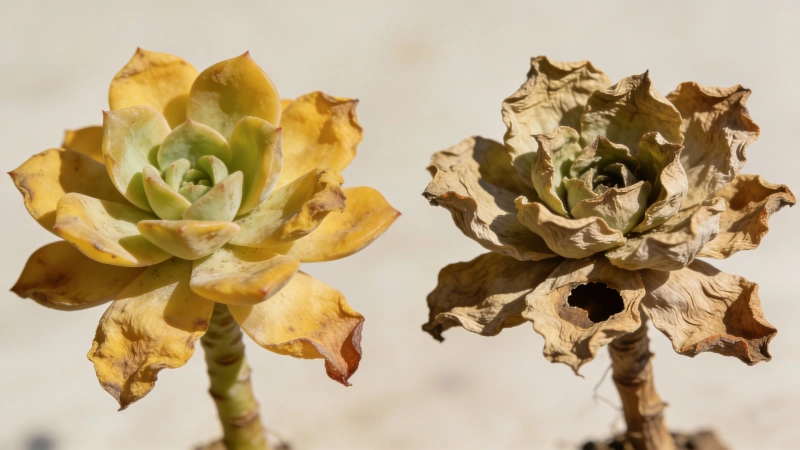
If leaves are yellowing and you can’t tell whether watering is responsible, use the yellow leaves diagnosis guide before changing your schedule.
Succulent Light Requirements: Duration Is Only Half the Story
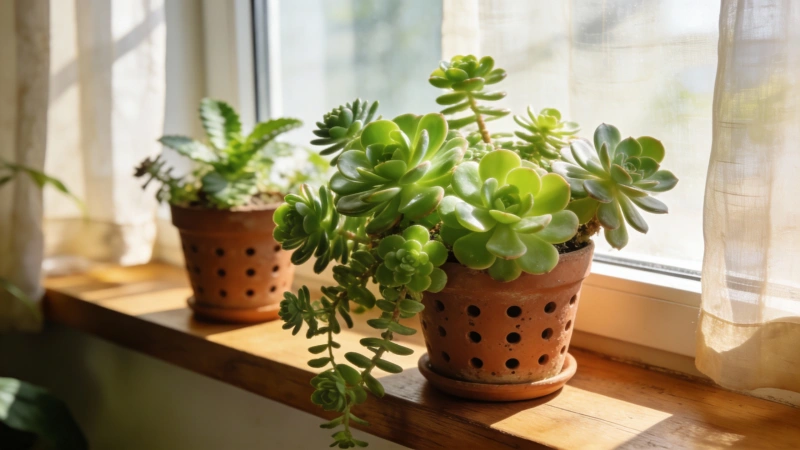
Iowa State University Extension identifies light as one of the biggest limits when growing succulents indoors. It recommends abundant bright light and notes that many types need at least 6–8 hours of bright light, with 10 or more hours beneficial indoors because window light is weaker than outdoor sunlight.
A rule like “4–6 hours of sun” is too simplistic. What matters is both light intensity and duration: four hours through a shaded north window isn’t equivalent to four hours of strong outdoor light.
Good Indoor Light Strategy
- High-light rosette succulents: use the brightest suitable window you have, often south or west in the Northern Hemisphere.
- More shade-tolerant types: Haworthia and Gasteria can often handle bright filtered light better than intense midday sun.
- Rotate pots: turn them periodically if growth is leaning strongly toward the window.
- Use a grow light when needed: low-light apartments may not get enough intensity naturally.
Iowa State suggests supplemental high-output full-spectrum lighting when windows aren’t enough, often for 12–16 hours per day depending on the fixture and setup.
For broader placement guidance, see the indoor plant light requirements guide.
What Is Etiolation?
Etiolation is stretched, weak growth caused by insufficient light. Common signs include:
- large gaps between leaves;
- a rosette opening and elongating upward;
- pale new growth;
- a stem leaning strongly toward the window.
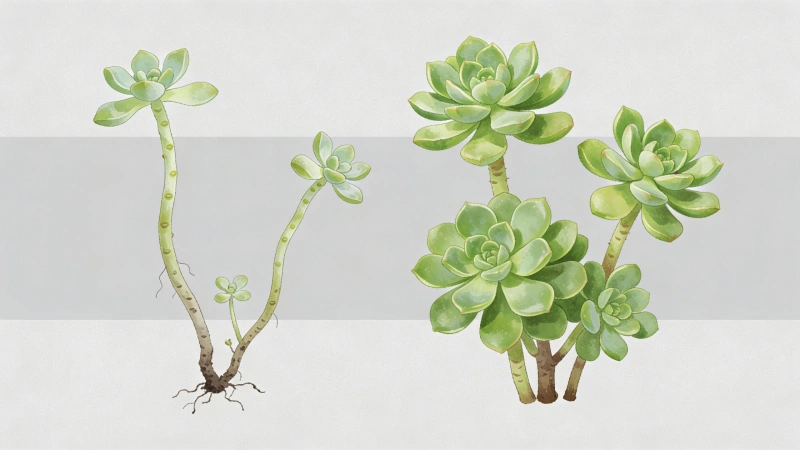
Better light can make new growth more compact, but the stretched section that already exists normally stays stretched. For rosette-forming plants that tolerate it, beheading and re-rooting the top can reset the plant’s shape.
Sun Stress vs. Sunburn
Red, pink or purple pigmentation can be normal in some succulent species under stronger light, cooler temperatures or other environmental stress. Not every red edge is proof of perfect care, so tell healthy coloration apart from actual sunburn:
- Normal pigmentation: even coloration, firm tissue, no dead scar.
- Sunburn: bleached, tan, brown or black scarred patches, often after a sudden increase in light.
When moving a plant from indoors to stronger sun, acclimate it gradually.
Best Soil for Succulents: Fast Drainage Without a Magic Recipe
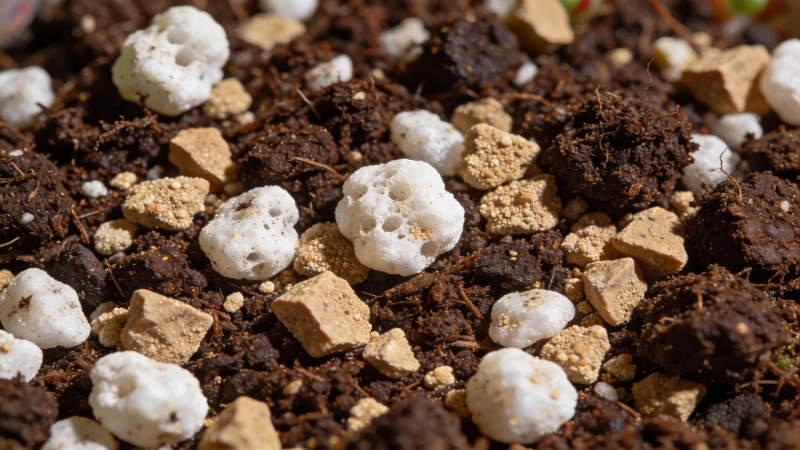
Standard moisture-retentive potting mixes can stay wet too long for many succulents. Iowa State recommends a sharply drained medium and offers a useful starting framework of roughly one-third organic material and two-thirds mineral material.
A Practical DIY Starting Mix
- 1 part potting mix, pine bark, composted material or coir;
- 2 parts mineral drainage material such as pumice, perlite, coarse sand or fine gravel.
This is a starting point, not a universal formula. A plant in hot Arizona sun, a plastic pot in a humid climate and a tiny Echeveria beside a cool indoor window may need different ratios.
Commercial Succulent Mix
A commercial cactus/succulent mix is a convenient beginner option. If it stays wet for an unusually long time in your conditions, increase the mineral component rather than compensating by never watering deeply.
For more on growing-media components, see the soil and fertilizer guide.
Drainage Holes Matter More Than a Gravel Layer
Iowa State explicitly notes that a gravel layer at the bottom of a sealed pot is not a substitute for a drainage hole. If you love a decorative container with no hole, keep the succulent in a smaller draining nursery pot and set that inside the decorative one. Our guide to watering plants without drainage holes explains how to manage that kind of setup without leaving excess water trapped around the roots.
Useful pot choices:
- Terracotta: porous and forgiving for growers who tend to overwater.
- Glazed ceramic: works well with a drainage hole but dries more slowly than terracotta.
- Plastic: lightweight and practical, but moisture generally lingers longer.
Choose a pot reasonably close to the root mass, since oversized containers hold a larger volume of wet substrate. Compare container types in the pots and planters guide.
Should You Repot a Store-Bought Succulent Immediately?
Not automatically. Inspect the plant first. Repot soon if the container has no drainage, the mix is dense and soggy, the roots show rot or pests, or the plant is severely root-bound. A healthy new succulent in a draining nursery pot doesn’t need to be bare-rooted on day one just because it came from a store.
A better first step is to quarantine and inspect new plants for mealybugs, scale and root problems before putting them next to the rest of your collection.
Temperature, Humidity and Airflow
Most commonly grown indoor succulents tolerate normal home conditions. Iowa State gives approximately 55–75°F (13–24°C) as a useful indoor range for many types, with some tolerating conditions outside that range.
Species differences matter, though. Cold-hardy Sempervivum has very different needs from a frost-sensitive Aloe or Euphorbia, so don’t use one frost threshold for every succulent.
Humidity
Average indoor humidity is generally suitable for common dry-growing succulents. Closed terrariums are a poor fit for most desert-type succulents because they trap moisture and limit airflow.
Airflow
Good air movement helps the growing medium dry and can reduce conditions favorable to some pests and diseases. You don’t need to blast plants with a fan; just avoid crowding a large collection into a stagnant, humid corner.
How to Fertilize Succulents
Succulents usually need less fertilizer than fast-growing foliage plants. Iowa State recommends light feeding during active growth, such as an all-purpose or succulent fertilizer at roughly one-quarter to one-half the label rate.
The key phrase is active growth. “Fertilize spring and summer, never winter” works for many common indoor succulents, but it isn’t universal, because some species have different seasonal growth cycles.
- Don’t fertilize a plant with active root rot.
- Don’t increase fertilizer just because a low-light plant is growing slowly.
- If white salt crust builds up on the pot or substrate, reconsider fertilizer concentration and watering practices.
Succulent Dormancy: Why a Universal Seasonal Watering Chart Can Mislead You
The common rule of “water often in summer, treat everything as dormant in winter” is too broad. Many popular house succulents slow down in lower winter light, but species don’t all share the same calendar.
Aeonium is a useful example. Wisconsin Horticulture notes that its seasonal behavior can differ from many other common succulents, and that its growth responds to climate and temperature rather than a simple universal schedule.
Use These Signals Instead of the Month
- Is the plant actively producing new leaves or roots?
- How quickly is the pot actually drying?
- Has light intensity dropped substantially?
- Has the temperature changed?
- Does the species naturally have a summer or winter rest period?
How to Propagate Succulents: Choose the Method by Species
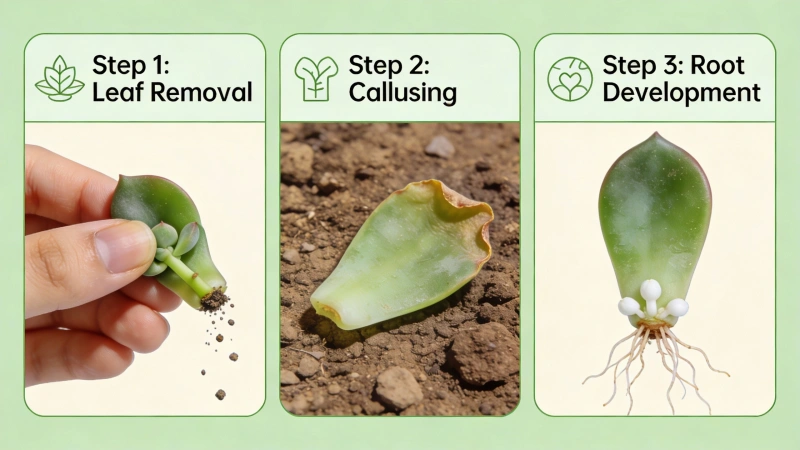
Iowa State Extension emphasizes that the propagation method depends on how the plant grows. A common beginner mistake is assuming every fleshy leaf can be detached and turned into a new plant.
| Propagation method | Good candidates | Key point |
|---|---|---|
| Offsets / division | Aloe, Haworthia, Gasteria, Sempervivum, Agave and many clustering plants | Separate a pup/offset with healthy tissue and roots when possible |
| Stem cuttings | Aeonium, Echeveria, Crassula, Sedum, Kalanchoe and many trailing types | Allow fresh succulent stems to callus before rooting in a draining medium |
| Leaf cuttings | Graptopetalum, Pachyphytum, many Crassula, Sedum and Kalanchoe | The complete leaf base/meristem tissue must be removed intact |
Leaf Propagation
- Select a healthy leaf from a species known to propagate this way.
- Remove the entire leaf cleanly at its base.
- Allow the wound to dry/callus as appropriate for the species and conditions.
- Place it against a well-drained propagation medium rather than burying the entire leaf.
- Keep the medium from becoming saturated while roots and new growth develop.
Temperature, species, leaf maturity and season can stretch propagation from weeks to months.
Stem Cuttings and Beheading
Stem cuttings work for many rosette and branching succulents. They’re also useful for correcting severe etiolation: cut off the compact top, let it callus and re-root it, and the old base may produce additional shoots.
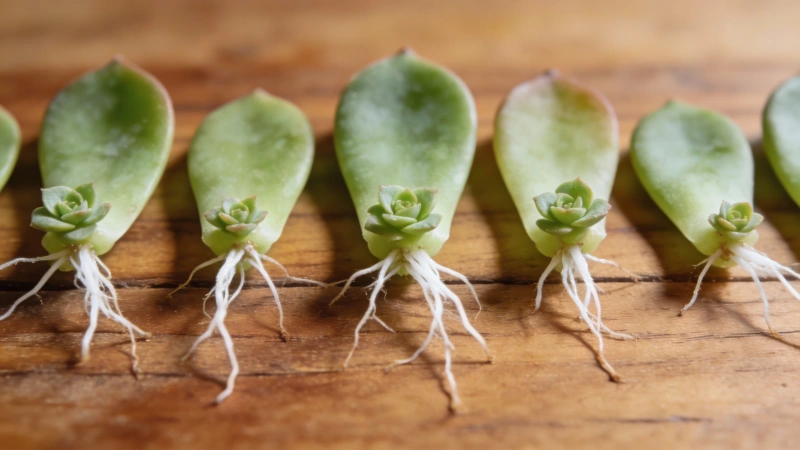
For more techniques, see the plant propagation methods guide. Aloe is better propagated by offsets or division than by the leaf method used for Graptopetalum; see the Aloe vera care guide.
Succulent Problem Diagnosis: What Is Your Plant Telling You?
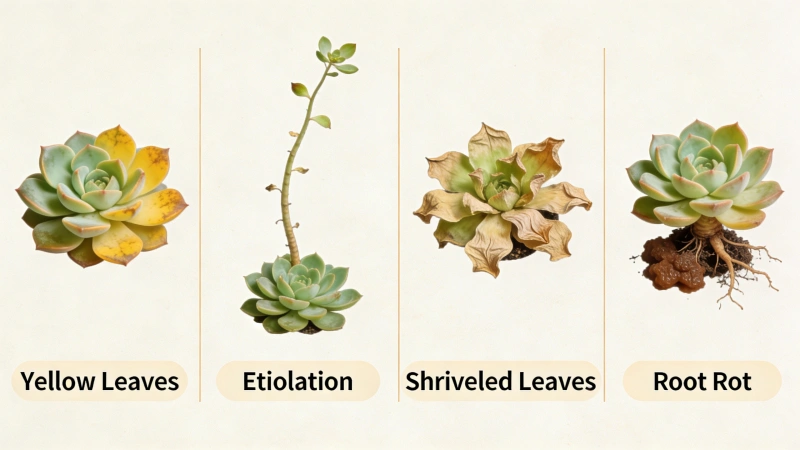
| Symptom | Check first | Likely direction | First step |
|---|---|---|---|
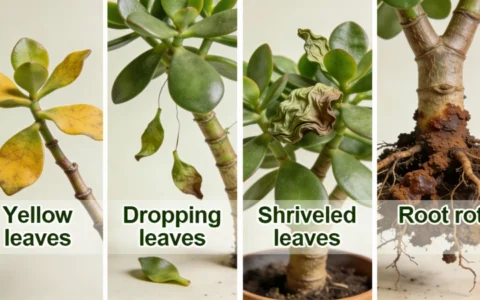
| Yellow, translucent, mushy leaves | Root-zone moisture | Excess moisture / root stress | Stop watering and inspect drainage |
| Wrinkled, deflated leaves | Whether root zone is genuinely dry | Drought or damaged roots | If roots/mix are healthy and dry, water thoroughly |
| Tall, stretched growth | Light intensity/duration | Etiolation | Increase light gradually; consider pruning/propagation later |
| Bleached/tan scar | Recent move into strong sun | Sunburn | Move out of harsh exposure and acclimate gradually |
| Black/soft stem base | Roots and lower stem | Advanced rot | Isolate healthy tissue above rot if possible |
| White cottony clusters | Leaf joints, crown and roots | Mealybugs / root mealybugs | Isolate and identify before treatment |
| Dry lower leaves only | Overall new growth | Possibly normal aging | Monitor rather than immediately changing care |
A Wrinkled Succulent Is Not Always Simply “Thirsty”
If the plant is wrinkled but the mix is wet, do not add more water. Damaged or rotting roots can’t absorb water normally, so the top of the plant can look dehydrated while the root zone is saturated. That pattern calls for a root inspection.
Succulent Root Rot: What to Do
Root rot is one of the most important problems to catch early, because the visible leaves may stay relatively normal until the damage is advanced.
Warning Signs
- soil stays wet for an unusually long time;
- lower leaves become translucent or mushy;
- the base of the stem darkens or softens;
- the plant becomes unstable in the pot;
- roots are dark, soft and deteriorating rather than firm.
Basic Rescue Workflow
- Stop watering and remove the plant from persistently wet mix.
- Inspect the roots and lower stem tissue.
- Remove clearly rotten tissue using a clean tool.
- If the base is rotten but the upper stem is healthy, some species can be saved as a stem cutting above the rot.
- Allow succulent cut surfaces to callus when appropriate.
- Replant healthy material in clean, fast-draining mix and a draining container.
- Correct the original cause: dense soil, excess watering, low light or an oversized or sealed pot.
For the complete rescue process, see the root rot treatment guide. If the whole plant is declining and you’re not sure why, use the dying plant diagnosis guide.
Common Succulent Pests
Mealybugs are among the most common indoor succulent pests. They can hide deep in rosettes, at leaf joints and around roots. Scale and spider mites can also occur, depending on the plant and environment.
Root Mealybugs
If a succulent stalls for no obvious reason despite appropriate light and watering, it may be worth repotting to inspect the root ball. Root mealybugs can appear as white insects or cottony/waxy material around the roots and on the inside of the pot.
When you find pests:
- isolate the affected plant;
- inspect nearby plants;
- remove heavily infested material when appropriate;
- use a pest-control product only when its label permits the specific use;
- avoid homemade detergent mixtures that may damage succulent tissue.
Use the Pests & Diseases hub for identification, or the spider mite guide if you see stippling and webbing.
Are Succulents Toxic to Cats and Dogs?
“Succulent” is too broad a category for a yes-or-no answer. The ASPCA warns that toxicity varies by species and recommends identifying plants by scientific name.
| Example | ASPCA status | Note |
|---|---|---|
| Jade plant (Crassula ovata) | Toxic to cats and dogs | Can cause vomiting and neurologic/depressive signs |
| Aloe vera | Toxic to cats and dogs | May cause vomiting, lethargy and diarrhea |
| Kalanchoe spp. | Toxic to cats and dogs | Vomiting/diarrhea; abnormal heart rhythm is possible in some exposures |
| Snake plant (Dracaena trifasciata) | Toxic to cats and dogs | Saponins can cause GI signs |
| Sempervivum spp. (hens and chicks) | Listed by ASPCA among non-toxic succulent options | Still discourage chewing of any plant material |
| Echeveria spp. | ASPCA lists Echeveria among non-toxic succulent options | Verify the exact identification when buying mixed unlabeled plants |
If you keep jade, see the jade plant care guide. For Aloe, see the Aloe vera guide. If a pet has eaten a plant and develops symptoms, contact a veterinarian or animal poison-control service.
Best Succulent Types for Beginners: Match the Plant to Your Space
The easiest succulent isn’t necessarily the toughest species on a generic list. It’s the one suited to the light and temperature you can actually provide.
| Plant | Best situation | Main beginner risk | Propagation |
|---|---|---|---|
| Haworthia | Bright filtered indoor light | Overwatering or intense sudden sun | Offsets/division |
| Echeveria | Very bright windows / strong grow light | Etiolation indoors | Stem/offset methods; species varies |
| Jade plant | Bright indoor location with room to grow | Wet soil / insufficient light | Stem or leaf cuttings |
| Aloe | Bright window and warm indoor conditions | Overwatering | Offsets/division |
| Sempervivum | Outdoor containers in suitable climates | Trying to keep a sun-loving hardy plant permanently in weak indoor light | Offsets |
For more low-maintenance choices, browse the best plants for beginners. If your home is genuinely low light, a snake plant or ZZ plant may fit the room better than a high-light rosette succulent.
5 Succulent Care Mistakes to Avoid
- Watering by weekday. Check the root zone instead of watering every Sunday.
- Using a sealed decorative pot. A gravel layer doesn’t replace a drainage hole.
- Assuming every succulent loves harsh direct sun. Acclimate gradually and know the species.
- Treating every succulent as winter-dormant. Growth seasons vary.
- Assuming every detached leaf will propagate. Use the method that matches the plant.
Frequently Asked Questions About Succulent Care
How often should I water succulents indoors?
Don’t use a fixed calendar. Water thoroughly, let the excess drain, and water again after the root zone has dried appropriately for that species. For some indoor setups that may average every two or three weeks, but light, pot size, soil, temperature and season can shift the interval substantially.
Should succulent soil be completely dry before watering?
For many common dry-growing indoor succulents, a thorough dry-down between waterings is a safe starting point. But “succulent” covers many species, and specialized plants such as Lithops or epiphytic holiday cacti have different watering cycles. Identify the plant when possible.
How much light do indoor succulents need?
Most need abundant bright light. Iowa State notes that many indoor succulents benefit from at least 6–8 hours of bright light, and that 10 or more hours is useful indoors. High-light Echeveria-type plants may need your brightest window or supplemental lighting, while Haworthia is generally more tolerant of filtered light.
Can succulents survive in low light?
Some species tolerate lower light better than others, but many rosette succulents stretch and weaken in dim rooms. If a plant is leaning, turning pale or developing large gaps between leaves, improve the light gradually or use a grow light.
Why is my succulent tall and stretched?
That is usually etiolation from insufficient light. Better light will improve future growth, but the existing stretched stem normally won’t shrink back. Some rosette plants can later be beheaded and re-rooted to restore a compact form.
Why are my succulent leaves mushy?
Soft, translucent or mushy leaves combined with damp soil strongly suggest excess moisture or root stress. Stop watering and check drainage. If the stem base is dark or soft, inspect for root or stem rot.
Why is my succulent wrinkled even though the soil is wet?
Wet soil plus a dehydrated-looking plant can mean damaged roots that can’t absorb water properly. Don’t add more water automatically; inspect root health and drainage.
What is the best soil for succulents?
Use a fast-draining mix with a substantial mineral component. Iowa State gives roughly one-third organic material and two-thirds mineral material as one useful starting framework. Adjust the mix for your species, pot and climate.
Do succulent pots need drainage holes?
Yes, drainage holes are the safest setup, and a layer of gravel in the bottom doesn’t replace one. If a decorative pot has no hole, place a smaller draining pot inside it and lift out the inner pot when watering.
Should I repot a succulent right after buying it?
Not automatically. Inspect and quarantine it first. Repot soon if the nursery mix stays soggy, the container has no drainage, the roots are rotting, pests are present or the plant is severely root-bound.
Can all succulents grow from leaves?
No. Propagation depends on the species. Many Crassula, Graptopetalum, Pachyphytum and Sedum can grow from leaf cuttings, while Aloe and Haworthia are usually better propagated by offsets or division, and Aeonium commonly by stem cuttings.
Why are my succulent’s edges turning red?
Red or purple pigmentation can be a normal stress response in some species under stronger light, cooler temperatures or other environmental changes. It isn’t automatically good or bad. Firm, evenly colored tissue is different from bleached, tan or dead sunburn scars.
Are succulents safe for cats and dogs?
It depends on the exact species. The ASPCA lists jade, Aloe, Kalanchoe and snake plant among toxic examples, while Sempervivum and Echeveria are among the non-toxic succulent options. Always check the scientific name of an unlabeled plant.
Should I fertilize succulents in winter?
Only if the specific plant is actively growing and its care requirements support feeding. Many common indoor succulents slow substantially in winter and need little or no fertilizer, but not every succulent follows the same seasonal cycle.
Succulent Care Checklist
- Identify the plant: genus/species matters more than the word “succulent.”
- Water deeply: soak the root ball, drain completely, then allow an appropriate dry-down.
- Give abundant light: insufficient indoor light causes etiolation and slows drying.
- Use sharp drainage: fast-draining mix + a real drainage hole.
- Avoid oversized pots: excess substrate can stay wet too long.
- Feed lightly: fertilize during active growth, not just because the calendar says spring.
- Propagate by species: leaves, stems and offsets are not interchangeable.
- Diagnose texture + moisture: mushy/wet and wrinkled/dry call for opposite responses.
- Check pets: toxicity varies by exact succulent species.
Related Guides
- Root Rot Treatment: How to Save an Overwatered Plant
- How to Save a Dying Houseplant
- Why Is My Plant Turning Yellow?
- Houseplant Pests & Diseases
- Houseplant Watering Guide
- Indoor Plant Light Requirements
- Soil & Fertilizer Guide
- Best Pots & Planters
- Houseplant Repotting Guide
- Plant Propagation Methods
- Aloe Vera Care Guide
- Jade Plant Care Guide
- Christmas Cactus Care Guide
- Snake Plant Care Guide
- ZZ Plant Care Guide
Sources Reviewed
- Iowa State University Extension — Growing Succulents Indoors
- Iowa State University Extension — Common Problems and Issues of Succulents
- Iowa State University Extension — How to Propagate Succulents
- West Virginia University Extension — Succulents 101
- Wisconsin Horticulture — Aeonium
- ASPCA — Are Succulents Safe to Have Around Pets?
For more species-specific care, browse the Plant Care Guides or use the Plant Problems & Solutions hub when your plant is already showing symptoms.
Editorial Note: This article was written and edited by Spring Mei. AI tools may be used to assist with research and organizing information. The final content is reviewed before publication, and important factual claims are checked against reliable sources where appropriate. Personal experience is distinguished from general guidance, and methods are described as personally tested only when they have actually been tested.
Please indicate the source when reposting:https://gardeningtoolsgarden.com/how-to-care-for-succulents/
Author: Spring Mei